- ≥99% by HPLC
- Lot-matched certificate of analysis
- Ships next business day, tracked
ARA-290 (Cibinetide) Peptide
Cibinetide, an 11-residue erythropoietin helix-B mimetic for research
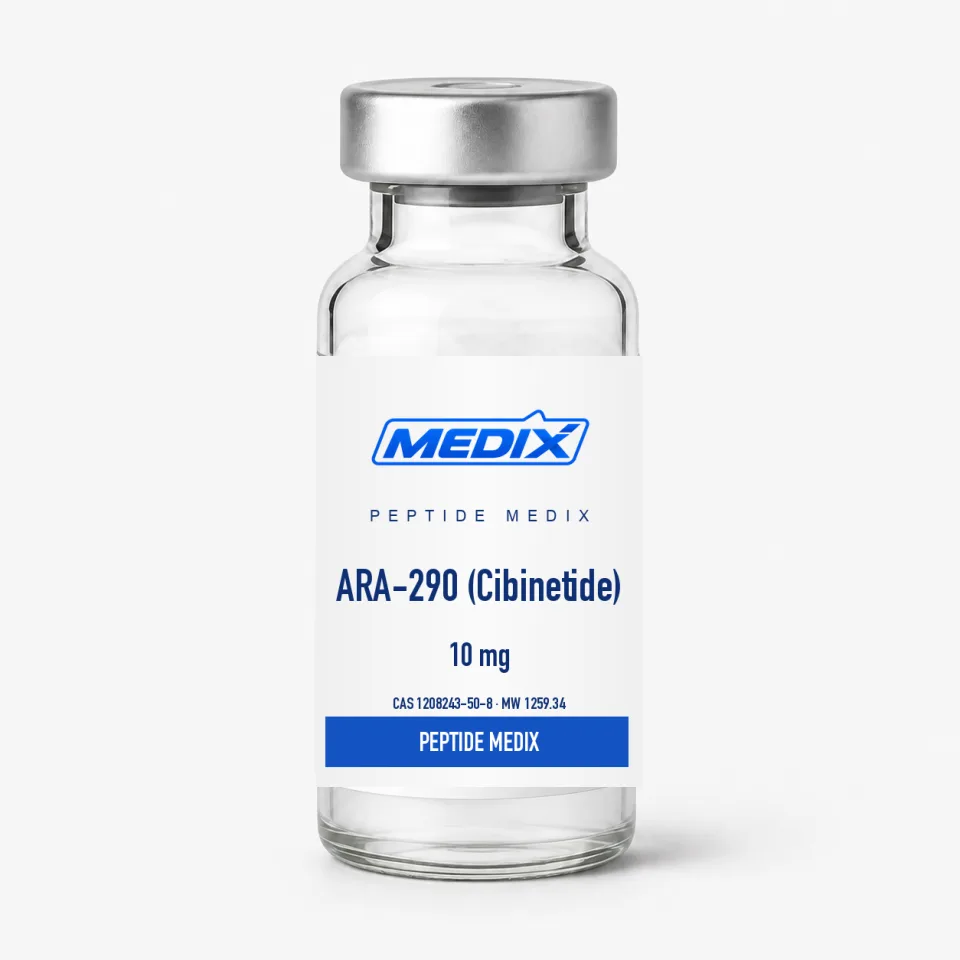
- FormLyophilized powder, sealed glass vial with crimped stopper
- Mol. weight1259.34 g/mol
- Research areasSmall-fibre neuropathy, neuropathic pain, sarcoidosis, inflammatory and ischaemic models
Overview
ARA-290, also known as cibinetide, is an eleven-amino-acid peptide modelled on the helix-B external surface of erythropoietin. Erythropoietin has two distinct activity profiles: the familiar haematopoietic one, exerted through the classical receptor homodimer, and a tissue-protective one attributed to a heterocomplex of the erythropoietin receptor with the beta-common receptor, sometimes called the innate repair receptor. ARA-290 was designed to engage the second without the first.
That design intent is the reason the peptide appears so consistently in neuroprotection and inflammation research rather than in haematology. Because the sequence is drawn from a surface region of the parent protein that does not participate in classical receptor binding, published work reports no meaningful effect on red cell production, which removes a major confounder from tissue-protection experiments.
The material is made by solid-phase synthesis, purified by reversed-phase HPLC to at least 99% and supplied as a lyophilized powder in sealed 10 mg and 20 mg glass vials with a lot-matched certificate of analysis. Investigation has centred on small-fibre neuropathy, neuropathic pain and inflammatory models. It is sold for laboratory research only.
Specifications
Identity
- CAS number
- 1208243-50-8
- Molecular formula
- C51H84N14O21
- Molecular weight
- 1259.34 g/mol
- Amino acid sequence
- Pyr-Glu-Gln-Leu-Glu-Arg-Ala-Leu-Asn-Ser-Ser
- Chain length
- 11 amino acids, N-terminal pyroglutamate
- Peptide class
- Erythropoietin-derived tissue-protective peptide
Supply & purity
- Form
- Lyophilized powder, sealed glass vial with crimped stopper
- Purity
- ≥99% by HPLC; lot-matched COA available
- Available sizes
- 10 mg, 20 mg
Handling & storage
- Storage (lyophilized)
- −20 °C, sealed and protected from light and moisture
Additional detail
- Other names
- Cibinetide, pyroglutamate helix-B surface peptide (pHBSP)
- Proposed target
- Innate repair receptor (EPOR/CD131 heterocomplex)
- Research areas
- Small-fibre neuropathy, neuropathic pain, sarcoidosis, inflammatory and ischaemic models
Working out the concentration
Because ARA-290 (Cibinetide) arrives dry, its concentration is a decision rather than a specification. Run the numbers through the reconstitution calculator — vial mass in, diluent volume in, mg/mL and mass per syringe unit out.
Certificate of analysis
Every lot of ARA-290 (Cibinetide) is released against a certificate of analysis: the batch-specific laboratory data for that lot, not a generic document for the compound. The lot number on the certificate matches the lot number printed on the label you receive — the vial label itself, where the product is vialled — so the record and the material it describes can always be reconciled.
Purity: ≥99% by HPLC — the specification for this listing. The figure for the lot you receive is the one reported on that lot’s certificate.
No lot certificate is on display on this page at the moment. That is a publishing state and not a testing one: lots are released and documented as described above whether or not the document is posted here, and we will send what exists for the lot in stock, or for a lot already on your bench, by its number.
Certificates are available on request before you order as well as after, with no account and no charge. Request the certificate for this listing, read the testing and documentation policy in full, or see how to read a peptide COA.
Questions about ARA-290 (Cibinetide)
What is ARA-290?
ARA-290, also called cibinetide, is a synthetic eleven-amino-acid peptide based on the helix-B external surface of erythropoietin. It is supplied as a lyophilized research powder and is studied for signalling at the innate repair receptor rather than for any effect on red cell production.
Does ARA-290 raise red blood cell counts like erythropoietin?
Published work reports that it does not. The sequence is taken from a surface region of erythropoietin that is not involved in binding the classical receptor homodimer responsible for haematopoiesis, which is precisely why it is used in tissue-protection experiments where erythropoietic activity would confound results.
Is a certificate of analysis provided?
Yes. Each lot is tested by reversed-phase HPLC to at least 99% purity with mass-spectrometric confirmation of identity, and a certificate matched to the lot number printed on your vial is available on request either before or after purchase.
How should ARA-290 be stored?
Keep the sealed lyophilized vial at −20 °C, dry and shielded from light. After reconstitution, hold the solution at 2–8 °C protected from light and use it within the planned study window, aliquoting beforehand so the material is not subjected to repeated freeze–thaw cycles.
Related