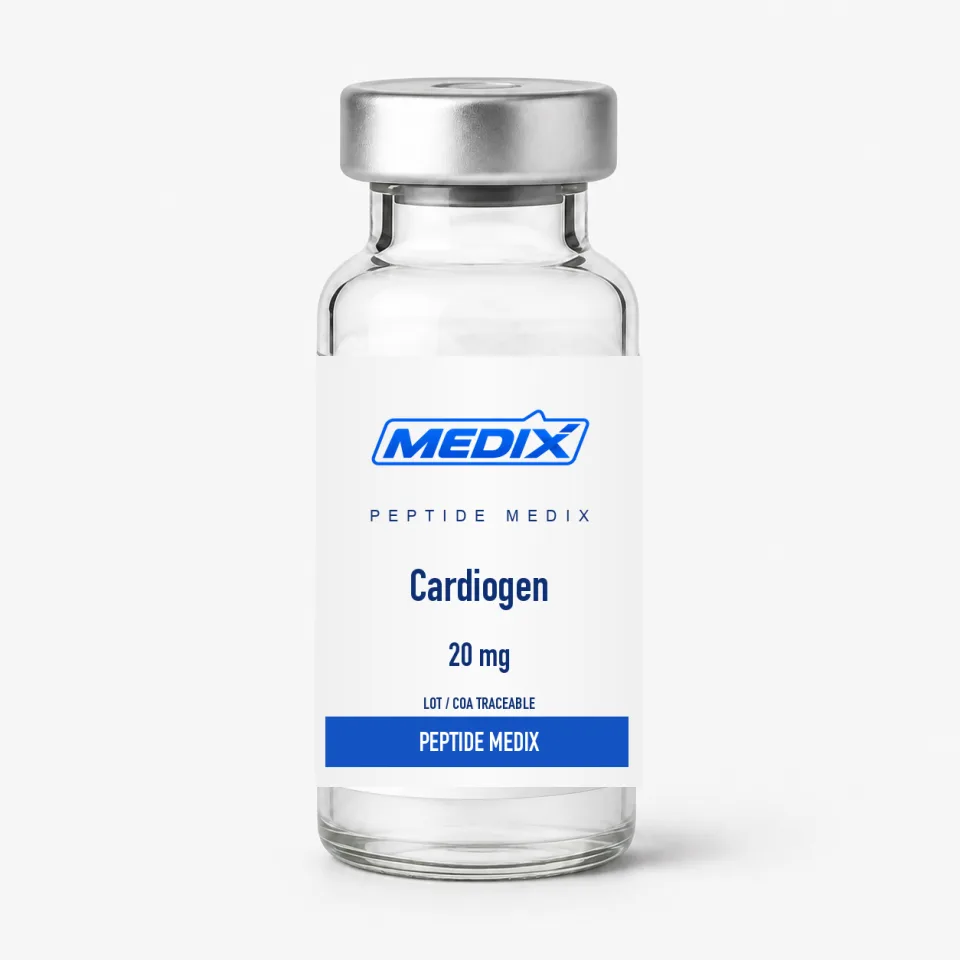
- ≥99% by HPLC
- Lot-matched certificate of analysis
- Ships next business day, tracked
Cardiogen
Ala-Glu-Asp-Arg (AEDR) tetrapeptide used in cardiac-tissue research models
- FormLyophilized powder in a sealed glass vial
- Mol. weight489.48 g/mol
- Research areasCardiomyocyte culture, stem-cell differentiation models, myocardial tissue, gene expression
Overview
Cardiogen is a synthetic tetrapeptide with the sequence L-alanyl-L-glutamyl-L-aspartyl-L-arginine (Ala-Glu-Asp-Arg, or AEDR). It is the cardiac member of the Khavinson short-peptide bioregulator series, developed along the same lines as the rest of the family: heart tissue peptide preparations were studied first, a short candidate sequence was identified, and the synthetic tetrapeptide replaced the extract as a defined and reproducible research material.
Arginine at the fourth position gives Cardiogen a strongly basic side chain that the other Ala-Glu-Asp peptides lack. At neutral pH the guanidinium group carries a positive charge, so AEDR is zwitterionic in a different way from Cortagen or Bronchogen and interacts differently with anionic surfaces, nucleic acids, and ion-exchange media. Researchers doing chromatography or binding work with the series routinely note this, since retention behaviour and apparent affinity can diverge sharply from the neutral or hydrophobic variants.
Published work involving AEDR includes cardiomyocyte and stem-cell differentiation cultures, isolated cardiac tissue preparations, expression studies on a limited gene panel, and rodent experiments examining myocardial tissue with age. Our Cardiogen is supplied as a 20 mg lyophilized vial produced by SPPS and purified by HPLC to a ≥99% specification, with a lot-matched certificate of analysis. It is sold for laboratory research only.
Specifications
Identity
- Molecular formula
- C18H31N7O9
- Molecular weight
- 489.48 g/mol
- Amino acid sequence
- Ala-Glu-Asp-Arg (AEDR), linear tetrapeptide
- Peptide class
- Khavinson short-peptide bioregulator (tetrapeptide)
Supply & purity
- Form
- Lyophilized powder in a sealed glass vial
- Purity
- ≥99% by HPLC; lot-matched COA available
- Available sizes
- 20 mg
- Solubility
- Bacteriostatic or sterile water; readily soluble in aqueous buffers
Handling & storage
- Storage (lyophilized)
- −20 °C, sealed and protected from light and moisture
- Storage (reconstituted)
- 2–8 °C, protected from light; use within the study window
Additional detail
- Tissue association
- Heart and myocardial peptide preparations
- Research areas
- Cardiomyocyte culture, stem-cell differentiation models, myocardial tissue, gene expression
- Sequence relationship
- Shares the Ala-Glu-Asp core with Cortagen (AEDP) and Bronchogen (AEDL)
Working out the concentration
Cardiogen ships as a lyophilized powder, so nothing on this page can state a concentration: the figure you work with is the one you create when you add diluent. Put the vial mass and the volume you intend to use into the peptide reconstitution calculator and it returns mg/mL, mcg/mL and the mass sitting at each mark on a U-100 syringe.
For work specified in µM or nM rather than mg/mL, feed 489.48 g/mol and your volume into the peptide molarity calculator.
Certificate of analysis
Every lot of Cardiogen is released against a certificate of analysis: the batch-specific laboratory data for that lot, not a generic document for the compound. The lot number on the certificate matches the lot number printed on the label you receive — the vial label itself, where the product is vialled — so the record and the material it describes can always be reconciled.
Purity: ≥99% by HPLC — the specification for this listing. The figure for the lot you receive is the one reported on that lot’s certificate.
No lot certificate is on display on this page at the moment. That is a publishing state and not a testing one: lots are released and documented as described above whether or not the document is posted here, and we will send what exists for the lot in stock, or for a lot already on your bench, by its number.
Certificates are available on request before you order as well as after, with no account and no charge. Request the certificate for this listing, read the testing and documentation policy in full, or see how to read a peptide COA.
Questions about Cardiogen
What is Cardiogen?
Cardiogen is the synthetic tetrapeptide Ala-Glu-Asp-Arg (AEDR) from the Khavinson short-peptide bioregulator series, associated in that literature with heart tissue. It is supplied as a lyophilized research chemical for laboratory investigation only.
How is purity confirmed?
Each batch is analysed by HPLC against a ≥99% purity specification, and a lot-matched certificate of analysis is available on request. The COA records the batch number, purity result, identity confirmation, and physical description of the material.
Why is no CAS number shown?
No widely recognised CAS registry entry exists for this sequence, so the field is left blank rather than filled with an unverified value. Identity rests on the sequence, molecular formula, and weight, all confirmed against the lot certificate of analysis.
What makes the arginine residue significant?
Arginine carries a positively charged guanidinium group at neutral pH, which no other Ala-Glu-Asp peptide in the series has. It changes how the molecule behaves on chromatography columns and in binding assays, so methods often need adjusting for this peptide.
How should the vial be stored?
Keep the unopened lyophilized vial at −20 °C, away from light and moisture. After reconstitution store the solution at 2–8 °C for the planned study window, or freeze single-use aliquots if the material is needed over a longer period.