- ≥99% by HPLC
- Lot-matched certificate of analysis
- Ships next business day, tracked
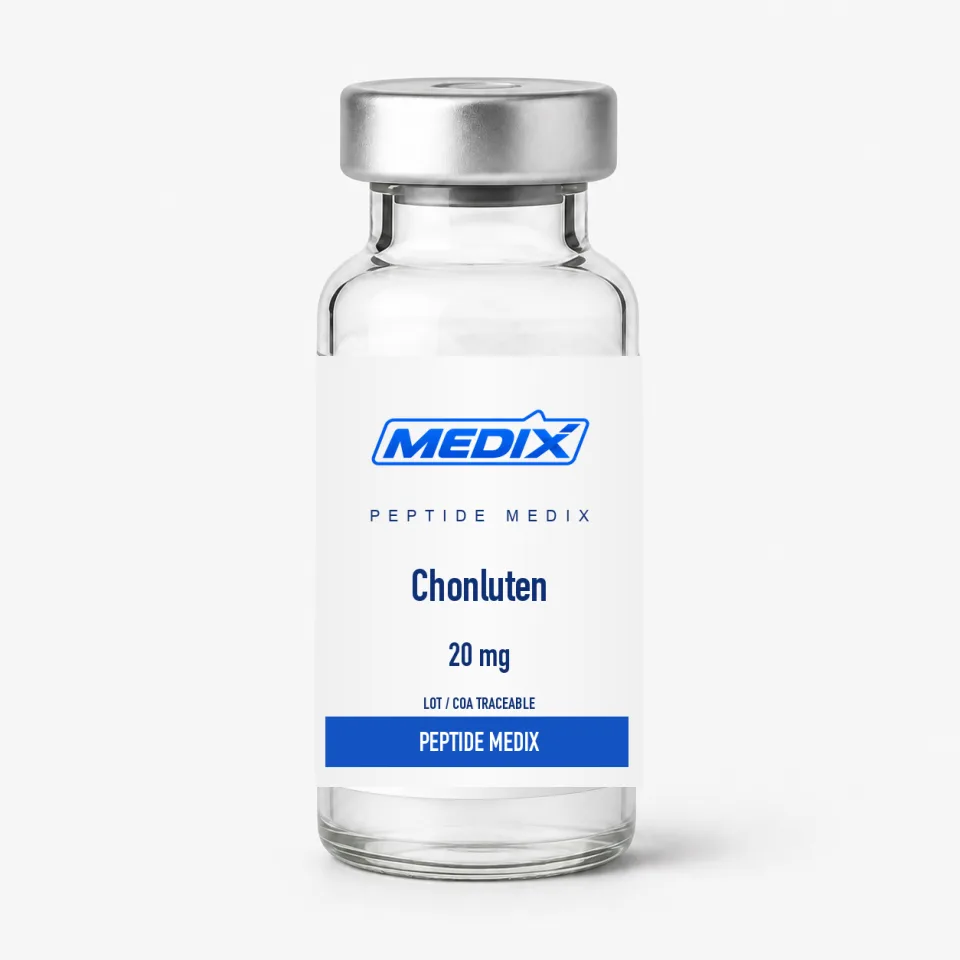
Chonluten
Glu-Asp-Gly (EDG) tripeptide used in bronchopulmonary and mucosal research
- FormLyophilized powder in a sealed glass vial
- Mol. weight319.27 g/mol
- Research areasAirway epithelium, gastric and intestinal mucosa, irritant-exposure models, gene expression
Overview
Chonluten is a synthetic tripeptide with the sequence L-glutamyl-L-aspartyl-glycine (Glu-Asp-Gly, or EDG). It is part of the Khavinson short-peptide bioregulator series and is the sequence associated with bronchopulmonary tissue, with some of the published work also covering gastric and intestinal mucosa. As with the rest of the family, the compound replaced an earlier tissue-derived preparation once a short active sequence had been identified and could be synthesised to a defined specification.
At 319 g/mol EDG is one of the smallest members of the series, only slightly larger than the Vilon dipeptide. Glycine at the C-terminus has no side chain at all, which makes the molecule unusually flexible and almost entirely polar. Those properties matter in practice: EDG dissolves very readily, elutes early on reversed-phase columns, and is a useful lower bound when researchers ask how much structure a peptide needs before sequence-selective behaviour can be detected at all.
Published laboratory work with EDG covers bronchial and alveolar epithelial preparations, gastric mucosal models, and rodent experiments involving inhaled or ingested irritants where tissue histology and stress markers are the endpoints. Our Chonluten is supplied as a 20 mg lyophilized vial made by SPPS and HPLC purified to a ≥99% specification, with a lot-matched certificate of analysis. It is sold for laboratory research only.
Specifications
Identity
- Molecular formula
- C11H17N3O8
- Molecular weight
- 319.27 g/mol
- Amino acid sequence
- Glu-Asp-Gly (EDG), linear tripeptide
- Peptide class
- Khavinson short-peptide bioregulator (tripeptide)
Supply & purity
- Form
- Lyophilized powder in a sealed glass vial
- Purity
- ≥99% by HPLC; lot-matched COA available
- Available sizes
- 20 mg
- Solubility
- Bacteriostatic or sterile water; readily soluble in aqueous buffers
Handling & storage
- Storage (lyophilized)
- −20 °C, sealed and protected from light and moisture
- Storage (reconstituted)
- 2–8 °C, protected from light; use within the study window
Additional detail
- Tissue association
- Bronchopulmonary and mucosal peptide preparations
- Research areas
- Airway epithelium, gastric and intestinal mucosa, irritant-exposure models, gene expression
- Sequence relationship
- Shares its acidic Glu-Asp core with Pinealon (EDR) and Ovagen (EDL)
Working out the concentration
Reconstitution is where the arithmetic lives. The same vial made up with 1 mL or with 3 mL of diluent gives three-fold different numbers, which is why a reconstitution volume calculator is more use here than a fixed table: enter the vial mass and your diluent volume and read the concentration back.
Where a method is written in molar terms instead, the molecular weight above — 319.27 g/mol — is the input the molarity calculator needs.
Certificate of analysis
Every lot of Chonluten is released against a certificate of analysis: the batch-specific laboratory data for that lot, not a generic document for the compound. The lot number on the certificate matches the lot number printed on the label you receive — the vial label itself, where the product is vialled — so the record and the material it describes can always be reconciled.
Purity: ≥99% by HPLC — the specification for this listing. The figure for the lot you receive is the one reported on that lot’s certificate.
No lot certificate is on display on this page at the moment. That is a publishing state and not a testing one: lots are released and documented as described above whether or not the document is posted here, and we will send what exists for the lot in stock, or for a lot already on your bench, by its number.
Certificates are available on request before you order as well as after, with no account and no charge. Request the certificate for this listing, read the testing and documentation policy in full, or see how to read a peptide COA.
Questions about Chonluten
What is Chonluten?
Chonluten is the synthetic tripeptide Glu-Asp-Gly (EDG) from the Khavinson short-peptide bioregulator series, associated in that literature with bronchopulmonary and mucosal tissue. It is supplied as a lyophilized research chemical for laboratory use only.
How is purity documented?
Every lot is analysed by HPLC against a ≥99% purity specification, and a lot-matched certificate of analysis is available on request. The COA records the batch identifier, purity result, identity confirmation, and the appearance of the material.
How does it differ from Bronchogen?
Both are linked to respiratory tissue, but Chonluten is the smaller EDG tripeptide while Bronchogen is the AEDL tetrapeptide. Chonluten is also discussed in gastric and intestinal mucosal research, a context that rarely appears in the Bronchogen literature.
Why is no CAS number listed?
There is no widely recognised CAS registry entry for this sequence, so we leave the field blank rather than publish an unverified number. Identity is defined by the sequence, molecular formula, and weight, all confirmed against the lot COA.
How should it be stored?
Keep the unopened lyophilized vial at −20 °C, away from light and moisture. After reconstitution store the solution at 2–8 °C for the planned study window, or freeze single-use aliquots to avoid repeated freeze-thaw cycles.