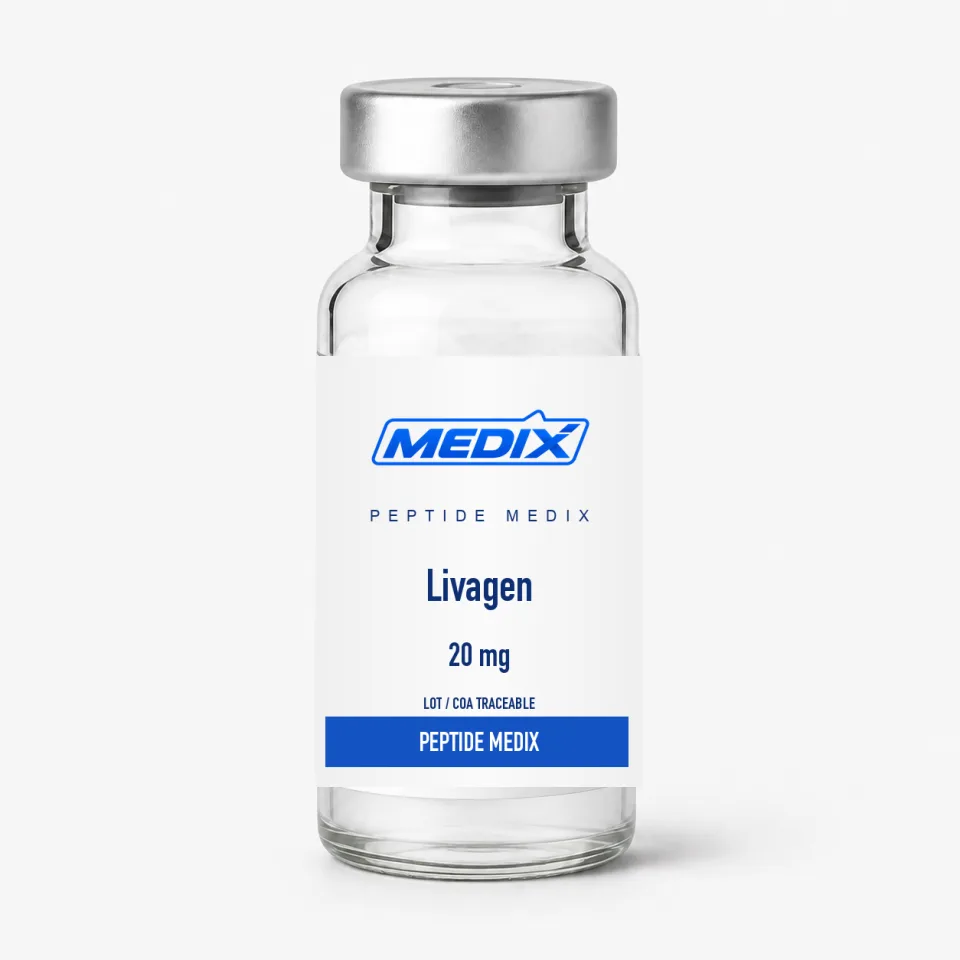
- ≥99% by HPLC
- Lot-matched certificate of analysis
- Ships next business day, tracked
Livagen
Lys-Glu-Asp-Ala (KEDA) tetrapeptide used in hepatic and chromatin research models
- FormLyophilized powder in a sealed glass vial
- Mol. weight461.47 g/mol
- Research areasChromatin decondensation, lymphocyte cytogenetics, hepatocyte culture, liver tissue models
Overview
Livagen is a synthetic tetrapeptide with the sequence L-lysyl-L-glutamyl-L-aspartyl-L-alanine (Lys-Glu-Asp-Ala, or KEDA). It belongs to the Khavinson short-peptide bioregulator series and is the sequence associated with liver tissue preparations. Like the rest of the family it began as a tissue-derived peptide extract and was then reduced to a defined synthetic sequence so that experiments could be run on a single characterised molecule.
KEDA is notable within the series because it appears prominently in the cytogenetic literature rather than only in organ-focused studies. Several published experiments applied it to cultured human lymphocytes, including cells from older donors, and reported changes in heterochromatin decondensation and in the activity of ribosomal gene regions assessed by staining. That work is the most frequently cited evidence offered for the claim that these ultrashort peptides reach the nucleus and act on chromatin structure.
Beyond the chromatin work, laboratories use Livagen in hepatocyte cultures and rodent liver models where markers of tissue structure, protein synthesis, and gene expression are measured. Our material ships as a 20 mg lyophilized vial, synthesised by SPPS and HPLC purified to a ≥99% specification, with a lot-matched certificate of analysis available on request. It is supplied for laboratory research only.
Specifications
Identity
- Molecular formula
- C18H31N5O9
- Molecular weight
- 461.47 g/mol
- Amino acid sequence
- Lys-Glu-Asp-Ala (KEDA), linear tetrapeptide
- Peptide class
- Khavinson short-peptide bioregulator (tetrapeptide)
Supply & purity
- Form
- Lyophilized powder in a sealed glass vial
- Purity
- ≥99% by HPLC; lot-matched COA available
- Available sizes
- 20 mg
- Solubility
- Bacteriostatic or sterile water; readily soluble in aqueous buffers
Handling & storage
- Storage (lyophilized)
- −20 °C, sealed and protected from light and moisture
- Storage (reconstituted)
- 2–8 °C, protected from light; use within the study window
Additional detail
- Tissue association
- Liver peptide preparations
- Research areas
- Chromatin decondensation, lymphocyte cytogenetics, hepatocyte culture, liver tissue models
- Sequence relationship
- Vesugen (KED) extended by a C-terminal alanine residue
Working out the concentration
A lyophilized vial carries a mass on the label and no concentration anywhere, so the first calculation of any protocol is the reconstitution one. The peptide concentration calculator converts vial mass plus diluent volume into mg/mL, and back into the draw volume for a given mass.
Where a method is written in molar terms instead, the molecular weight above — 461.47 g/mol — is the input the molarity calculator needs.
Certificate of analysis
Every lot of Livagen is released against a certificate of analysis: the batch-specific laboratory data for that lot, not a generic document for the compound. The lot number on the certificate matches the lot number printed on the label you receive — the vial label itself, where the product is vialled — so the record and the material it describes can always be reconciled.
Purity: ≥99% by HPLC — the specification for this listing. The figure for the lot you receive is the one reported on that lot’s certificate.
No lot certificate is on display on this page at the moment. That is a publishing state and not a testing one: lots are released and documented as described above whether or not the document is posted here, and we will send what exists for the lot in stock, or for a lot already on your bench, by its number.
Certificates are available on request before you order as well as after, with no account and no charge. Request the certificate for this listing, read the testing and documentation policy in full, or see how to read a peptide COA.
Questions about Livagen
What is Livagen?
Livagen is the synthetic tetrapeptide Lys-Glu-Asp-Ala (KEDA) from the Khavinson short-peptide bioregulator series, associated in that literature with liver tissue. It is supplied as a lyophilized research chemical for laboratory investigation only.
Is the purity independently documented?
Yes. Every lot is tested by HPLC against a ≥99% purity specification and a lot-matched certificate of analysis is available, recording the batch identifier, purity result, identity confirmation, and physical description of the powder.
Why is Livagen cited in chromatin research?
Published cytogenetic experiments applied KEDA to cultured human lymphocytes and reported increased heterochromatin decondensation and nucleolar organiser activity, particularly in cells from older donors. That work is the most frequently referenced support for the chromatin hypothesis behind this peptide family.
Why is no CAS number listed?
No widely accepted CAS registry entry is available for this sequence, so the field is left blank rather than filled with an unverified number. Identity is defined by sequence, molecular formula, and weight, all confirmed on the lot COA.
How should it be stored?
Store the unopened lyophilized vial at −20 °C, away from light and moisture. After reconstitution keep the solution refrigerated at 2–8 °C for the planned study window, or freeze single-use aliquots for longer-term storage.