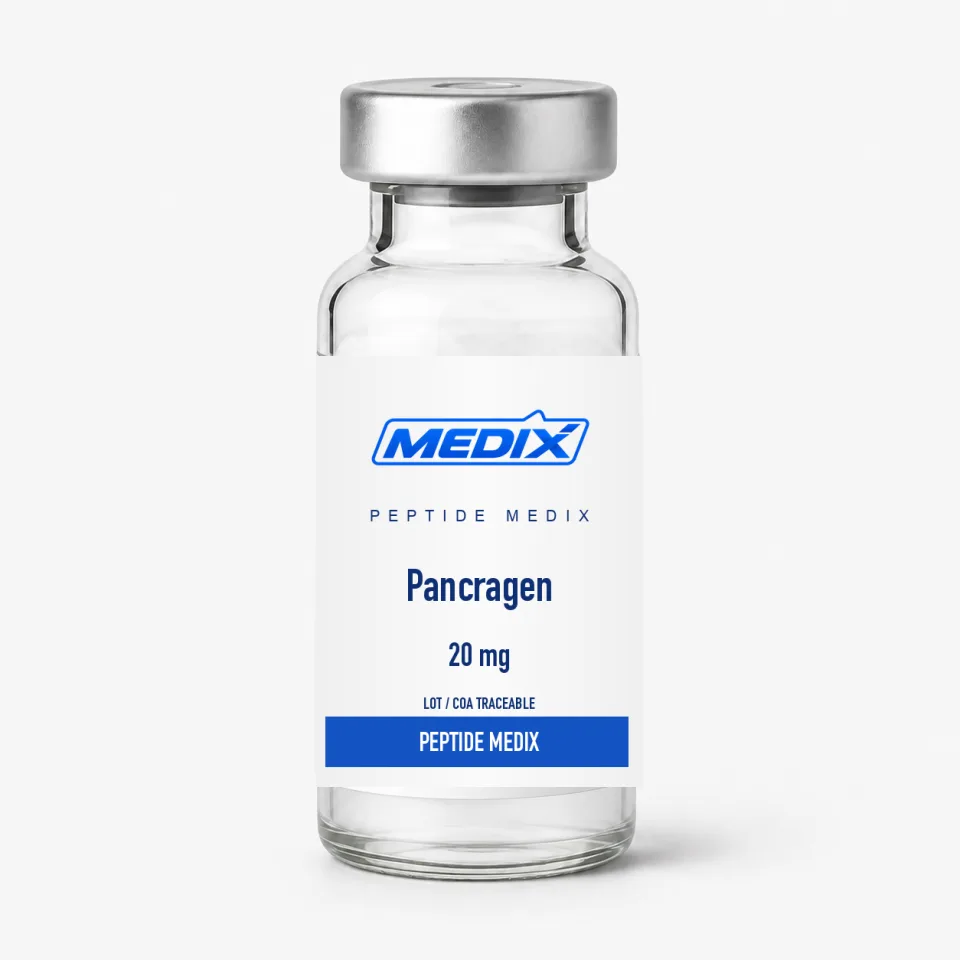
- ≥99% by HPLC
- Lot-matched certificate of analysis
- Ships next business day, tracked
Pancragen
Lys-Glu-Asp-Trp (KEDW) short-peptide bioregulator, 20 mg vial
- FormLyophilized powder in a sealed glass vial
- Mol. weight≈576.6 g/mol
- Research areasIslet and beta-cell cultures, Pdx1 and Ngn3 expression, insulin gene expression, cell proliferation and apoptosis in ageing models
Overview
Pancragen is the tetrapeptide Lys-Glu-Asp-Trp, usually written KEDW, one of the synthetic short-peptide bioregulators developed within Vladimir Khavinson's programme at the Saint Petersburg Institute of Bioregulation and Gerontology. In that framework each short sequence is associated with a specific tissue, and Pancragen is the peptide linked to pancreatic tissue — the synthetic counterpart of the earlier organ-extract preparation Suprefort.
Supplied as a lyophilized 20 mg vial of ≥99% HPLC-purity peptide with a lot-matched certificate of analysis. At four residues and roughly 577 g/mol, KEDW is small enough that the mechanism proposed for this peptide family — direct entry into cells and nuclei with interaction at specific DNA sequences to modulate transcription, rather than binding a cell-surface receptor — is at least structurally plausible. Molecular-modelling and cell studies from the originating group support it; independent replication outside that group remains limited.
Specifications
Identity
- Molecular formula
- C26H36N6O9
- Molecular weight
- ≈576.6 g/mol
- Amino acid sequence
- Lys-Glu-Asp-Trp (KEDW)
- Chain length
- 4 amino acids (tetrapeptide)
- Peptide class
- Khavinson short-peptide bioregulator (tetrapeptide)
Supply & purity
- Form
- Lyophilized powder in a sealed glass vial
- Purity
- ≥99% by HPLC; lot-matched COA available
- Solubility
- Bacteriostatic or sterile water; readily soluble in aqueous buffers
Handling & storage
- Storage (lyophilized)
- −20 °C, sealed and protected from light and moisture
- Storage (reconstituted)
- 2–8 °C, protected from light; use within the study window
Additional detail
- Available size
- 20 mg
- Tissue association
- Pancreatic peptide preparations; synthetic analogue of Suprefort
- Proposed mechanism studied
- Direct peptide–DNA and chromatin interaction influencing transcription, rather than surface-receptor signalling
- Research areas
- Islet and beta-cell cultures, Pdx1 and Ngn3 expression, insulin gene expression, cell proliferation and apoptosis in ageing models
Working out the concentration
Because Pancragen arrives dry, its concentration is a decision rather than a specification. Run the numbers through the reconstitution calculator — vial mass in, diluent volume in, mg/mL and mass per syringe unit out.
Where a method is written in molar terms instead, the molecular weight above — ≈576.6 g/mol — is the input the molarity calculator needs.
Certificate of analysis
Every lot of Pancragen is released against a certificate of analysis: the batch-specific laboratory data for that lot, not a generic document for the compound. The lot number on the certificate matches the lot number printed on the label you receive — the vial label itself, where the product is vialled — so the record and the material it describes can always be reconciled.
Purity: ≥99% by HPLC — the specification for this listing. The figure for the lot you receive is the one reported on that lot’s certificate.
No lot certificate is on display on this page at the moment. That is a publishing state and not a testing one: lots are released and documented as described above whether or not the document is posted here, and we will send what exists for the lot in stock, or for a lot already on your bench, by its number.
Certificates are available on request before you order as well as after, with no account and no charge. Request the certificate for this listing, read the testing and documentation policy in full, or see how to read a peptide COA.
Questions about Pancragen
What does KEDW stand for?
It is single-letter shorthand for the sequence: K for lysine, E for glutamic acid, D for aspartic acid, W for tryptophan. Pancragen is the name used in the Khavinson short-peptide literature for that synthetic tetrapeptide, which is associated there with pancreatic tissue preparations.
How does Pancragen relate to Suprefort?
Suprefort is the older preparation made from animal pancreatic tissue extract, containing a mixture of peptides. Pancragen is the defined synthetic tetrapeptide developed to reproduce that activity with a single known sequence, which makes it far more tractable as a research article.
What purity and documentation do you provide?
Vials are ≥99% pure by HPLC and each lot carries a matched certificate of analysis with purity and mass-spectrometric identity confirmation. Quote the lot number printed on the vial label when requesting the document.
How strong is the published evidence?
It is preliminary. Most work comes from the research group that developed the short-peptide bioregulator concept and consists of cell-culture and small-animal studies rather than independent trials. Sequence-specific controls are advisable, since specificity is the central claim being tested.
How should the vial be stored?
Store the lyophilized powder sealed at −20 °C, dry and away from light. Once reconstituted, keep the solution at 2–8 °C protected from light and use it within your defined study window, or aliquot and freeze to avoid repeated freeze–thaw cycles that degrade peptide.