- ≥98% by HPLC
- Lot-matched certificate of analysis
- Ships next business day, tracked
Cartalax
Ala-Glu-Asp synthetic bioregulator tripeptide studied in cartilage models
- FormLyophilized powder, sealed glass vial
- Mol. weight333.30 g/mol
- Research areasChondrocyte biology, cartilage matrix expression, peptide–DNA interaction models, cellular senescence
Overview
Cartalax is a synthetic tripeptide with the sequence Ala-Glu-Asp (AED), one of the short peptides developed within the Russian bioregulator research programme associated with Vladimir Khavinson at the St Petersburg Institute of Bioregulation and Gerontology. Within that programme it is designated the cartilage and connective-tissue bioregulator, the synthetic counterpart to Sigumir, which is a peptide fraction extracted from animal cartilage.
The bioregulator hypothesis holds that very short, tissue-associated peptides act at the level of gene expression rather than through classical receptor signalling — the proposal is that acidic tripeptides and tetrapeptides can enter cells, reach the nucleus and interact directly with promoter regions or with histone-associated DNA, modulating transcription of tissue-specific genes. Cartalax is one of the sequences most often used to test that idea in cartilage and chondrocyte systems, and its close structural relatives — Vesugen (Lys-Glu-Asp), Chonluten (Glu-Asp-Gly) and Epitalon (Ala-Glu-Asp-Gly) — form a family in which single residue changes are said to redirect tissue specificity.
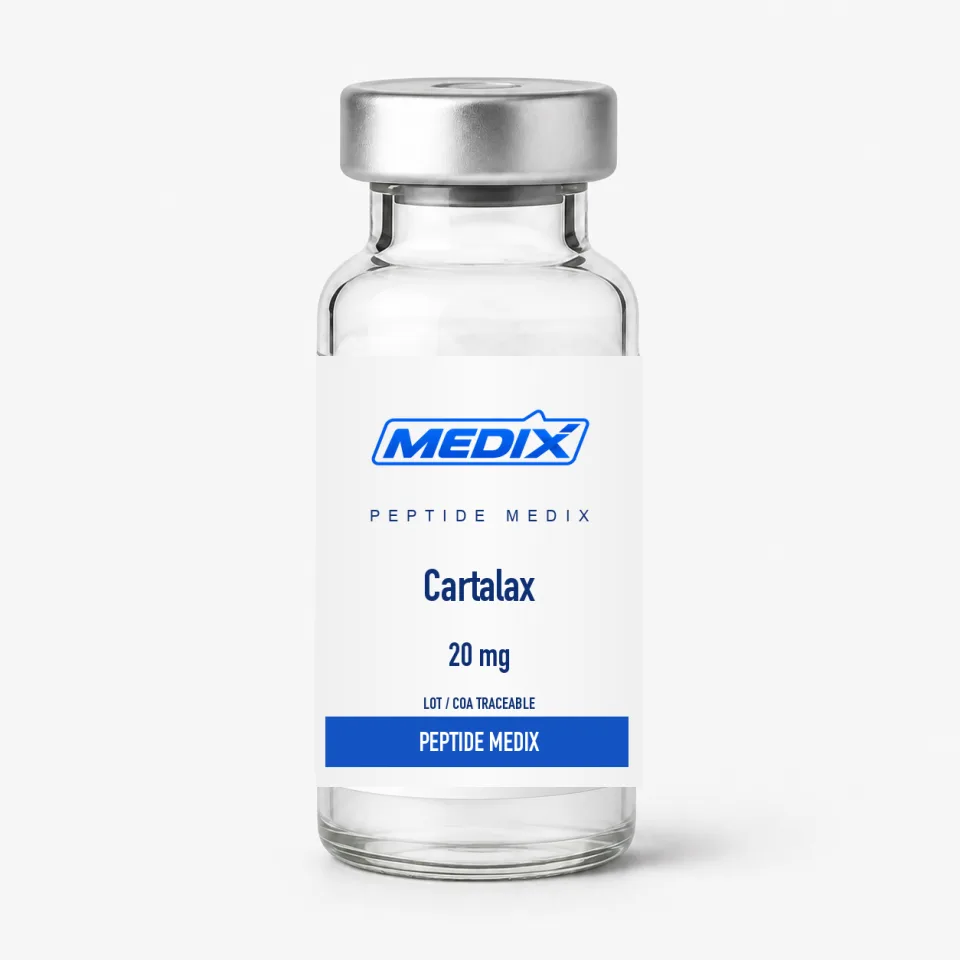
Supplied as lyophilized powder in a sealed 20 mg vial with a lot-matched certificate of analysis. It should be said plainly that the bioregulator literature is concentrated in a relatively small number of laboratories and journals, and independent replication remains limited. It is not a drug, supplement or consumer product.
Specifications
Identity
- Molecular formula
- C12H19N3O8
- Molecular weight
- 333.30 g/mol
- Amino acid sequence
- H-Ala-Glu-Asp-OH
- Chain length
- 3 amino acids, free N-terminus and C-terminus
- Peptide class
- Synthetic short-chain bioregulator (Khavinson peptide family)
Supply & purity
- Form
- Lyophilized powder, sealed glass vial
- Purity
- ≥98% by HPLC; lot-matched COA available
- Available sizes
- 20 mg
- Solubility
- Freely soluble in water and bacteriostatic water; solutions are acidic
Handling & storage
- Storage (lyophilized)
- −20 °C, sealed and protected from light and moisture
- Storage (reconstituted)
- 2–8 °C, used within the study window
Additional detail
- Also known as
- AED peptide, Ala-Glu-Asp, cartilage bioregulator peptide
- Associated tissue
- Cartilage and connective tissue
- Related sequences
- Vesugen (Lys-Glu-Asp), Chonluten (Glu-Asp-Gly), Epitalon (Ala-Glu-Asp-Gly), Vilon (Lys-Glu)
- Research areas
- Chondrocyte biology, cartilage matrix expression, peptide–DNA interaction models, cellular senescence
Working out the concentration
Because Cartalax arrives dry, its concentration is a decision rather than a specification. Run the numbers through the reconstitution calculator — vial mass in, diluent volume in, mg/mL and mass per syringe unit out.
For work specified in µM or nM rather than mg/mL, feed 333.30 g/mol and your volume into the peptide molarity calculator.
Certificate of analysis
Every lot of Cartalax is released against a certificate of analysis: the batch-specific laboratory data for that lot, not a generic document for the compound. The lot number on the certificate matches the lot number printed on the label you receive — the vial label itself, where the product is vialled — so the record and the material it describes can always be reconciled.
Purity: ≥98% by HPLC — the specification for this listing. The figure for the lot you receive is the one reported on that lot’s certificate.
No lot certificate is on display on this page at the moment. That is a publishing state and not a testing one: lots are released and documented as described above whether or not the document is posted here, and we will send what exists for the lot in stock, or for a lot already on your bench, by its number.
Certificates are available on request before you order as well as after, with no account and no charge. Request the certificate for this listing, read the testing and documentation policy in full, or see how to read a peptide COA.
Questions about Cartalax
What is the difference between Cartalax and Sigumir?
Sigumir is a peptide fraction extracted from animal cartilage — a mixture of undefined composition. Cartalax is a single, fully synthetic tripeptide, Ala-Glu-Asp, made by solid-phase synthesis. It is the defined synthetic counterpart within the same bioregulator programme, which makes it far more tractable experimentally.
How is Cartalax related to Epitalon?
Closely. Epitalon is Ala-Glu-Asp-Gly — the same three residues with a glycine added at the C-terminus. Within the bioregulator framework that single extra residue is said to shift the peptide's tissue association from cartilage to the pineal gland, a claim that itself is a common subject of comparative research.
What purity documentation comes with it?
Material is supplied at ≥98% by HPLC with a lot-matched certificate of analysis available on request. Very short peptides like this typically assay cleanly, and the COA reports identity by mass spectrometry alongside the HPLC purity figure.
How is it reconstituted and stored?
It dissolves freely in bacteriostatic or sterile water — add diluent down the vial wall and swirl gently. Solutions are acidic, so buffer or check pH before adding to culture medium. Store the sealed powder at −20 °C and reconstituted solution at 2–8 °C, used within the study window.
How strong is the evidence behind bioregulator peptides?
It is limited. Most published work originates from a small number of laboratories, much of it in regional journals, with small sample sizes and sparse independent replication. The proposed direct peptide–DNA mechanism is unusual and remains a working hypothesis. Scrambled-sequence controls are advisable.
Why is it sold in only one size?
A 20 mg vial is the standard presentation across the Khavinson bioregulator range in this catalogue, which keeps lot handling and record-keeping consistent when researchers compare several sequences from the family side by side in the same study.