- Lot-matched certificate of analysis
- Ships next business day, tracked
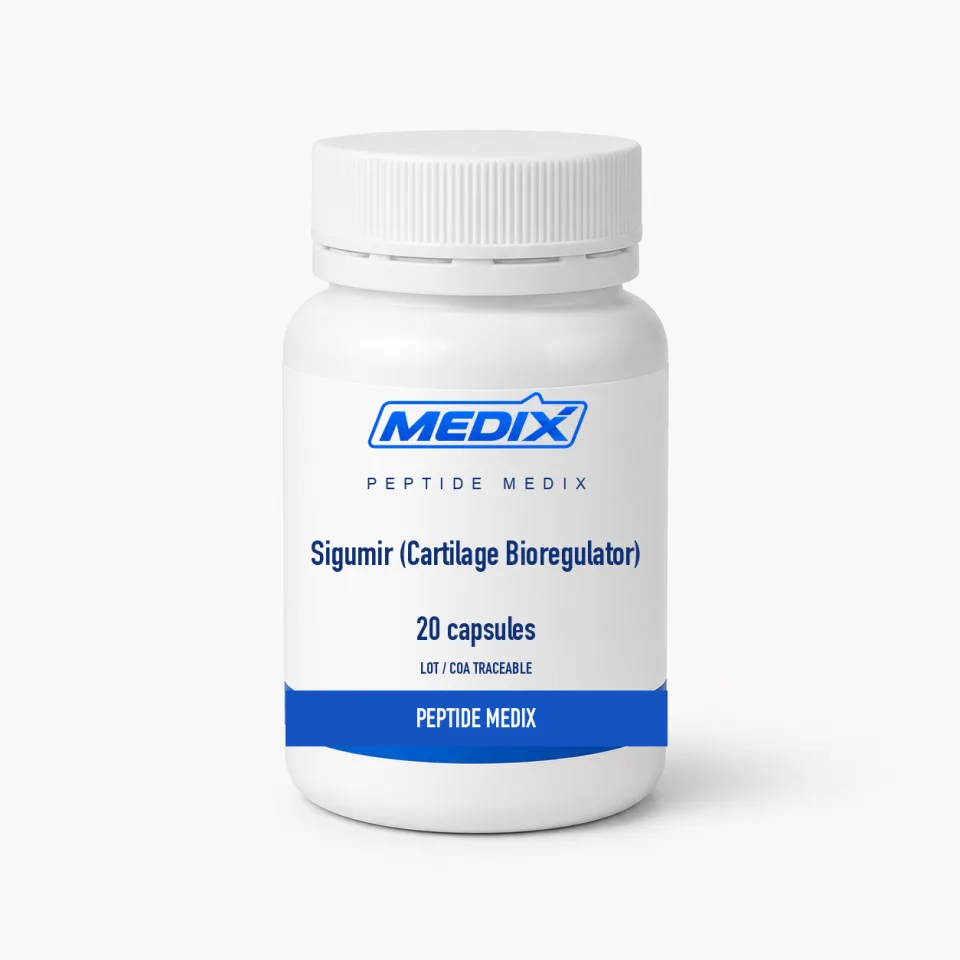
Sigumir (Cartilage Bioregulator)
Cartilage-derived peptide bioregulator from the Khavinson Cytomax series
- FormCapsules containing a dried peptide complex, in a sealed pack
- Research areasTissue-specific peptide regulation, connective tissue and cartilage models, gerontology and ageing research
Overview
Sigumir is the cartilage-directed member of the Cytomax series of peptide bioregulators developed at the St Petersburg Institute of Bioregulation and Gerontology under Vladimir Khavinson. Unlike a synthetic peptide with a single defined sequence, the Cytomax preparations are low-molecular-weight peptide complexes extracted from a specific tissue of young animals — in this case cartilage and connective tissue — then fractionated and dried. The product is therefore a characterised mixture rather than one molecule, which is why no single CAS number, formula or sequence can be assigned to it.
The organising idea behind the bioregulator programme is tissue specificity: the hypothesis that short peptide fractions derived from a given tissue interact preferentially with cells of that same tissue, influencing gene expression and protein synthesis. Khavinson's group has published on this concept for several decades, including work on peptide–DNA interaction, and it has also produced defined synthetic analogues for individual tissues — Cartalax (Ala-Glu-Asp) is the short synthetic counterpart most often discussed alongside Sigumir in the cartilage context.
Specifications
Supply & purity
- Form
- Capsules containing a dried peptide complex, in a sealed pack
- Available sizes
- 20 capsules, 60 capsules
Additional detail
- Product type
- Tissue-derived low-molecular-weight peptide complex (peptide bioregulator)
- Source tissue
- Cartilage and connective tissue of young animals
- Series
- Cytomax line, St Petersburg Institute of Bioregulation and Gerontology
- Composition
- Mixture of short peptide fractions; no single defined sequence, formula or CAS number applies
- Fraction size
- Low molecular weight, characteristically below approximately 10 kDa
- Peptide content per capsule
- Stated on the pack label for your lot
- Synthetic counterpart
- Cartalax, the tetrapeptide Ala-Glu-Asp-Gly, is the defined-sequence analogue for this tissue
- Research areas
- Tissue-specific peptide regulation, connective tissue and cartilage models, gerontology and ageing research
- Regulatory status
- Not approved as a drug in the United States or European Union
- Storage
- Room temperature or cooler, sealed, protected from light, heat and humidity
Units and conversions
Capsule and troche strengths are stated per unit, so the figure a method needs is usually a conversion rather than a dilution. The mcg to mg converter handles the milligram-to-microgram step, and the millilitre arithmetic if you are working from a solution format instead.
Certificate of analysis
Every lot of Sigumir (Cartilage Bioregulator) is released against its own lot documentation, and where the manufacturer issues a certificate of analysis for it, that certificate is the record for the lot rather than a generic document for the compound. The lot number on the certificate matches the lot number printed on the label you receive — the vial label itself, where the product is vialled — so the record and the material it describes can always be reconciled.
This listing carries no purity percentage, so none is claimed for it here. Where the manufacturer issues analytical documentation for a lot of this item, it is passed on unaltered — ask and we will send whatever exists.
No lot certificate is on display on this page at the moment. That is a publishing state and not a testing one: lots are released and documented as described above whether or not the document is posted here, and we will send what exists for the lot in stock, or for a lot already on your bench, by its number.
Certificates are available on request before you order as well as after, with no account and no charge. Request the certificate for this listing, read the testing and documentation policy in full, or see how to read a peptide COA.
Questions about Sigumir (Cartilage Bioregulator)
What is Sigumir made from?
It is a low-molecular-weight peptide complex extracted from cartilage and connective tissue of young animals, then fractionated and dried. It is a characterised mixture defined by source tissue and fraction size, not a synthetic peptide with one sequence, which is why no single formula or CAS number is listed.
How does it differ from Cartalax?
Cartalax is a defined synthetic tetrapeptide, Ala-Glu-Asp-Gly, that can be characterised precisely by HPLC and mass spectrometry. Sigumir is the natural extract fraction for the same tissue. Comparative studies often run both, since a mixture cannot support the same structural claims as a single sequence.
Is any documentation supplied?
Each lot ships with the available certificate of analysis and pack labelling stating peptide content. Because the article is a fraction rather than a single molecule, that documentation covers batch identity, source designation and fraction characteristics rather than a single-compound purity figure.
How should it be stored?
Keep the pack sealed at room temperature or cooler, protected from light, heat and humidity. Dried peptide fractions are hygroscopic, so moisture exclusion matters. Log the lot number and receipt date and retain a reference sample, since composition can vary between batches of a tissue-derived preparation.