- Lot-matched certificate of analysis
- Ships next business day, tracked
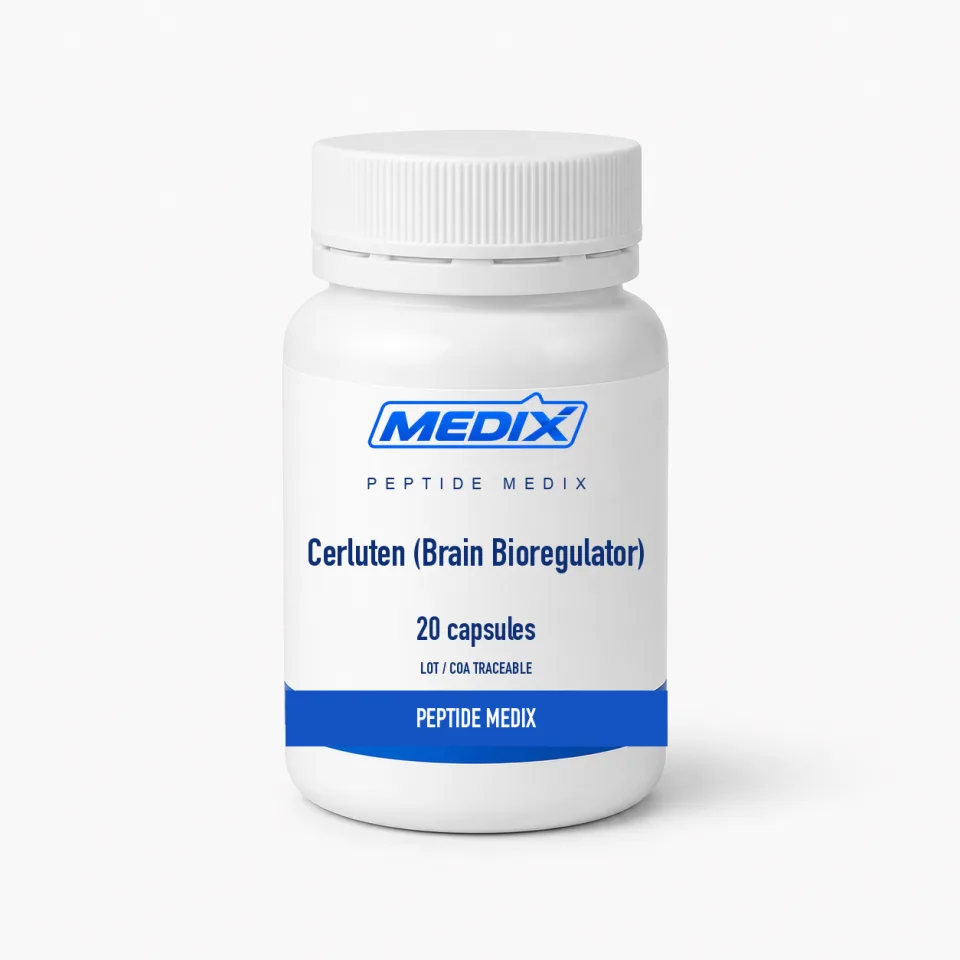
Cerluten (Brain Bioregulator)
Natural brain peptide complex in capsules, 20 or 60 count
- FormOral capsule in a sealed bottle
- Research areasTissue-specific peptide regulation, neuronal ageing models, gene-expression hypotheses, comparative bioregulator studies
Overview
Cerluten is a natural peptide complex rather than a single defined molecule. It belongs to the Cytomax line of the St. Petersburg bioregulator programme associated with Vladimir Khavinson, in which low-molecular-weight peptide fractions are extracted from a specific animal tissue and matched to the same tissue in research use. Cerluten is the brain preparation of that series, sitting beside Vladonix for thymus, Ventfort for vascular tissue and Endoluten for pineal.
The material is prepared by extracting and fractionating young bovine nervous tissue so that the finished complex contains peptides below roughly ten kilodaltons together with amino acids and trace elements. Because it is a mixture, it has no CAS number, no molecular formula and no single amino acid sequence — its identity is defined by fraction profile and source tissue rather than by structure, which distinguishes it sharply from synthetic bioregulators such as Pinealon or Cortagen.
Specifications
Supply & purity
- Form
- Oral capsule in a sealed bottle
- Available sizes
- 20 capsules; 60 capsules
Additional detail
- Product type
- Natural peptide complex (mixture), not a single-sequence peptide
- Source tissue
- Nervous tissue of young cattle, extracted and fractionated
- Composition
- Water-soluble peptide fractions with free amino acids and trace elements, plus inert capsule excipients
- Molecular weight range
- Peptide fractions below approximately 10 kDa
- Compound class
- Tissue-derived peptide bioregulator (Cytomax-type natural complex)
- Series relationship
- Brain preparation of the Cytomax line; the synthetic counterparts in the Cytogen line are defined short sequences
- Comparable preparations
- Cortexin and Cerebrolysin, both nervous-tissue polypeptide complexes
- Analytical documentation
- Identity and fraction-profile testing per lot; COA available
- Research areas
- Tissue-specific peptide regulation, neuronal ageing models, gene-expression hypotheses, comparative bioregulator studies
- Storage
- Cool, dry and dark in the closed bottle; refrigeration extends shelf stability
- Preparation required
- None — fixed unit content, no reconstitution step
Units and conversions
Capsule and troche strengths are stated per unit, so the figure a method needs is usually a conversion rather than a dilution. The mcg to mg converter handles the milligram-to-microgram step, and the millilitre arithmetic if you are working from a solution format instead.
Certificate of analysis
Every lot of Cerluten (Brain Bioregulator) is released against its own lot documentation, and where the manufacturer issues a certificate of analysis for it, that certificate is the record for the lot rather than a generic document for the compound. The lot number on the certificate matches the lot number printed on the label you receive — the vial label itself, where the product is vialled — so the record and the material it describes can always be reconciled.
This listing carries no purity percentage, so none is claimed for it here. Where the manufacturer issues analytical documentation for a lot of this item, it is passed on unaltered — ask and we will send whatever exists.
No lot certificate is on display on this page at the moment. That is a publishing state and not a testing one: lots are released and documented as described above whether or not the document is posted here, and we will send what exists for the lot in stock, or for a lot already on your bench, by its number.
Certificates are available on request before you order as well as after, with no account and no charge. Request the certificate for this listing, read the testing and documentation policy in full, or see how to read a peptide COA.
Questions about Cerluten (Brain Bioregulator)
Why does Cerluten have no CAS number or sequence?
It is a fractionated tissue extract rather than a synthesised molecule. The finished material contains many peptides below roughly 10 kDa along with amino acids and trace elements, so identity is described by source tissue and fraction profile instead of by a single structure.
How does it differ from Pinealon or Cortagen?
Those are synthetic peptides with defined sequences — EDR and AEDP respectively — that can be characterised precisely by mass and HPLC. Cerluten is a natural complex from the earlier, extract-based branch of the same research programme, so it is a mixture rather than a compound.
How does it compare with Cortexin?
Both are nervous-tissue peptide complexes with similar molecular-weight profiles. The practical difference is presentation: Cortexin is supplied as a lyophilized vial for reconstitution, while Cerluten is a capsule format, which places their research applications in different delivery contexts.
What documentation is supplied?
A lot-matched certificate of analysis covering identity and fraction-profile testing is available. For extracted preparations this documentation is more important than usual, because composition varies between batches in a way that synthetic peptides do not.
How strong is the evidence base?
Limited. The literature comes mainly from one research programme, is largely published in Russian-language journals, and has seen little independent replication or blinded controlled testing. The material is best regarded as a subject of ongoing research rather than an established intervention.