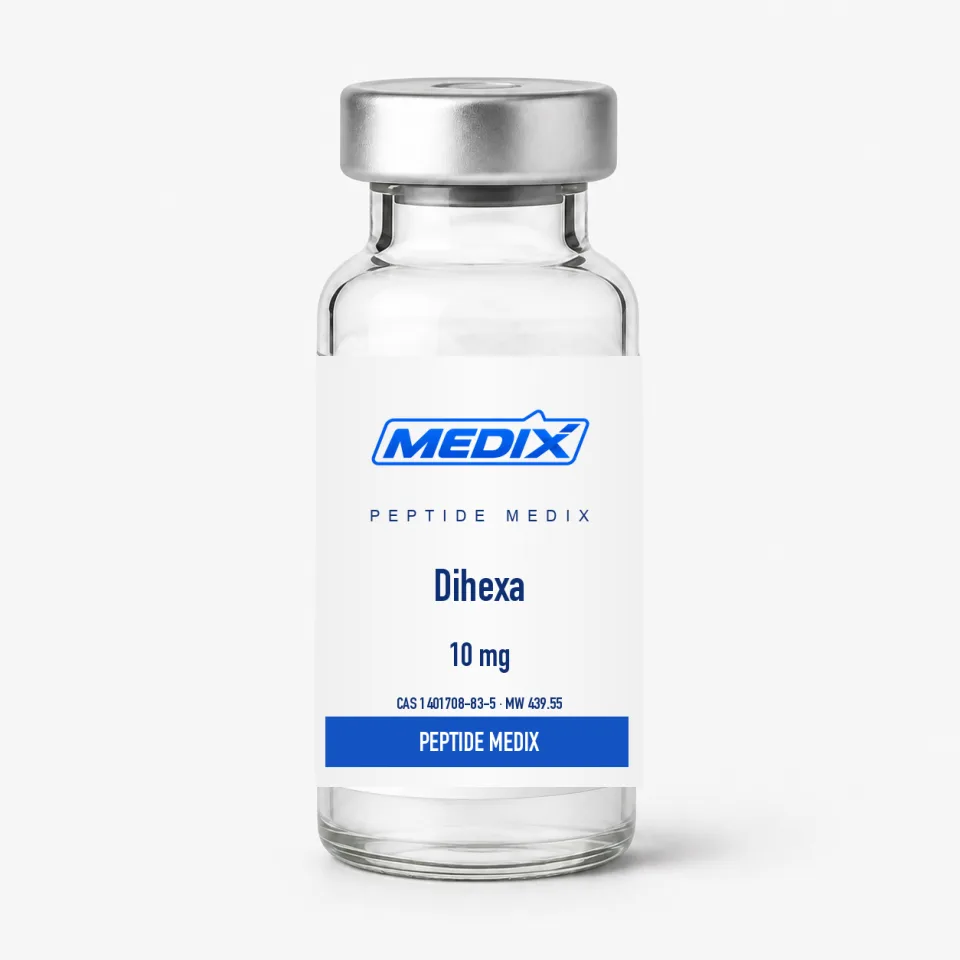
- ≥99% by HPLC
- Lot-matched certificate of analysis
- Ships next business day, tracked
Dihexa
Angiotensin IV-derived peptidomimetic studied in HGF/c-Met synaptogenesis models
- FormLyophilized powder in a sealed glass vial
- Research areasSynaptogenesis, dendritic spine density, hippocampal culture models, cognitive impairment models
Overview
Dihexa is a small synthetic peptidomimetic developed from angiotensin IV research at Washington State University. Its full chemical name, N-hexanoic-Tyr-Ile-(6)-aminohexanoic amide, describes the design: a two-residue core flanked by a hexanoyl chain at one end and an aminohexanoic amide at the other. Those non-standard, lipophilic ends are the point — they were added to make the molecule metabolically stable and far more lipid-soluble than a conventional short peptide.
Published characterisation centres on hepatocyte growth factor and its receptor c-Met, and the assays that follow from that are dendritic spine counts and synaptic markers in hippocampal culture, electrophysiological measures of synaptic strength, and rodent models of cognitive impairment. Because published formula and mass values for the molecule differ between sources, the lot certificate rather than a database entry is the record that describes what is in the vial. Preparation is the other practical constraint: the hexanoyl and aminohexanoic termini that confer metabolic stability leave the compound poorly water-soluble, so a concentrated DMSO stock is made first and checked for precipitation at the working dilution, with solvent content kept inside the tolerance of the assay system. Vials are 10 mg and 20 mg.
Specifications
Identity
- CAS number
- 1401708-83-5
Supply & purity
- Form
- Lyophilized powder in a sealed glass vial
- Purity
- ≥99% by HPLC; lot-matched COA available
- Available sizes
- 10 mg, 20 mg
- Solubility
- Poorly water-soluble; a co-solvent such as DMSO is commonly used before dilution
Handling & storage
- Storage (lyophilized)
- −20 °C, protected from light and moisture
Additional detail
- Chemical name
- N-hexanoic-Tyr-Ile-(6)-aminohexanoic amide
- Compound class
- Angiotensin IV-derived peptidomimetic (dipeptide core with lipophilic termini)
- Primary research target
- HGF / c-Met receptor signaling
- Research areas
- Synaptogenesis, dendritic spine density, hippocampal culture models, cognitive impairment models
- Synthesis
- Solid-phase synthesis with preparative HPLC purification
- Storage (in solution)
- 2–8 °C short term; −20 °C in aliquots for longer storage
Working out the concentration
A lyophilized vial carries a mass on the label and no concentration anywhere, so the first calculation of any protocol is the reconstitution one. The peptide concentration calculator converts vial mass plus diluent volume into mg/mL, and back into the draw volume for a given mass.
Certificate of analysis
Every lot of Dihexa is released against a certificate of analysis: the batch-specific laboratory data for that lot, not a generic document for the compound. The lot number on the certificate matches the lot number printed on the label you receive — the vial label itself, where the product is vialled — so the record and the material it describes can always be reconciled.
Purity: ≥99% by HPLC — the specification for this listing. The figure for the lot you receive is the one reported on that lot’s certificate.
No lot certificate is on display on this page at the moment. That is a publishing state and not a testing one: lots are released and documented as described above whether or not the document is posted here, and we will send what exists for the lot in stock, or for a lot already on your bench, by its number.
Certificates are available on request before you order as well as after, with no account and no charge. Request the certificate for this listing, read the testing and documentation policy in full, or see how to read a peptide COA.
Questions about Dihexa
Is Dihexa actually a peptide?
Not in the conventional sense. It is a peptidomimetic built on a two-residue core with a hexanoyl group and an aminohexanoic amide at the termini. Those non-amino-acid components give it protease resistance and high lipophilicity, so it behaves more like a small drug-like molecule than a standard research peptide.
Why does Dihexa need a co-solvent?
The lipophilic termini that make the molecule stable also make it poorly soluble in water. Most laboratories dissolve it first in a compatible organic solvent such as DMSO, then dilute into buffer, verifying that nothing precipitates at the working concentration used in the assay.
What purity documentation is included?
Every lot is analyzed by HPLC for purity and mass spectrometry for identity, with a lot-matched certificate of analysis available on request. Because published formula and mass values for this compound vary between sources, the COA is the authoritative record for the material you receive.
What sizes are offered?
Dihexa is supplied in 10 mg and 20 mg lyophilized vials. Given the co-solvent stock workflow most laboratories use, the larger vial helps keep an extended experimental series on a single lot and a single stock preparation.
Related