- ≥95% by SDS-PAGE and HPLC
- Lot-matched certificate of analysis
- Ships next business day, tracked
GDF-8 / Myostatin Propeptide
Recombinant myostatin propeptide — the natural latency domain of GDF-8
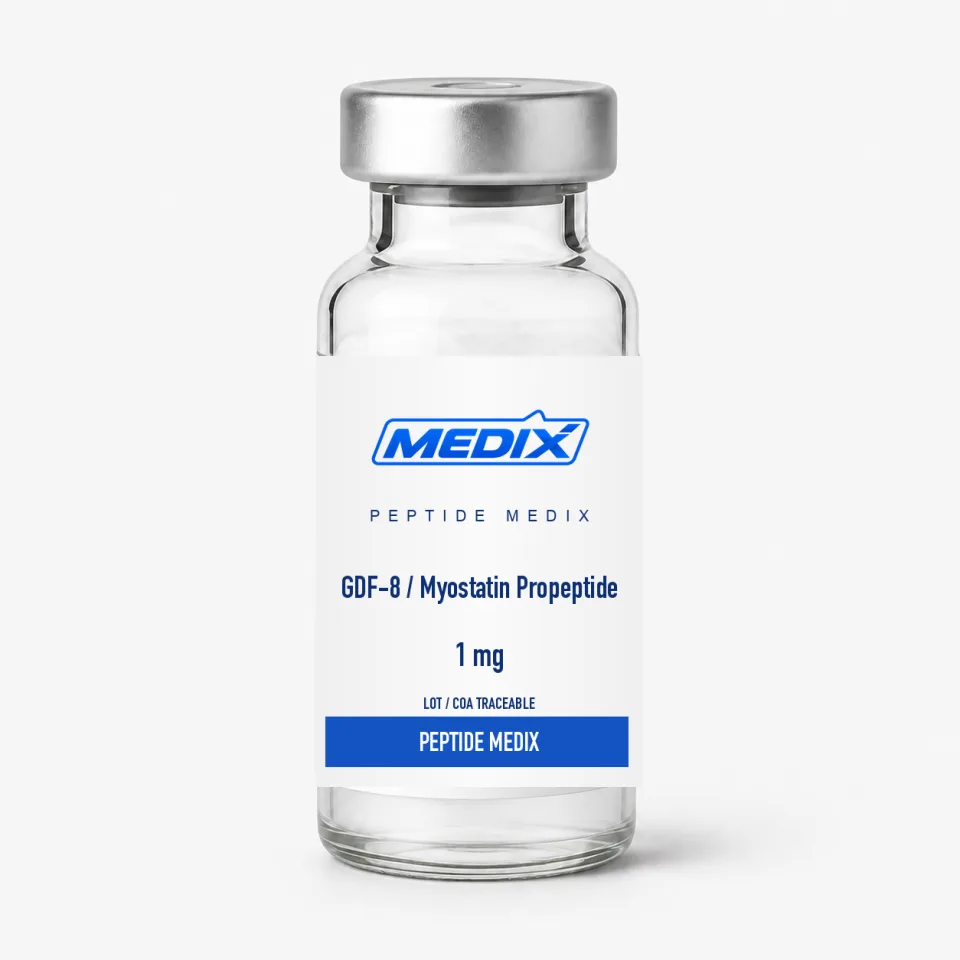
- FormLyophilized recombinant protein in a sealed glass vial
- Research areasMuscle-mass regulation, myostatin-pathway inhibition, cachexia and dystrophy models, bone and metabolic endpoints
Overview
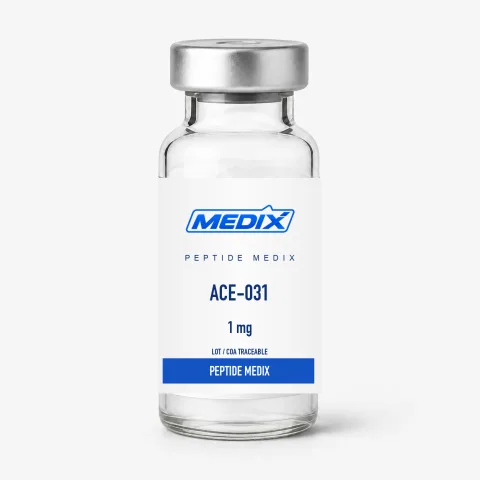
Myostatin is synthesised as a precursor that is cleaved into a mature C-terminal dimer and an N-terminal prodomain, the propeptide. That propeptide does not simply fall away; it stays bound to the mature growth factor and holds it in a latent, receptor-inert complex until it is released by BMP-1/tolloid proteases. Supplying the propeptide on its own is therefore the most physiological way to inhibit myostatin signalling in a model system, which is why it is used as a comparator against engineered traps such as ACE-031 and against follistatin.
Signalling in the axis it interrupts is well mapped. The mature ligand is a disulfide-linked homodimer of 109-residue subunits that binds the type II receptors ActRIIB and ActRIIA, recruits the type I receptors ALK4 and ALK5, and signals through Smad2/3 phosphorylation. Because the propeptide acts on the ligand rather than on the receptor, it leaves other ActRIIB ligands untouched, and that selectivity difference is what makes it a useful parallel arm beside ACE-031, which intercepts a considerably broader set. It is supplied as 1 mg of lyophilized recombinant protein purified to 95% or better by SDS-PAGE and HPLC, reconstituted gently in sterile or bacteriostatic water with a carrier protein added to dilute stocks, and aliquoted before freezing rather than thawed repeatedly.
Specifications
Supply & purity
- Form
- Lyophilized recombinant protein in a sealed glass vial
- Purity
- ≥95% by SDS-PAGE and HPLC; lot-matched COA available
- Available sizes
- 1 mg
- Solubility
- Sterile or bacteriostatic water; carrier protein recommended for dilute stocks
Handling & storage
- Storage (lyophilized)
- −20 °C, sealed and protected from light and moisture
- Storage (reconstituted)
- 2–8 °C for immediate work; aliquot and freeze for longer studies
Additional detail
- Protein class
- TGF-beta superfamily prodomain (latency-associated propeptide)
- Gene
- MSTN, encoding growth differentiation factor 8
- Also known as
- GDF-8 propeptide, myostatin prodomain, latency-associated peptide of myostatin
- Mature ligand it binds
- Myostatin (GDF-8), a disulfide-linked homodimer of 109-residue subunits
- Receptor axis
- ActRIIB / ActRIIA with type I receptors ALK4 and ALK5, signalling through Smad2/3
- Latency release
- Cleavage of the propeptide by BMP-1/tolloid metalloproteinases frees the active dimer
- Research areas
- Muscle-mass regulation, myostatin-pathway inhibition, cachexia and dystrophy models, bone and metabolic endpoints
Working out the concentration
Reconstitution is where the arithmetic lives. The same vial made up with 1 mL or with 3 mL of diluent gives three-fold different numbers, which is why a reconstitution volume calculator is more use here than a fixed table: enter the vial mass and your diluent volume and read the concentration back.
Certificate of analysis
Every lot of GDF-8 / Myostatin Propeptide is released against a certificate of analysis: the batch-specific laboratory data for that lot, not a generic document for the compound. The lot number on the certificate matches the lot number printed on the label you receive — the vial label itself, where the product is vialled — so the record and the material it describes can always be reconciled.
Purity: ≥95% by SDS-PAGE and HPLC — the specification for this listing. The figure for the lot you receive is the one reported on that lot’s certificate.
No lot certificate is on display on this page at the moment. That is a publishing state and not a testing one: lots are released and documented as described above whether or not the document is posted here, and we will send what exists for the lot in stock, or for a lot already on your bench, by its number.
Certificates are available on request before you order as well as after, with no account and no charge. Request the certificate for this listing, read the testing and documentation policy in full, or see how to read a peptide COA.
Questions about GDF-8 / Myostatin Propeptide
What is the difference between GDF-8 and the myostatin propeptide?
GDF-8 is myostatin itself, the mature signalling dimer. The propeptide is the N-terminal prodomain cleaved from the same precursor, which remains bound to the mature dimer and keeps it latent. Researchers use the propeptide as an endogenous inhibitor of the ligand rather than as the ligand.
How does it compare with ACE-031 and Follistatin-344?
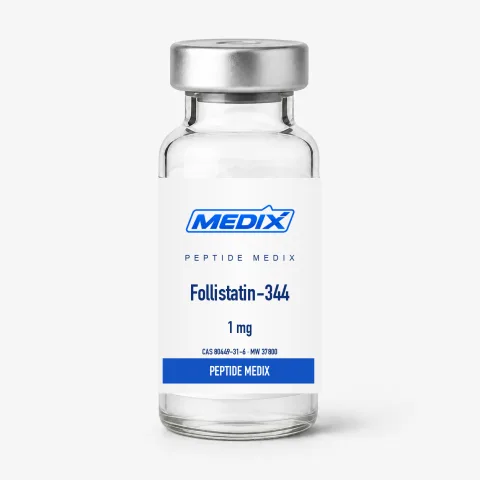
All three intercept signalling in the same axis but at different points. ACE-031 is an engineered soluble ActRIIB receptor that binds a broad ligand set, follistatin is a natural binding protein active against activins and myostatin, and the propeptide is myostatin's own latency domain. Selectivity differs, which is why parallel arms are common.
Is this material third-party tested?
Yes. Each lot is analysed by an independent laboratory, with purity assessed by SDS-PAGE and HPLC and identity confirmed by appropriate protein methods. The certificate of analysis is matched to the lot number printed on your vial and is available on request before or after ordering.
How should the vial be reconstituted and stored?
Sterile or bacteriostatic water added slowly down the vial wall, with gentle swirling and no vortexing. Hold the solution at 2–8 °C for immediate work, or aliquot and freeze for longer studies. Sealed lyophilized vials belong at −20 °C, protected from light and moisture.
Related