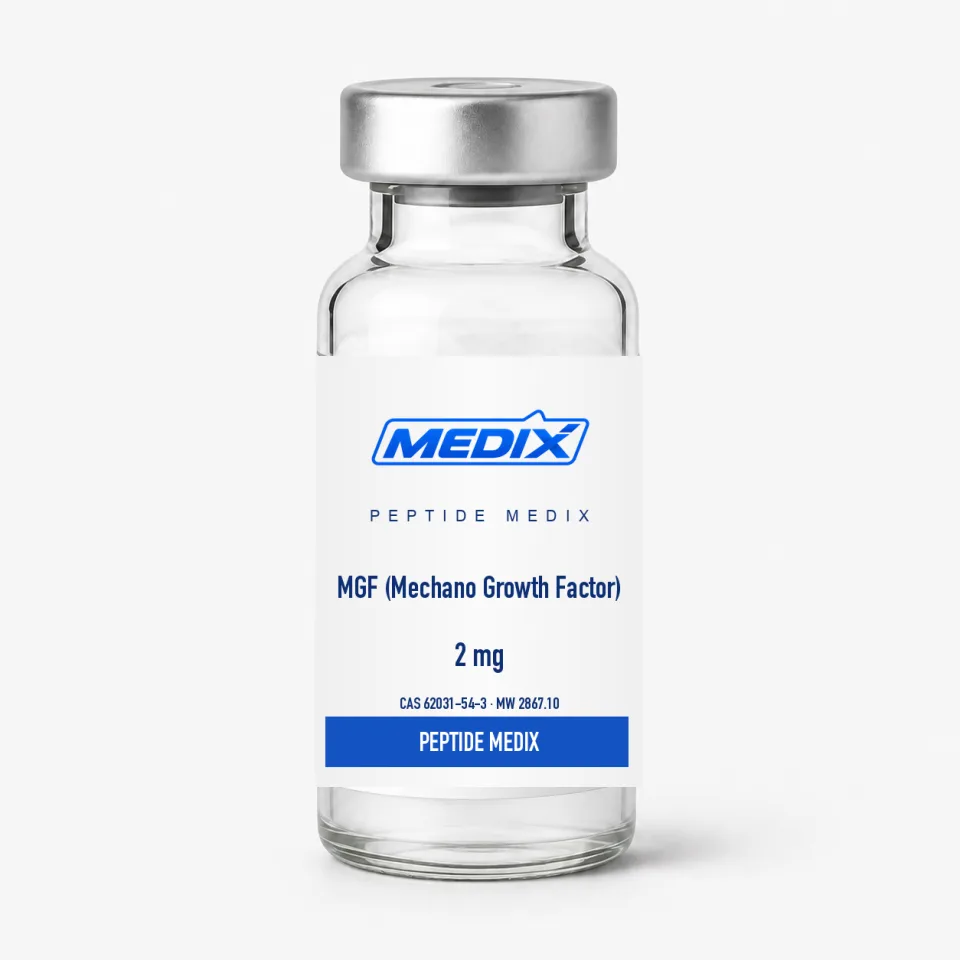
- ≥99% by HPLC
- Lot-matched certificate of analysis
- Ships next business day, tracked
MGF (Mechano Growth Factor)
Mechano Growth Factor, the 24-residue IGF-1 Ec splice-variant peptide
- FormLyophilized powder, sealed glass vial
- Mol. weight2867.10 g/mol
- Research areasSatellite-cell activation, myoblast proliferation, mechanical-load response, tissue repair models
Overview
MGF, or Mechano Growth Factor, is the peptide corresponding to the C-terminal E-domain of IGF-1 Ec — a splice variant of insulin-like growth factor 1 that skeletal muscle expresses transiently after mechanical loading or damage. The research peptide sold here is the 24-amino-acid E-domain fragment on its own, separated from the mature IGF-1 portion of the parent molecule, which is why its behaviour in culture and in animal work is studied independently of classic IGF-1 signalling.
Interest in MGF grew out of exercise-physiology literature showing that the Ec transcript rises sharply in loaded muscle and then falls away within days, tracking the window in which satellite cells are recruited. Because the isolated E-domain does not bind the IGF-1 receptor in the way mature IGF-1 does, several groups have proposed a distinct, receptor-independent mode of action, and that question remains genuinely open in the literature.
Specifications
Identity
- CAS number
- 62031-54-3
- Molecular weight
- 2867.10 g/mol
- Amino acid sequence
- Tyr-Gln-Pro-Pro-Ser-Thr-Asn-Lys-Asn-Thr-Lys-Ser-Gln-Arg-Arg-Lys-Gly-Ser-Thr-Phe-Glu-Glu-Arg-Lys
- Peptide class
- IGF-1 Ec splice-variant E-domain peptide
Supply & purity
- Form
- Lyophilized powder, sealed glass vial
- Purity
- ≥99% by HPLC; lot-matched COA available
- Available sizes
- 2 mg, 5 mg
- Solubility
- Bacteriostatic or sterile water; mildly acidic buffers also used in the literature
Handling & storage
- Storage (lyophilized)
- −20 °C, protected from light and moisture
- Storage (reconstituted)
- 2–8 °C; short working window, aliquot and freeze for longer studies
Additional detail
- Residue count
- 24 amino acids
- Also known as
- Mechano Growth Factor, IGF-1 Ec (E-domain), MGF C-terminal peptide
- Research areas
- Satellite-cell activation, myoblast proliferation, mechanical-load response, tissue repair models
Working out the concentration
A lyophilized vial carries a mass on the label and no concentration anywhere, so the first calculation of any protocol is the reconstitution one. The peptide concentration calculator converts vial mass plus diluent volume into mg/mL, and back into the draw volume for a given mass.
Where a method is written in molar terms instead, the molecular weight above — 2867.10 g/mol — is the input the molarity calculator needs.
Certificate of analysis
Every lot of MGF (Mechano Growth Factor) is released against a certificate of analysis: the batch-specific laboratory data for that lot, not a generic document for the compound. The lot number on the certificate matches the lot number printed on the label you receive — the vial label itself, where the product is vialled — so the record and the material it describes can always be reconciled.
Purity: ≥99% by HPLC — the specification for this listing. The figure for the lot you receive is the one reported on that lot’s certificate.
No lot certificate is on display on this page at the moment. That is a publishing state and not a testing one: lots are released and documented as described above whether or not the document is posted here, and we will send what exists for the lot in stock, or for a lot already on your bench, by its number.
Certificates are available on request before you order as well as after, with no account and no charge. Request the certificate for this listing, read the testing and documentation policy in full, or see how to read a peptide COA.
Questions about MGF (Mechano Growth Factor)
What is MGF and how does it relate to IGF-1?
MGF is the 24-residue C-terminal E-domain of IGF-1 Ec, a splice variant that skeletal muscle expresses after mechanical loading. Researchers study the isolated E-domain separately from mature IGF-1 because it shows little affinity for the IGF-1 receptor and appears to act through a different route.
Is your MGF third-party tested, and can I see the COA?
Yes. Every lot is analysed by an independent laboratory using HPLC, with identity confirmed by mass spectrometry. The certificate of analysis is matched to the lot number printed on your vial and can be requested before or after ordering.
What is the difference between MGF and PEG-MGF?
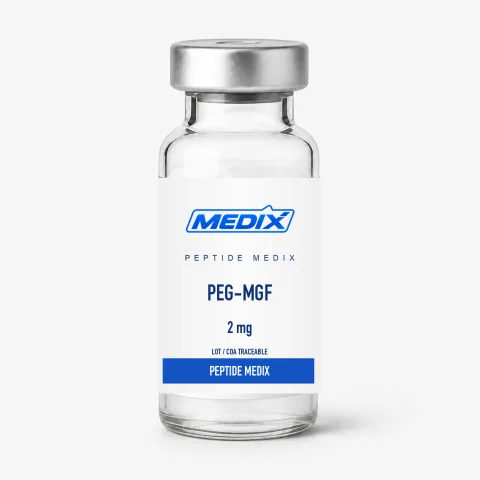
PEG-MGF is the same core peptide with a polyethylene glycol group attached. The PEG chain slows clearance and degradation, which is why the two are often run side by side in study designs that need a longer exposure window than unmodified MGF can provide.
What sizes are available and what is in the vial?
MGF is offered in 2 mg and 5 mg vials. Each contains sterile-filtered lyophilized peptide under a vacuum seal, with no diluent included. Bacteriostatic water and reconstitution supplies are listed separately in our lab supplies section.
How should MGF be stored?
Keep sealed lyophilized vials at −20 °C, protected from light and moisture; they are stable for extended periods under those conditions. Once reconstituted, hold at 2–8 °C and use within a short window, or aliquot and freeze, since MGF degrades faster in solution than most research peptides.
Related