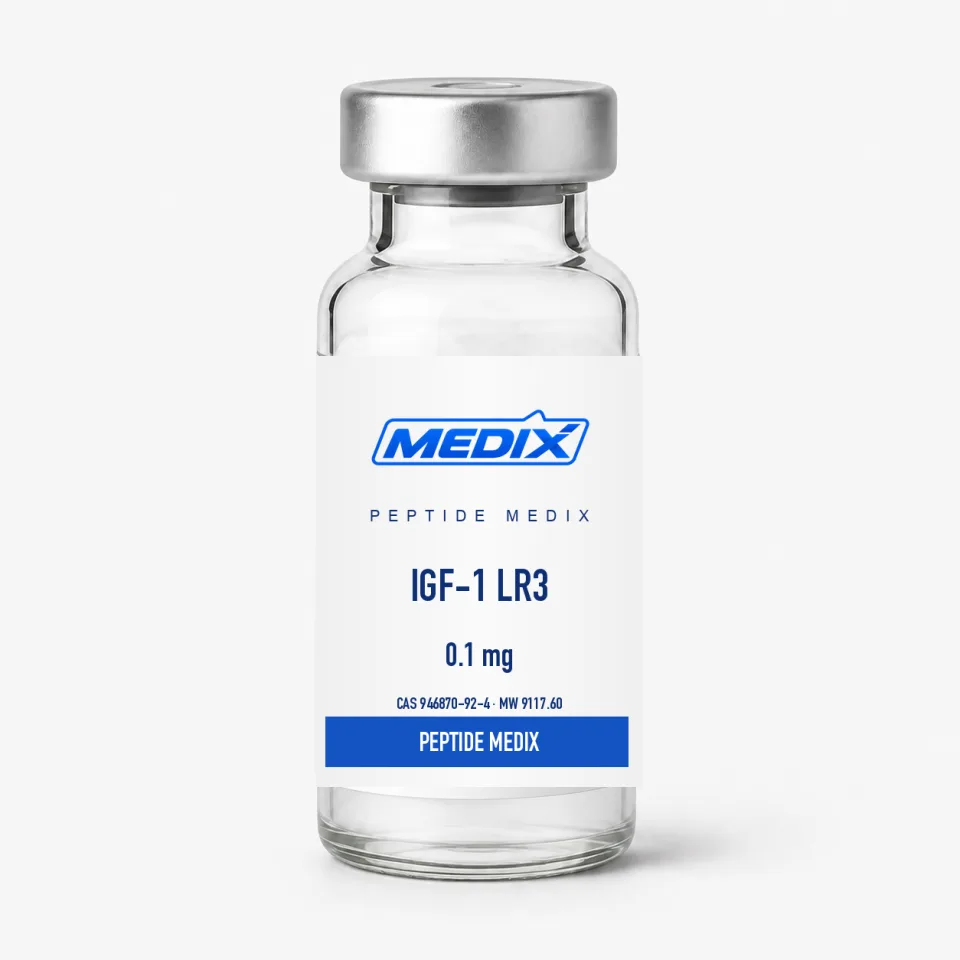
- ≥99% by HPLC
- Lot-matched certificate of analysis
- Ships next business day, tracked
IGF-1 LR3 Peptide
Long R3 IGF-1 — 83-residue recombinant analogue, low IGFBP affinity
- FormLyophilized powder, sealed glass vial
- Mol. weight9117.60 g/mol
- Research areasIGF-1R signalling, myoblast and cell proliferation assays, serum-free culture
Overview
IGF-1 LR3, or Long R3 insulin-like growth factor 1, is an 83-residue recombinant analogue of human IGF-1. Two engineered changes define it: arginine replaces glutamate at position 3, and a 13-amino-acid extension is added to the N-terminus. Together these raise the molecular weight to roughly 9118 g/mol and, more importantly, sharply reduce affinity for the IGF binding proteins that normally sequester more than 95% of circulating IGF-1.
Vials are filled at 0.1 mg and 1 mg, small by the standards of this catalogue, because the analogue is used at nanomolar concentrations in culture and a milligram covers a great many plates. At 9117.60 g/mol, 1 mg is about 110 nanomoles, so reconstituting into 1 mL gives a stock near 110 micromolar that is then diluted several thousand-fold. At those working concentrations adsorption onto plastic tubes and tips becomes a measurable loss, which is why dilute stocks are normally carried in a carrier protein such as 0.1% bovine serum albumin. Published use sits mostly in serum-free and reduced-serum culture, myoblast and other proliferation assays, and IGF-1 receptor signalling work where binding-protein interference from serum would otherwise confound the readout.
Specifications
Identity
- CAS number
- 946870-92-4
- Molecular formula
- C400H625N111O115S9
- Molecular weight
- 9117.60 g/mol
- Chain length
- 83 amino acids (70-residue IGF-1 core plus 13-residue N-terminal extension)
Supply & purity
- Form
- Lyophilized powder, sealed glass vial
- Purity
- ≥99% by HPLC; lot-matched COA available
- Available sizes
- 0.1 mg, 1 mg
Handling & storage
- Storage (lyophilized)
- −20 °C or below, sealed and protected from light and moisture
Additional detail
- Also known as
- Long R3 IGF-1, LR3 IGF-1
- Key modifications
- Arg substituted for Glu at position 3; N-terminal 13-residue extension
- Protein class
- Recombinant insulin-like growth factor analogue
- Primary target
- IGF-1 receptor (IGF-1R), a receptor tyrosine kinase
- Research areas
- IGF-1R signalling, myoblast and cell proliferation assays, serum-free culture
Working out the concentration
IGF-1 LR3 ships as a lyophilized powder, so nothing on this page can state a concentration: the figure you work with is the one you create when you add diluent. Put the vial mass and the volume you intend to use into the peptide reconstitution calculator and it returns mg/mL, mcg/mL and the mass sitting at each mark on a U-100 syringe.
Certificate of analysis
Every lot of IGF-1 LR3 is released against a certificate of analysis: the batch-specific laboratory data for that lot, not a generic document for the compound. The lot number on the certificate matches the lot number printed on the label you receive — the vial label itself, where the product is vialled — so the record and the material it describes can always be reconciled.
Purity: ≥99% by HPLC — the specification for this listing. The figure for the lot you receive is the one reported on that lot’s certificate.
No lot certificate is on display on this page at the moment. That is a publishing state and not a testing one: lots are released and documented as described above whether or not the document is posted here, and we will send what exists for the lot in stock, or for a lot already on your bench, by its number.
Certificates are available on request before you order as well as after, with no account and no charge. Request the certificate for this listing, read the testing and documentation policy in full, or see how to read a peptide COA.
Questions about IGF-1 LR3
What is IGF-1 LR3?
IGF-1 LR3 is an 83-amino-acid recombinant analogue of insulin-like growth factor 1, carrying an Arg3 substitution and a 13-residue N-terminal extension. Both changes reduce IGF binding protein affinity, making it a dependable IGF-1 receptor agonist in cell culture.
How does it compare with IGF-1 DES(1-3)?
Both evade IGF binding proteins, but by different routes. DES(1-3) removes the first three N-terminal residues, while LR3 substitutes Arg at position 3 and adds an extension. LR3 is larger and generally reported to have the longer working stability.
Is a Certificate of Analysis provided?
Yes. Each lot is third-party tested by HPLC for ≥99% purity and identity, with a lot-matched Certificate of Analysis available on request. Verify the lot number on your vial against the certificate before entering the material into your laboratory records.
Why is a carrier protein recommended?
At the low concentrations typical of cell culture, proteins adsorb onto plastic tubes and pipette tips, silently lowering the delivered amount. Adding a carrier such as 0.1% BSA to dilute working stocks occupies those surfaces and preserves the concentration you intend to apply.
Related