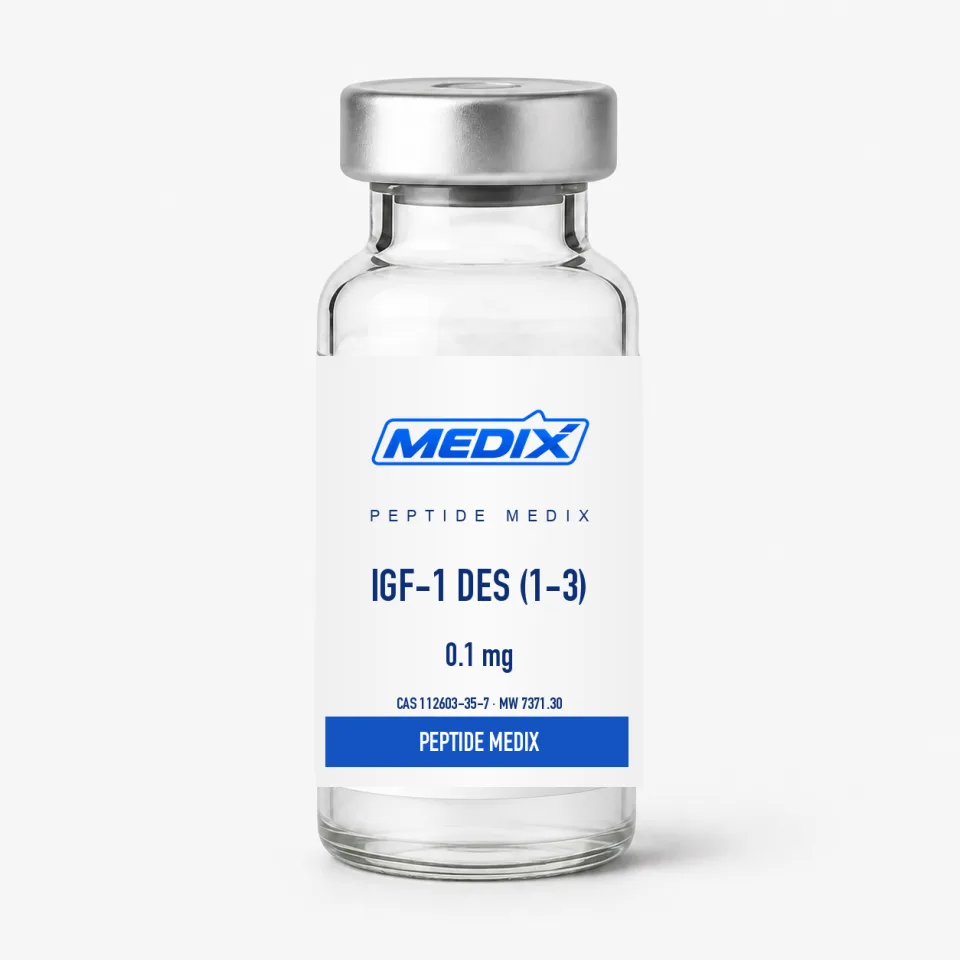
- ≥99% by HPLC
- Lot-matched certificate of analysis
- Ships next business day, tracked
IGF-1 DES (1-3)
DES(1-3) IGF-1 — 67-residue truncated analogue, low IGFBP affinity
- FormLyophilized powder, sealed glass vial
- Mol. weight7371.30 g/mol
- Research areasIGF-1R signalling, myoblast differentiation, binding-protein-independent assays
Overview
IGF-1 DES(1-3) is a truncated analogue of insulin-like growth factor 1 in which the first three N-terminal residues — glycine, proline and glutamate — have been removed, leaving a 67-amino-acid chain of roughly 7371 g/mol. Unlike most engineered analogues, DES(1-3) is not purely synthetic in origin: it was first identified as a naturally occurring form isolated from bovine colostrum and human brain tissue, produced by a specific protease acting on native IGF-1.
Deleting the Glu3 residue removes a critical contact point for the IGF binding proteins, and the resulting analogue has been reported to bind IGFBPs with dramatically lower affinity than intact IGF-1 while retaining full activity at the IGF-1 receptor. In binding-protein-rich systems such as serum-containing culture media, that translates into substantially greater apparent potency, which is why DES(1-3) became a standard tool for probing IGF-1 receptor signalling without binding-protein interference.
Specifications
Identity
- CAS number
- 112603-35-7
- Molecular weight
- 7371.30 g/mol
- Chain length
- 67 amino acids (native IGF-1 minus the N-terminal Gly-Pro-Glu)
Supply & purity
- Form
- Lyophilized powder, sealed glass vial
- Purity
- ≥99% by HPLC; lot-matched COA available
- Available sizes
- 0.1 mg, 1 mg
Handling & storage
- Storage (lyophilized)
- −20 °C or below, sealed and protected from light and moisture
Additional detail
- Also known as
- DES(1-3) IGF-1, IGF-1 DES, des-Gly-Pro-Glu IGF-1
- Key modification
- Deletion of residues 1–3, removing the Glu3 IGFBP contact
- Protein class
- Truncated insulin-like growth factor analogue
- Primary target
- IGF-1 receptor (IGF-1R), a receptor tyrosine kinase
- Origin note
- Also occurs naturally; first isolated from bovine colostrum and brain tissue
- Research areas
- IGF-1R signalling, myoblast differentiation, binding-protein-independent assays
Working out the concentration
Reconstitution is where the arithmetic lives. The same vial made up with 1 mL or with 3 mL of diluent gives three-fold different numbers, which is why a reconstitution volume calculator is more use here than a fixed table: enter the vial mass and your diluent volume and read the concentration back.
Certificate of analysis
Every lot of IGF-1 DES (1-3) is released against a certificate of analysis: the batch-specific laboratory data for that lot, not a generic document for the compound. The lot number on the certificate matches the lot number printed on the label you receive — the vial label itself, where the product is vialled — so the record and the material it describes can always be reconciled.
Purity: ≥99% by HPLC — the specification for this listing. The figure for the lot you receive is the one reported on that lot’s certificate.
No lot certificate is on display on this page at the moment. That is a publishing state and not a testing one: lots are released and documented as described above whether or not the document is posted here, and we will send what exists for the lot in stock, or for a lot already on your bench, by its number.
Certificates are available on request before you order as well as after, with no account and no charge. Request the certificate for this listing, read the testing and documentation policy in full, or see how to read a peptide COA.
Questions about IGF-1 DES (1-3)
What is IGF-1 DES(1-3)?
It is a 67-amino-acid analogue of insulin-like growth factor 1 missing the first three N-terminal residues, Gly-Pro-Glu. That deletion greatly reduces binding to IGF binding proteins while retaining activity at the IGF-1 receptor, making it a useful in vitro research tool.
Why is DES(1-3) more potent in culture?
Its potency advantage is contextual rather than intrinsic. Native IGF-1 is largely captured by binding proteins present in serum and secreted by cells, whereas DES(1-3) escapes that sequestration, so more of what is added actually reaches the receptor.
How does it differ from IGF-1 LR3?
Both evade IGF binding proteins, but LR3 substitutes Arg at position 3 and adds a 13-residue N-terminal extension, while DES(1-3) simply deletes the first three residues. LR3 is larger and generally reported to have the longer functional window.
Does it occur naturally?
Yes. DES(1-3) IGF-1 was first isolated from bovine colostrum and human brain tissue, where it appears to be generated by proteolytic processing of intact IGF-1. That natural origin distinguishes it from purely engineered analogues in the same product class.
Is the purity third-party verified?
Yes. Every lot is analysed by an independent laboratory using HPLC to confirm ≥99% purity and identity, and a lot-matched Certificate of Analysis is available on request. Check the lot number on your vial against the certificate.
Related