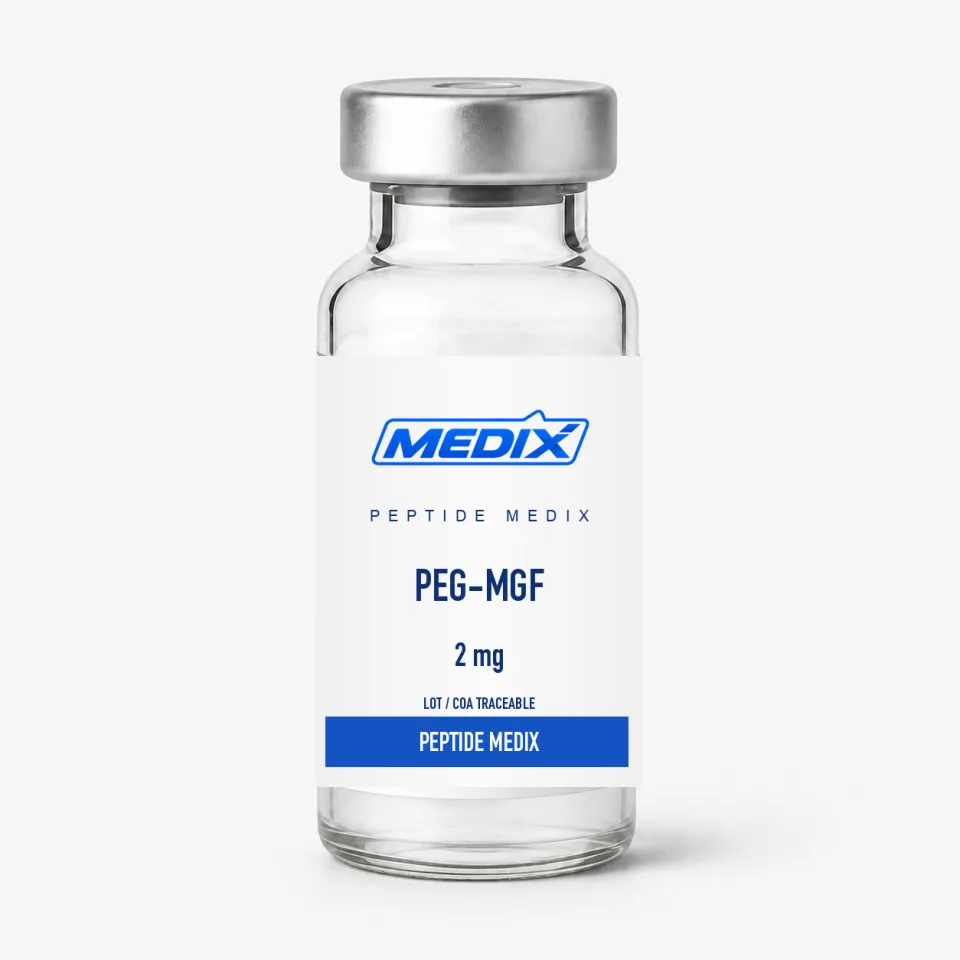
- ≥99% by HPLC
- Lot-matched certificate of analysis
- Ships next business day, tracked
PEG-MGF
PEGylated Mechano Growth Factor with extended in-solution stability
- FormLyophilized powder, sealed glass vial
- Mol. weightVaries with PEG chain length; stated on the lot certificate of analysis
- Research areasSkeletal-muscle remodelling, satellite-cell activation, repair kinetics, peptide half-life comparison
Overview
That difference is the entire reason PEG-MGF exists as a separate research article. Unmodified MGF is notoriously short-lived, which makes it awkward to use in whole-animal designs where a sustained exposure is needed. Investigators working on skeletal-muscle remodelling, satellite-cell dynamics and post-injury repair frequently run the two forms in parallel so that peptide half-life becomes a controlled variable rather than a confound.
Peptide Medix supplies PEG-MGF as a lyophilized powder in a sealed glass vial, third-party tested by HPLC with a lot-matched certificate of analysis. Because PEGylation is a heterogeneous process, molecular weight varies with PEG chain length and is stated on the certificate for each lot rather than being quoted as a single fixed figure. Sold for laboratory research only.
Specifications
Identity
- Molecular weight
- Varies with PEG chain length; stated on the lot certificate of analysis
- Peptide class
- PEGylated IGF-1 splice-variant E-domain peptide
Supply & purity
- Form
- Lyophilized powder, sealed glass vial
- Purity
- ≥99% by HPLC; lot-matched COA available
- Available sizes
- 2 mg, 5 mg
- Solubility
- Bacteriostatic or sterile water; PEGylation improves aqueous handling
Handling & storage
- Storage (lyophilized)
- −20 °C, protected from light and moisture
- Storage (reconstituted)
- 2–8 °C for short-term work; aliquot and freeze for longer studies
Additional detail
- Core peptide
- MGF, the 24-residue C-terminal E-domain of IGF-1 Ec
- Core amino acid sequence
- Tyr-Gln-Pro-Pro-Ser-Thr-Asn-Lys-Asn-Thr-Lys-Ser-Gln-Arg-Arg-Lys-Gly-Ser-Thr-Phe-Glu-Glu-Arg-Lys
- Modification
- Covalently attached polyethylene glycol (PEG) chain
- Research areas
- Skeletal-muscle remodelling, satellite-cell activation, repair kinetics, peptide half-life comparison
Working out the concentration
A lyophilized vial carries a mass on the label and no concentration anywhere, so the first calculation of any protocol is the reconstitution one. The peptide concentration calculator converts vial mass plus diluent volume into mg/mL, and back into the draw volume for a given mass.
Certificate of analysis
Every lot of PEG-MGF is released against a certificate of analysis: the batch-specific laboratory data for that lot, not a generic document for the compound. The lot number on the certificate matches the lot number printed on the label you receive — the vial label itself, where the product is vialled — so the record and the material it describes can always be reconciled.
Purity: ≥99% by HPLC — the specification for this listing. The figure for the lot you receive is the one reported on that lot’s certificate.
No lot certificate is on display on this page at the moment. That is a publishing state and not a testing one: lots are released and documented as described above whether or not the document is posted here, and we will send what exists for the lot in stock, or for a lot already on your bench, by its number.
Certificates are available on request before you order as well as after, with no account and no charge. Request the certificate for this listing, read the testing and documentation policy in full, or see how to read a peptide COA.
Questions about PEG-MGF
What is the difference between PEG-MGF and MGF?
The peptide sequence is identical — both are the 24-residue IGF-1 Ec E-domain. PEG-MGF carries a polyethylene glycol chain that slows proteolysis and renal clearance, giving a much longer window of availability. Researchers usually choose between them based on the exposure duration a study design requires.
Why is no single molecular weight listed?
PEGylation attaches a polymer that itself has a mass distribution, so PEG-MGF is a family of closely related species rather than one exact molecular weight. The lot certificate of analysis reports the peptide content and the PEG specification for the material you receive.
Is this product third-party tested?
Yes. Each lot is tested by an independent laboratory with HPLC for purity and mass spectrometry for identity of the core peptide. The resulting certificate of analysis is matched to the lot number on your vial and available on request.
What is in the vial and what else do I need?
The vial contains only sterile-filtered lyophilized PEG-MGF under a vacuum seal — no diluent, syringes or filters are included. Bacteriostatic water and reconstitution supplies are listed separately in our lab supplies category.
How stable is PEG-MGF once reconstituted?
More stable than unmodified MGF, but still a peptide in aqueous solution. Hold reconstituted material at 2–8 °C for short-term work, protect it from light and repeated warming, and aliquot then freeze for anything running longer than a few days.
Related