- Lot-matched certificate of analysis
- Ships next business day, tracked
Prescription Biologics (Reference Listings)
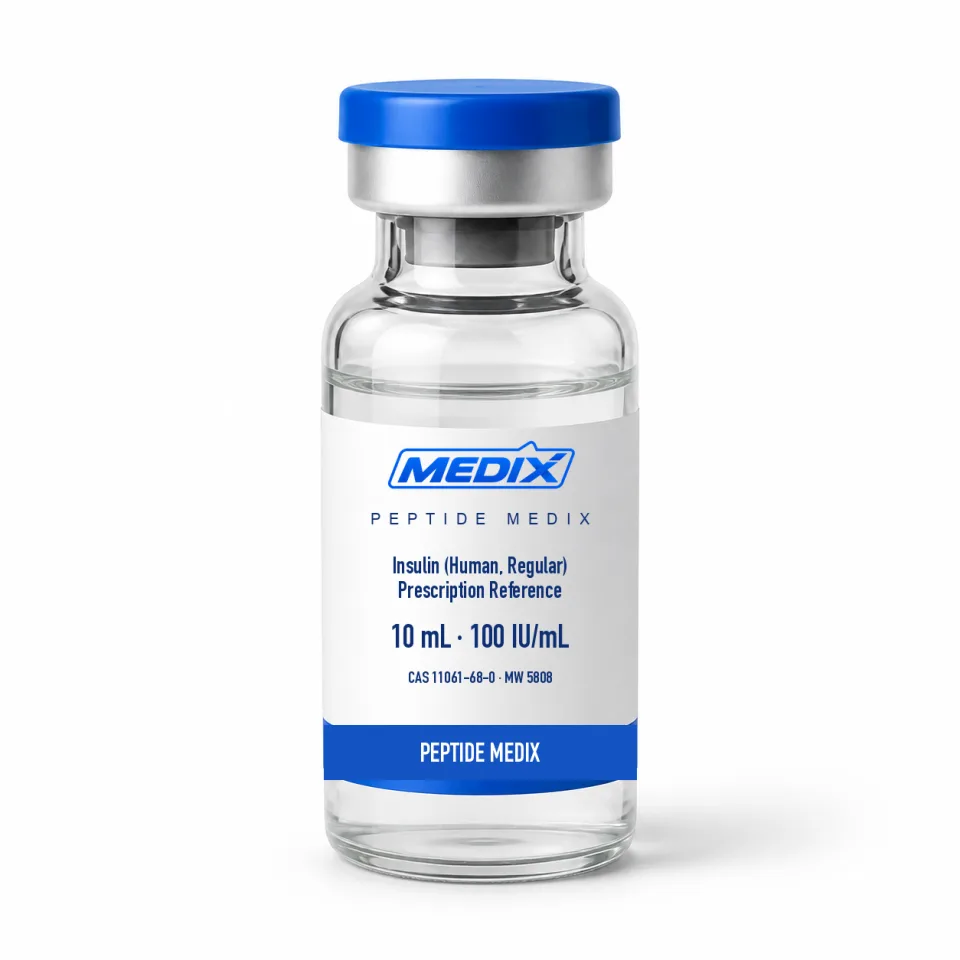
Insulin (Human, Regular) — Prescription Reference
Recombinant human insulin, short-acting — prescription-only reference listing
- Mol. weight≈5,808 Da (monomer)
Overview
Prescription-only reference listing. Regular human insulin is a prescription biologic medicine. It appears in this institutional catalogue as a reference entry so that clinics, pharmacies and laboratories can identify the molecule, its presentation, its approved indication and its cold-chain requirements. Product is supplied only against a valid prescription or documented institutional authorisation, and this page provides no dosing, titration, administration or sourcing guidance of any kind.
Structurally, human insulin is a small two-chain protein of 51 amino acids: an A chain of 21 residues and a B chain of 30 residues, held together by two interchain disulfide bonds with a third disulfide bridging within the A chain. The monomer has a molecular weight of about 5,808 Da, though in the concentrated, zinc-containing environment of a vial the protein exists largely as hexamers that dissociate to dimers and monomers on dilution. Modern product is made by recombinant DNA technology in Escherichia coli or Saccharomyces cerevisiae and is sequence-identical to the hormone secreted by pancreatic beta cells.
Specifications
Identity
- CAS number
- 11061-68-0
- Molecular formula
- C257H383N65O77S6
- Molecular weight
- ≈5,808 Da (monomer)
Additional detail
- Regulatory status
- Prescription-only biologic medicine (Rx); supplied solely against valid prescription or institutional authorisation
- Generic name
- Insulin human (rDNA origin), regular
- Also known as
- Soluble insulin, neutral insulin, regular human insulin, U-100 insulin
- Structure
- A chain of 21 residues and B chain of 30 residues joined by two interchain disulfide bonds, plus one intrachain A6–A11 bond
- Production
- Recombinant DNA technology in Escherichia coli or Saccharomyces cerevisiae
- Molecular target
- Insulin receptor (α2β2 receptor tyrosine kinase); IRS-1/2, PI3K/Akt signalling
- Principal actions
- GLUT4 translocation in muscle and adipose tissue, suppression of hepatic glucose output, glycogen and lipid storage
- Concentration
- 100 IU/mL (U-100); 1 mg of insulin human corresponds to approximately 28.8 IU
- Storage
- Unopened vials 2–8 °C, do not freeze, protect from light; in-use storage per the approved labelling
- Intended use
- Reference listing only — prescription medicine, not supplied for non-prescribed use
Certificate of analysis
Every lot of Insulin (Human, Regular) — Prescription Reference is released against its own lot documentation, and where the manufacturer issues a certificate of analysis for it, that certificate is the record for the lot rather than a generic document for the compound. The lot number on the certificate matches the lot number printed on the label you receive — the vial label itself, where the product is vialled — so the record and the material it describes can always be reconciled.
This listing carries no purity percentage, so none is claimed for it here. Where the manufacturer issues analytical documentation for a lot of this item, it is passed on unaltered — ask and we will send whatever exists.
No lot certificate is on display on this page at the moment. That is a publishing state and not a testing one: lots are released and documented as described above whether or not the document is posted here, and we will send what exists for the lot in stock, or for a lot already on your bench, by its number.
Certificates are available on request before you order as well as after, with no account and no charge. Request the certificate for this listing, read the testing and documentation policy in full, or see how to read a peptide COA.
Questions about Insulin (Human, Regular) — Prescription Reference
Is this insulin supplied without a prescription?
No. This is a prescription-only reference listing, supplied solely against a valid prescription or documented institutional authorisation. Classification of specific human insulin products has varied historically between jurisdictions and US states, but nothing on this page constitutes a supply route, and no product is released without valid authorisation.
How does insulin act at the receptor?
It binds the extracellular α subunits of the insulin receptor, an α2β2 receptor tyrosine kinase. The β subunits trans-autophosphorylate and recruit IRS proteins; the PI3K/Akt branch drives GLUT4 translocation in muscle and fat, activates glycogen synthase and suppresses hepatic glucose output, while the MAPK branch handles growth-related transcription.
How does "regular" insulin differ from rapid-acting analogues?
Regular insulin is the unmodified human sequence and self-associates into zinc hexamers in the vial, which must dissociate before absorption. Rapid-acting analogues such as lispro and aspart carry sequence changes that weaken self-association, so they disperse to monomers faster. NPH is a protamine suspension with a slower profile again.
Why is it in a catalogue alongside research peptides?
As a descriptive reference entry. Insulin is a standard reference protein in endocrine and metabolic literature and a routine control in receptor and glucose-uptake assays, so it is catalogued for identification. That listing does not change its status: it remains a prescription biologic supplied only on valid authorisation.
Do you provide dosing information?
No. Insulin dosing, titration, timing and route are individualised and determined by the prescribing clinician using the approved labelling. This listing is limited to identity, chemistry, mechanism, approved indication, presentation and storage requirements, and offers no administration guidance.
Related