- Lot-matched certificate of analysis
- Ships next business day, tracked
Prescription Biologics (Reference Listings)
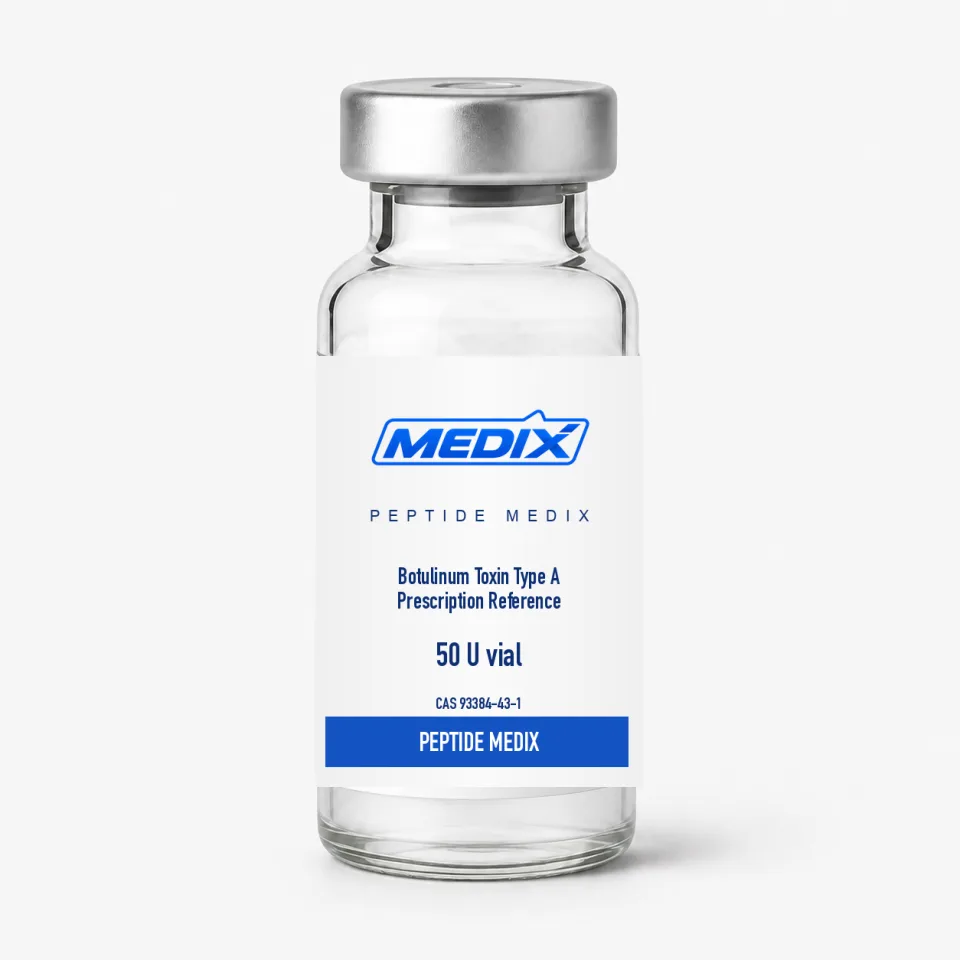
Botulinum Toxin Type A — Prescription Reference
Clostridial neurotoxin, SNAP-25 protease — prescription-only reference listing
- FormSterile vacuum-dried or lyophilised powder in a single-use glass vial, reconstituted before use
- Mol. weight≈150 kDa neurotoxin; commonly supplied as a ~900 kDa complex with non-toxic accessory proteins, or complex-free
Overview
The active substance is botulinum neurotoxin serotype A, produced by the anaerobic bacterium Clostridium botulinum. The purified neurotoxin is a roughly 150 kDa dichain protein: a 100 kDa heavy chain responsible for neuronal binding and translocation, disulfide-linked to a 50 kDa light chain that is a zinc-dependent endopeptidase. In most commercial presentations the neurotoxin is associated with non-toxic accessory proteins in a larger complex, although a purified complex-free formulation also exists.
A point that matters for identification: potency is expressed in Units defined by each manufacturer's own mouse assay, so Units are product-specific and are not interchangeable between brands. The 50 U and 100 U presentations listed here are reference descriptions of vial strength only. Listed for reference.
Specifications
Identity
- CAS number
- 93384-43-1
- Molecular weight
- ≈150 kDa neurotoxin; commonly supplied as a ~900 kDa complex with non-toxic accessory proteins, or complex-free
Supply & purity
- Form
- Sterile vacuum-dried or lyophilised powder in a single-use glass vial, reconstituted before use
Additional detail
- Regulatory status
- Prescription-only biologic medicine (Rx); supplied solely against valid prescription or institutional authorisation
- Active substance
- Botulinum neurotoxin type A (BoNT/A)
- Source organism
- Clostridium botulinum, anaerobic culture and purification
- Structure
- Dichain protein — 100 kDa heavy chain and 50 kDa light chain joined by an interchain disulfide bond
- Molecular target
- SNAP-25, cleaved by the zinc-dependent endopeptidase light chain
- Pharmacological effect
- Blocks calcium-dependent acetylcholine release at cholinergic nerve terminals
- Potency units
- Units defined by a manufacturer-specific mouse LD50 assay; not interchangeable between products
- Reference sizes listed
- 50 U vial; 100 U vial
- Storage
- Cold chain per approved labelling — unopened vials refrigerated at 2–8 °C (some presentations frozen); reconstituted product refrigerated and used within the labelled window
- Intended use
- Reference listing only — prescription medicine, administered exclusively by qualified clinicians
Certificate of analysis
Every lot of Botulinum Toxin Type A — Prescription Reference is released against its own lot documentation, and where the manufacturer issues a certificate of analysis for it, that certificate is the record for the lot rather than a generic document for the compound. The lot number on the certificate matches the lot number printed on the label you receive — the vial label itself, where the product is vialled — so the record and the material it describes can always be reconciled.
This listing carries no purity percentage, so none is claimed for it here. Where the manufacturer issues analytical documentation for a lot of this item, it is passed on unaltered — ask and we will send whatever exists.
No lot certificate is on display on this page at the moment. That is a publishing state and not a testing one: lots are released and documented as described above whether or not the document is posted here, and we will send what exists for the lot in stock, or for a lot already on your bench, by its number.
Certificates are available on request before you order as well as after, with no account and no charge. Request the certificate for this listing, read the testing and documentation policy in full, or see how to read a peptide COA.
Questions about Botulinum Toxin Type A — Prescription Reference
Is botulinum toxin available without a prescription?
No. It is a prescription-only biologic that must be administered by a qualified clinician, and in the United States the neurotoxin is additionally a regulated select agent above defined amounts. This page is a reference listing; product is supplied only against a valid prescription or documented institutional authorisation.
How does it stop muscle contraction?
The heavy chain binds SV2 and ganglioside receptors on cholinergic nerve terminals and the toxin is endocytosed. Vesicle acidification translocates the light chain into the cytosol, where this zinc endopeptidase cleaves SNAP-25. Without intact SNAP-25 the SNARE complex cannot fuse vesicles, so acetylcholine release is blocked.
Are Units the same across different brands?
No. Potency Units are defined by each manufacturer's own mouse assay, so a Unit of one product is not equivalent to a Unit of another. Approved labelling states explicitly that Units cannot be converted or compared between botulinum toxin products, which is why brand identity always accompanies a Unit figure.
Related