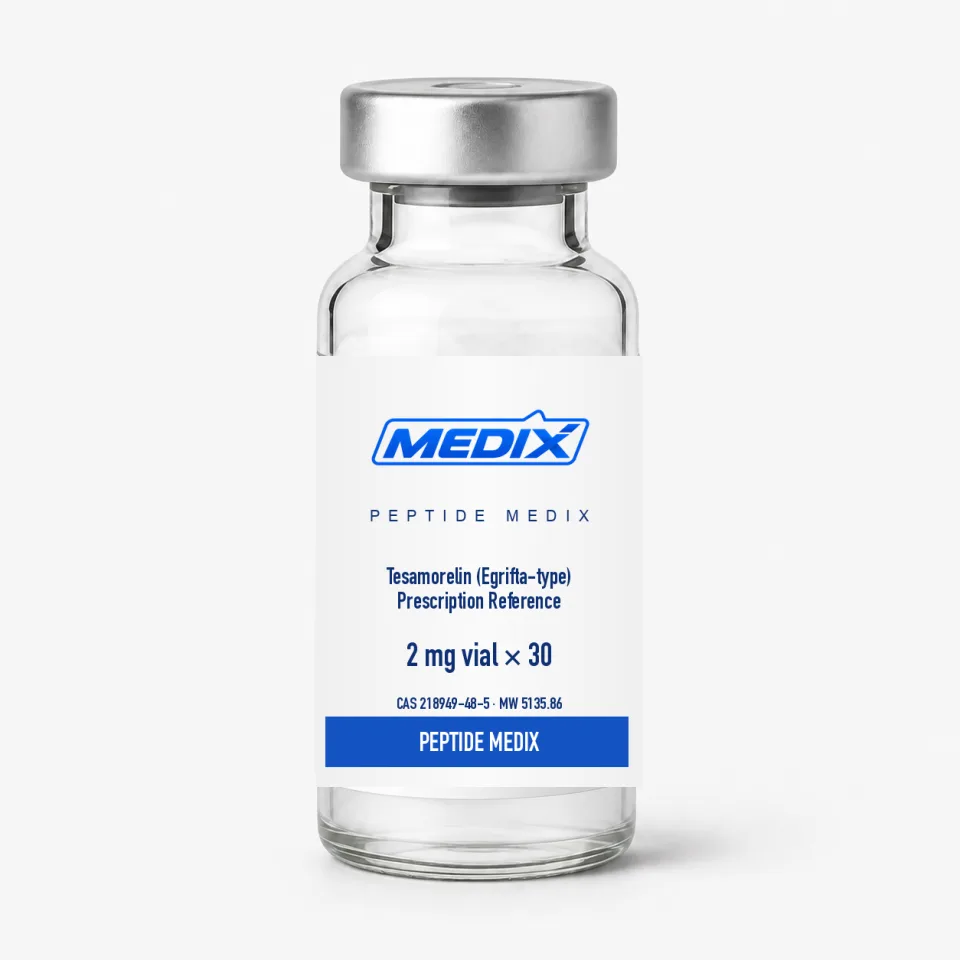
- Lot-matched certificate of analysis
- Ships next business day, tracked
Prescription Biologics (Reference Listings)
Tesamorelin (Egrifta-type) — Prescription Reference
GHRH(1–44) analogue, pharmaceutical grade — prescription-only reference listing
- Mol. weight5,135.86 g/mol
Overview
Prescription-only reference listing. This entry describes the pharmaceutical-grade, approved formulation of tesamorelin — the Egrifta family of products — rather than research-grade material. It appears in this institutional catalogue so that clinics and pharmacies can identify the molecule, its single approved indication, its presentation and its storage requirements. Product is supplied only against a valid prescription or documented institutional authorisation, and no dosing, administration or sourcing guidance appears on this page.
Tesamorelin is a synthetic analogue of human growth hormone-releasing hormone, retaining the full 44-residue GHRH sequence with a trans-3-hexenoyl group attached to the N-terminal tyrosine. That acyl cap sits at the site where dipeptidyl peptidase-4 cleaves native GHRH, and it is the structural basis for the molecule's improved stability. Supplied as the acetate salt, the peptide has a molecular weight of 5,135.86 g/mol and the formula C221H366N72O67S.
Specifications
Identity
- CAS number
- 218949-48-5
- Molecular formula
- C221H366N72O67S
- Molecular weight
- 5,135.86 g/mol
- Peptide class
- Growth hormone-releasing hormone (GHRH) analogue; growth hormone secretagogue
Additional detail
- Regulatory status
- Prescription-only medicine (Rx); supplied solely against valid prescription or institutional authorisation
- Generic name
- Tesamorelin acetate
- Approved brand family
- Egrifta, Egrifta SV and Egrifta WR formulations
- Structure
- Full 44-residue human GHRH sequence with a trans-3-hexenoyl group on the N-terminal tyrosine
- Molecular target
- GHRH receptor on anterior pituitary somatotrophs
- Downstream marker
- Endogenous pulsatile growth hormone release, with a consequent rise in IGF-1
- Approved indication
- Reduction of excess abdominal fat in adults with HIV infection and lipodystrophy
- Reference size listed
- 2 mg vial × 30
- Storage
- Per the approved labelling for the specific formulation — some presentations require 2–8 °C refrigeration, later reformulations are stable at controlled room temperature; reconstituted solution used per labelling
Certificate of analysis
Every lot of Tesamorelin (Egrifta-type) — Prescription Reference is released against its own lot documentation, and where the manufacturer issues a certificate of analysis for it, that certificate is the record for the lot rather than a generic document for the compound. The lot number on the certificate matches the lot number printed on the label you receive — the vial label itself, where the product is vialled — so the record and the material it describes can always be reconciled.
This listing carries no purity percentage, so none is claimed for it here. Where the manufacturer issues analytical documentation for a lot of this item, it is passed on unaltered — ask and we will send whatever exists.
No lot certificate is on display on this page at the moment. That is a publishing state and not a testing one: lots are released and documented as described above whether or not the document is posted here, and we will send what exists for the lot in stock, or for a lot already on your bench, by its number.
Certificates are available on request before you order as well as after, with no account and no charge. Request the certificate for this listing, read the testing and documentation policy in full, or see how to read a peptide COA.
Questions about Tesamorelin (Egrifta-type) — Prescription Reference
Is tesamorelin available without a prescription?
No. The pharmaceutical formulation described here is a prescription-only medicine. This page is a reference listing in an institutional catalogue, covering identity, pharmacology, approved indication and storage; product is supplied only against a valid prescription or documented institutional authorisation, and no supply route is offered here.
How does it differ from growth hormone itself?
Tesamorelin acts upstream. It is a GHRH receptor agonist on pituitary somatotrophs, so growth hormone is released from the patient's own pituitary in a pulsatile pattern that remains subject to IGF-1 and somatostatin feedback. Somatropin is exogenous growth hormone administered directly, bypassing that regulatory loop.
What does the trans-3-hexenoyl group do?
It caps the N-terminal tyrosine of the full 44-residue GHRH sequence, at the position where dipeptidyl peptidase-4 cleaves and inactivates native GHRH. The hydrophobic group sterically hinders that cleavage while leaving the receptor-binding region of the peptide unchanged, which is the basis of the molecule's improved stability.
Why do storage instructions vary between presentations?
Because the formulation has been revised over time. Earlier vial presentations required refrigeration at 2–8 °C, while later reformulations were developed for stability at controlled room temperature, with different reconstitution volumes and vial strengths. The approved labelling for the specific product on hand is the governing reference.
Related