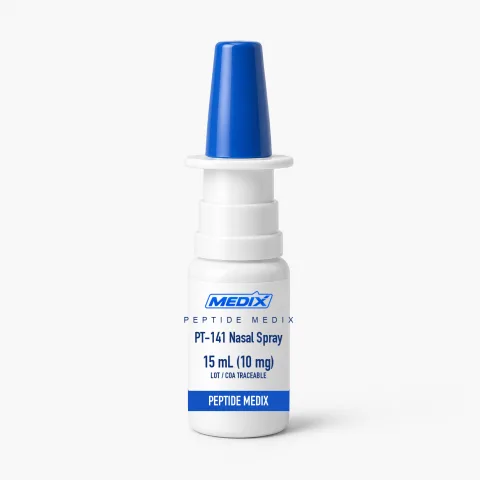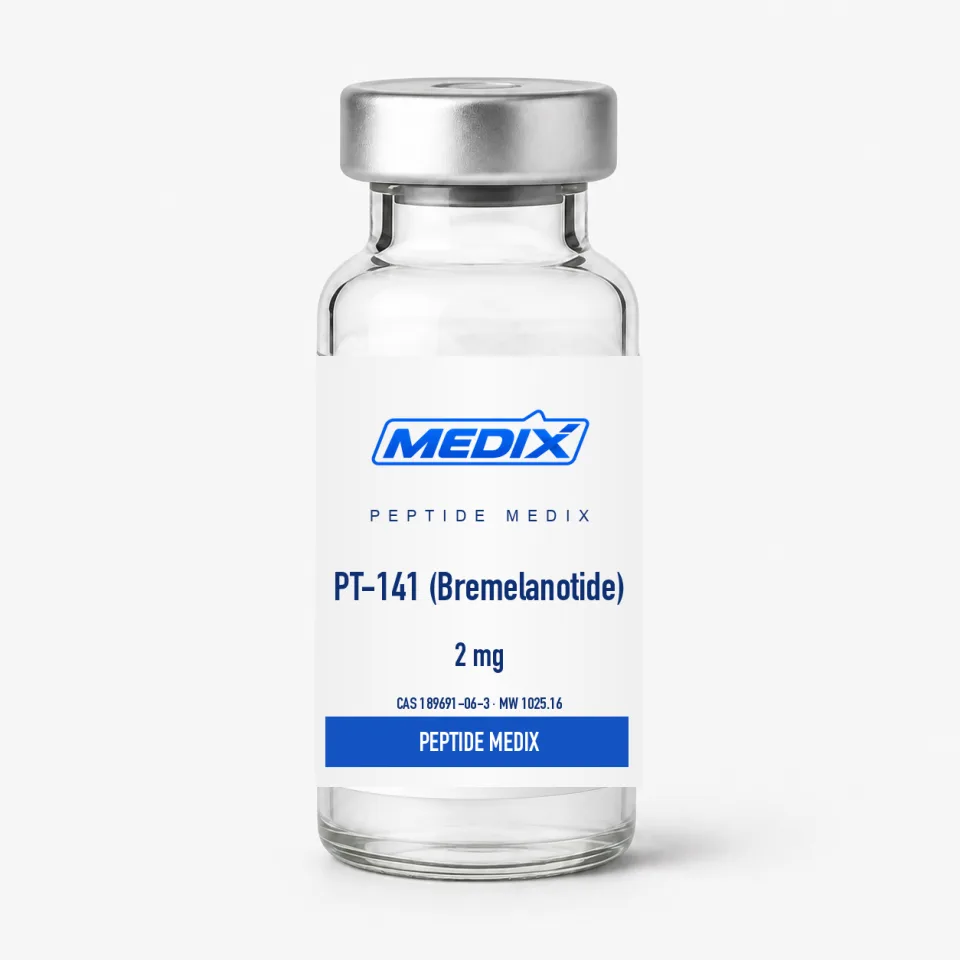
- ≥99% by HPLC
- Lot-matched certificate of analysis
- Ships next business day, tracked
Sexual Health & Hormonal Peptides
PT-141 (Bremelanotide) Peptide
Bremelanotide — cyclic heptapeptide melanocortin receptor agonist
- FormLyophilized white to off-white powder, sealed glass vial
- Mol. weight1025.16 g/mol
- Research areasCentral sexual arousal pathways, appetite and energy balance, melanocortin pharmacology
Overview
PT-141, also known as bremelanotide, is a synthetic cyclic heptapeptide developed as a melanocortin receptor agonist. Structurally it is a close relative of Melanotan II: the C-terminal amide of MT-2 is replaced by a free carboxylic acid, which removes most of the pigmentation-related MC1R activity and shifts the molecule’s preference toward the central MC3R and MC4R subtypes. The lactam bridge between the aspartate and lysine side chains, the N-terminal acetyl group, and the inclusion of norleucine and D-phenylalanine all contribute to its conformational rigidity and resistance to enzymatic degradation.
Melanocortin-4 receptor pharmacology is the reason the compound recurs in the literature. MC4R sits in hypothalamic circuits governing both energy balance and sexual arousal, and a soluble, protease-resistant agonist with low MC1R activity is a convenient way to probe those circuits without a confounding pigmentation response. Studies use it in receptor-transfected cells for binding and cyclic-AMP measurement, and in rodent models of central arousal and of feeding. Fills run from 2 mg for pilot work through 5, 10 and 20 mg, with a ten-vial kit of 10 mg cakes for series that need to stay on one lot number. The powder dissolves readily in bacteriostatic or sterile water and tolerates ambient temperature in transit before returning to −20 °C.
Specifications
Identity
- CAS number
- 189691-06-3
- Molecular formula
- C50H68N14O10
- Molecular weight
- 1025.16 g/mol
- Amino acid sequence
- Ac-Nle-cyclo[Asp-His-D-Phe-Arg-Trp-Lys]-OH (side-chain lactam bridge between Asp and Lys)
- Peptide class
- Cyclic heptapeptide; α-MSH analogue / melanocortin receptor agonist
Supply & purity
- Form
- Lyophilized white to off-white powder, sealed glass vial
- Purity
- ≥99% by HPLC; lot-matched COA
- Available sizes
- 2 mg, 5 mg, 10 mg, 20 mg
- Solubility
- Readily soluble in bacteriostatic or sterile water; also soluble in dilute acetic acid
Handling & storage
- Storage (lyophilized)
- −20 °C, protected from light and moisture; stable at room temperature during transit
- Storage (reconstituted)
- 2–8 °C, protected from light; use within the study window
Additional detail
- Receptor targets
- MC3R and MC4R (principal); weaker MC1R activity than Melanotan II
- Research areas
- Central sexual arousal pathways, appetite and energy balance, melanocortin pharmacology
Working out the concentration
Because PT-141 (Bremelanotide) arrives dry, its concentration is a decision rather than a specification. Run the numbers through the reconstitution calculator — vial mass in, diluent volume in, mg/mL and mass per syringe unit out.
If the protocol asks for a molar concentration, the molar concentration calculator converts between 1025.16 g/mol, the mass you weigh out and the volume you dissolve it in.
Certificate of analysis
Every lot of PT-141 (Bremelanotide) is released against a certificate of analysis: the batch-specific laboratory data for that lot, not a generic document for the compound. The lot number on the certificate matches the lot number printed on the label you receive — the vial label itself, where the product is vialled — so the record and the material it describes can always be reconciled.
Purity: ≥99% by HPLC — the specification for this listing. The figure for the lot you receive is the one reported on that lot’s certificate.
No lot certificate is on display on this page at the moment. That is a publishing state and not a testing one: lots are released and documented as described above whether or not the document is posted here, and we will send what exists for the lot in stock, or for a lot already on your bench, by its number.
Certificates are available on request before you order as well as after, with no account and no charge. Request the certificate for this listing, read the testing and documentation policy in full, or see how to read a peptide COA.
Questions about PT-141 (Bremelanotide)
What is PT-141 and how does it differ from Melanotan II?
PT-141 (bremelanotide) is the free-acid, deaminated analogue of Melanotan II. That single structural change lowers activity at the pigmentation-linked MC1R while preserving MC3R and MC4R agonism, which is why researchers use PT-141 when they want central melanocortin signalling with less peripheral melanogenic activity.
Is your PT-141 third-party tested, and can I see the COA?
Yes. Every lot is analysed by reverse-phase HPLC and mass spectrometry, and we hold a lot-matched certificate of analysis showing purity of ≥99% along with identity confirmation. Request the COA for the lot you receive and we will provide it; batch numbers on the vial match the document.
What vial sizes are available?
PT-141 is stocked in 5 mg, 10 mg and 20 mg lyophilized vials. Smaller vials suit short pilot experiments or assay development, while the 20 mg size is more economical for extended in vitro series where a single lot keeps the study internally consistent.
How should the lyophilized powder be stored?
Keep sealed vials at −20 °C, away from light and moisture; the lyophilized form tolerates ambient temperature during shipping without meaningful loss. After reconstitution, hold the solution at 2–8 °C, minimise freeze–thaw cycles, and use it within the window your protocol validates.
Does PT-141 cause tanning like Melanotan II?
The pigmentation response reported in Melanotan II literature is driven largely by MC1R activation, and PT-141’s affinity for that receptor is considerably lower. We do not make claims about physiological outcomes — this compound is supplied for laboratory research and any observations belong to the published literature, not to a product promise.
Related