- Lot-matched certificate of analysis
- Ships next business day, tracked
Sexual Health & Hormonal Peptides
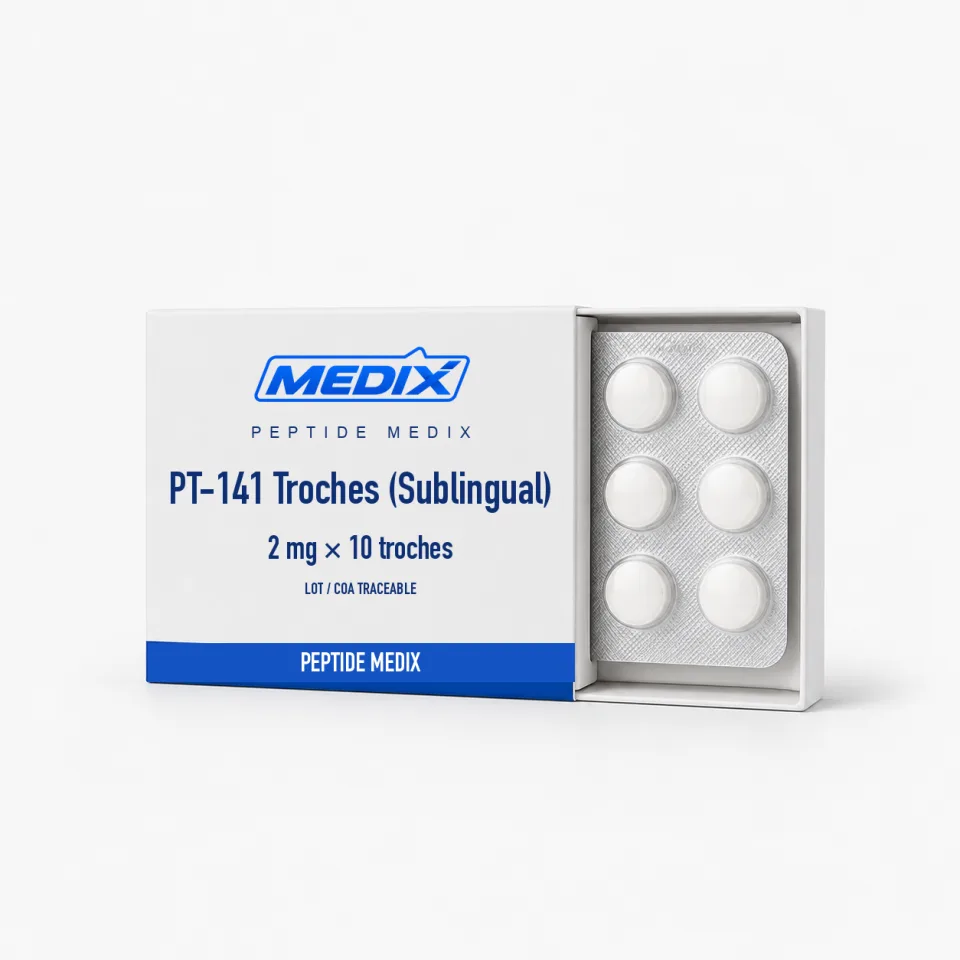
PT-141 Troches (Sublingual)
Sublingual bremelanotide lozenges, 2 mg per troche, 10 per pack
- FormCompressed sublingual troche (lozenge), slowly dissolving base
Overview
PT-141 troches are compressed sublingual lozenges containing 2 mg of bremelanotide each, supplied ten to a pack for 20 mg of peptide in total. The active is the same cyclic heptapeptide we supply as lyophilized powder and as a nasal solution: Ac-Nle-cyclo[Asp-His-D-Phe-Arg-Trp-Lys]-OH, closed by a side-chain lactam bridge between the aspartate and lysine residues, CAS 189691-06-3, molecular weight about 1025.2 g/mol.
Bremelanotide is a melanocortin receptor agonist derived from the alpha-MSH scaffold, acting principally at MC3R and MC4R with markedly less MC1R activity than its structural predecessor Melanotan II. What makes it distinctive in the literature is that its target pathway sits in the central nervous system rather than in vascular tissue, which is why it is discussed separately from PDE5 inhibitors in reviews of sexual-response pharmacology.
Specifications
Identity
- Peptide class
- Cyclic heptapeptide; α-MSH analogue and melanocortin receptor agonist
Supply & purity
- Form
- Compressed sublingual troche (lozenge), slowly dissolving base
Additional detail
- Available size
- 2 mg × 10 troches per pack (20 mg total peptide)
- Peptide per unit
- 2 mg bremelanotide
- Active component
- PT-141 (bremelanotide), ≥99% by HPLC with lot-matched COA
- CAS number (active)
- 189691-06-3
- Molecular formula (active)
- C50H68N14O10
- Molecular weight (active)
- 1025.16 g/mol
- Amino acid sequence (active)
- Ac-Nle-cyclo[Asp-His-D-Phe-Arg-Trp-Lys]-OH (side-chain lactam bridge between Asp and Lys)
- Receptor targets
- MC3R and MC4R principally; weaker MC1R activity than Melanotan II
- Delivery route studied
- Sublingual / buccal mucosal absorption
- Storage
- Cool, dry and dark; humidity is the principal degradation driver for solid peptide forms
- Preparation required
- None — fixed unit content, no reconstitution step
Units and conversions
There is no reconstitution step for a solid oral format: the mass per unit of PT-141 Troches (Sublingual) is fixed on the label. Where a published method is written in micrograms and the label is in milligrams, the peptide unit converter does the conversion.
Certificate of analysis
Every lot of PT-141 Troches (Sublingual) is released against its own lot documentation, and where the manufacturer issues a certificate of analysis for it, that certificate is the record for the lot rather than a generic document for the compound. The lot number on the certificate matches the lot number printed on the label you receive — the vial label itself, where the product is vialled — so the record and the material it describes can always be reconciled.
This listing carries no purity percentage, so none is claimed for it here. Where the manufacturer issues analytical documentation for a lot of this item, it is passed on unaltered — ask and we will send whatever exists.
No lot certificate is on display on this page at the moment. That is a publishing state and not a testing one: lots are released and documented as described above whether or not the document is posted here, and we will send what exists for the lot in stock, or for a lot already on your bench, by its number.
Certificates are available on request before you order as well as after, with no account and no charge. Request the certificate for this listing, read the testing and documentation policy in full, or see how to read a peptide COA.
Questions about PT-141 Troches (Sublingual)
How much PT-141 is in each troche?
Each troche contains 2 mg of bremelanotide, and a pack holds ten, giving 20 mg of peptide in total. The peptide used in manufacture is analysed to ≥99% purity by HPLC and the value is stated on the lot-matched certificate of analysis.
How does this differ from the PT-141 vial or nasal spray?
The molecule is identical; the presentation is not. The vial is lyophilized powder requiring reconstitution, the nasal spray is a metered aqueous solution, and the troche is a fixed-content solid. Having all three lets a study compare mucosal routes using one peptide lot.
Why study sublingual delivery for a peptide?
Because the sublingual mucosa drains into systemic circulation without first-pass hepatic metabolism, which destroys most swallowed peptides. The trade-off is a permeability barrier that penalises molecules above about a kilodalton, so PT-141 sits right where the interesting formulation questions are.
Is a certificate of analysis available?
Yes. The PT-141 used in each troche lot is analysed by reverse-phase HPLC for purity of ≥99% and confirmed by mass spectrometry. A lot-matched COA is available on request — quote the batch code printed on the pack.
Do troches need refrigeration?
Not strictly. Cool, dry, dark storage is sufficient and humidity control matters more than temperature. Refrigeration extends shelf life, but the pack should be equilibrated to room temperature before opening so moisture does not condense onto the troches.
Related