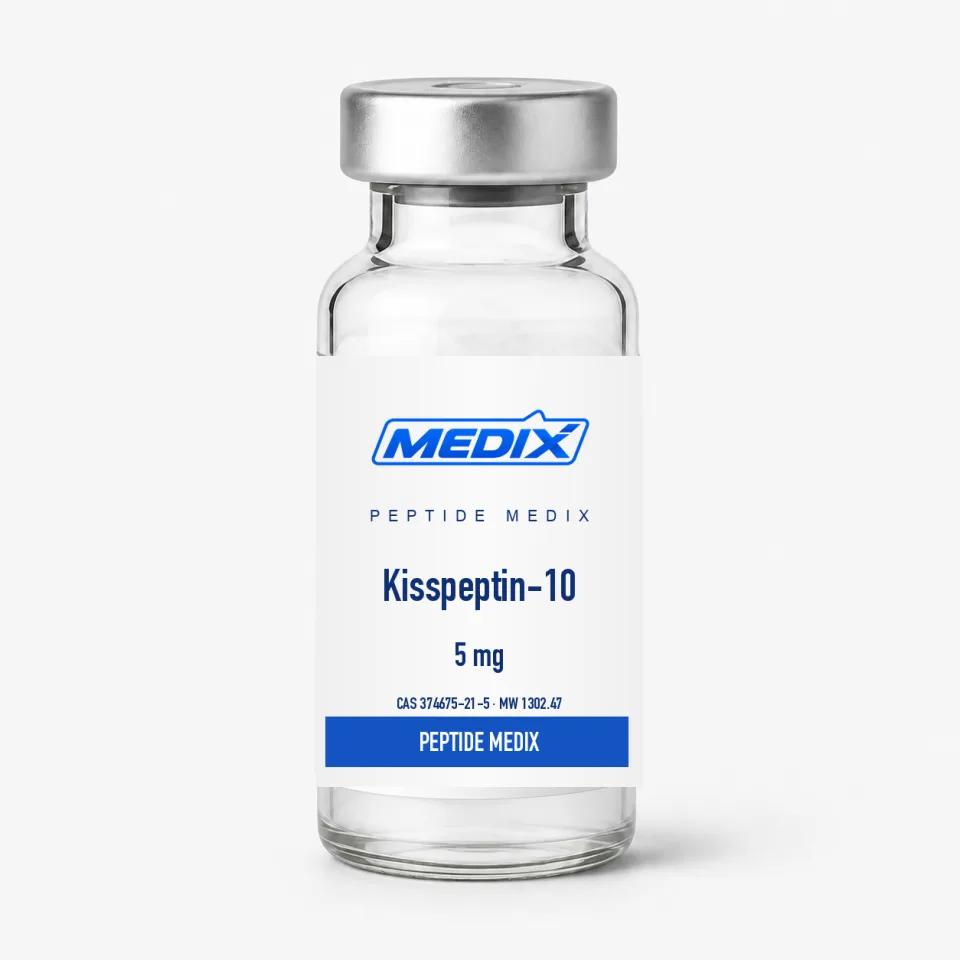
- ≥99% by HPLC
- Lot-matched certificate of analysis
- Ships next business day, tracked
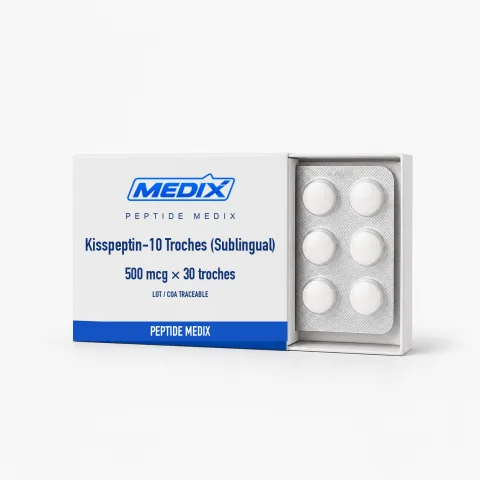
Kisspeptin-10
KISS1 decapeptide fragment and KISS1R (GPR54) receptor agonist
- FormLyophilized white to off-white powder, sealed glass vial
- Mol. weight1302.47 g/mol
- Research areasGnRH pulse generation, HPG-axis regulation, puberty onset models, metastasis suppression
Overview
Kisspeptin-10 is the ten-residue C-terminal fragment of kisspeptin-54, the product of the KISS1 gene. It is the minimum sequence that retains full activity at KISS1R — the G-protein-coupled receptor originally catalogued as GPR54 — and the C-terminal amide and terminal Arg-Phe motif are both essential to that binding. The parent gene was first identified in cancer research as a metastasis suppressor, which is why the family carries the name metastin, before its role in reproductive neuroendocrinology became apparent.
Two features of the decapeptide dictate handling. It ends in the Arg-Phe-NH2 motif that names the RFamide family, and that C-terminal amide is required for activity at the receptor, so loss of the amide is a degradation route worth considering in long incubations; and the sequence carries a tryptophan, which oxidises and photodegrades. Vials are therefore held desiccated at −20 °C and solutions aliquoted rather than thawed repeatedly, with dilute acetic acid or a little DMSO available for stubborn lots before dilution into buffer. Research use concentrates on reproductive neuroendocrinology — GnRH pulse generation in hypothalamic preparations, gonadotropin responses in rodent models, puberty-onset work — alongside a continuing strand on the metastasis-suppressor function of the parent gene.
Specifications
Identity
- CAS number
- 374675-21-5
- Molecular formula
- C63H83N17O14
- Molecular weight
- 1302.47 g/mol
- Amino acid sequence
- Tyr-Asn-Trp-Asn-Ser-Phe-Gly-Leu-Arg-Phe-NH2
- Peptide class
- Linear amidated decapeptide; RFamide-related peptide
Supply & purity
- Form
- Lyophilized white to off-white powder, sealed glass vial
- Purity
- ≥99% by HPLC; lot-matched COA
- Available sizes
- 5 mg, 10 mg
- Solubility
- Soluble in water and bacteriostatic water; dilute acetic acid or DMSO aids stubborn lots
Handling & storage
- Storage (lyophilized)
- −20 °C, desiccated and protected from light
- Storage (reconstituted)
- 2–8 °C for immediate use; aliquot at −20 °C or below for longer holds
Additional detail
- Receptor target
- KISS1R (GPR54), a Gq/11-coupled class A GPCR
- Research areas
- GnRH pulse generation, HPG-axis regulation, puberty onset models, metastasis suppression
Working out the concentration
Kisspeptin-10 ships as a lyophilized powder, so nothing on this page can state a concentration: the figure you work with is the one you create when you add diluent. Put the vial mass and the volume you intend to use into the peptide reconstitution calculator and it returns mg/mL, mcg/mL and the mass sitting at each mark on a U-100 syringe.
For work specified in µM or nM rather than mg/mL, feed 1302.47 g/mol and your volume into the peptide molarity calculator.
Certificate of analysis
Every lot of Kisspeptin-10 is released against a certificate of analysis: the batch-specific laboratory data for that lot, not a generic document for the compound. The lot number on the certificate matches the lot number printed on the label you receive — the vial label itself, where the product is vialled — so the record and the material it describes can always be reconciled.
Purity: ≥99% by HPLC — the specification for this listing. The figure for the lot you receive is the one reported on that lot’s certificate.
No lot certificate is on display on this page at the moment. That is a publishing state and not a testing one: lots are released and documented as described above whether or not the document is posted here, and we will send what exists for the lot in stock, or for a lot already on your bench, by its number.
Certificates are available on request before you order as well as after, with no account and no charge. Request the certificate for this listing, read the testing and documentation policy in full, or see how to read a peptide COA.
Questions about Kisspeptin-10
What is the relationship between Kisspeptin-10 and kisspeptin-54?
Kisspeptin-10 is the C-terminal ten residues of kisspeptin-54, the full-length KISS1 gene product. It retains essentially all activity at KISS1R, making it the practical tool compound, though it clears faster than the longer parent peptide — a difference researchers often exploit deliberately.
Which receptor does it act on?
KISS1R, previously catalogued as the orphan receptor GPR54. It is a Gq/11-coupled class A GPCR expressed densely on GnRH neurons, which places kisspeptin signalling directly upstream of the hypothalamic–pituitary–gonadal axis in the models where it is studied.
Is the purity independently verified?
Yes. Every lot is analysed by reverse-phase HPLC showing ≥99% purity and confirmed by mass spectrometry, with a lot-matched certificate of analysis available on request. The vial's batch number matches the COA so measurements can be traced to a specific analysis.
How does it differ from gonadorelin or triptorelin?
Kisspeptin-10 acts one level higher in the axis. It stimulates GnRH neurons themselves, whereas gonadorelin is GnRH and triptorelin is a GnRH analogue, both acting directly on pituitary GnRH receptors. That hierarchy is why the three are often compared within a single study design.
What sizes are stocked and how should they be stored?
Kisspeptin-10 is available in 5 mg and 10 mg lyophilized vials. Store sealed vials at −20 °C, desiccated and protected from light. After reconstitution, hold at 2–8 °C for short-term use or aliquot and freeze, avoiding repeated freeze–thaw cycles.
Why is a metastasis-suppressor gene involved in reproduction?
The KISS1 gene was named for its cancer biology role before its receptor's reproductive function was identified through human genetics. Both roles are genuine; the same peptide-receptor pair participates in distinct tissue contexts, and both literatures use Kisspeptin-10 as the reference agonist.
Related