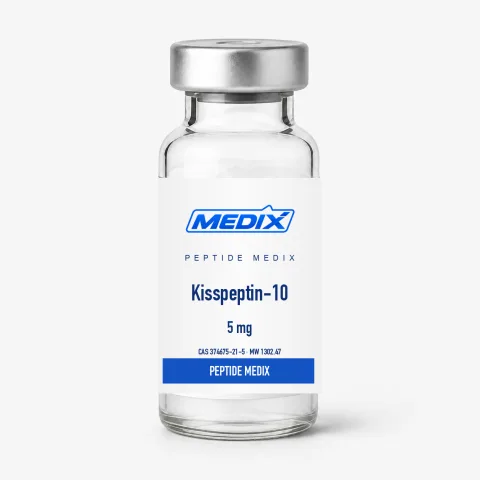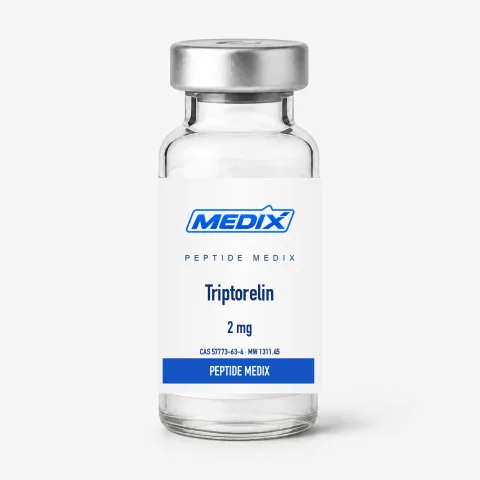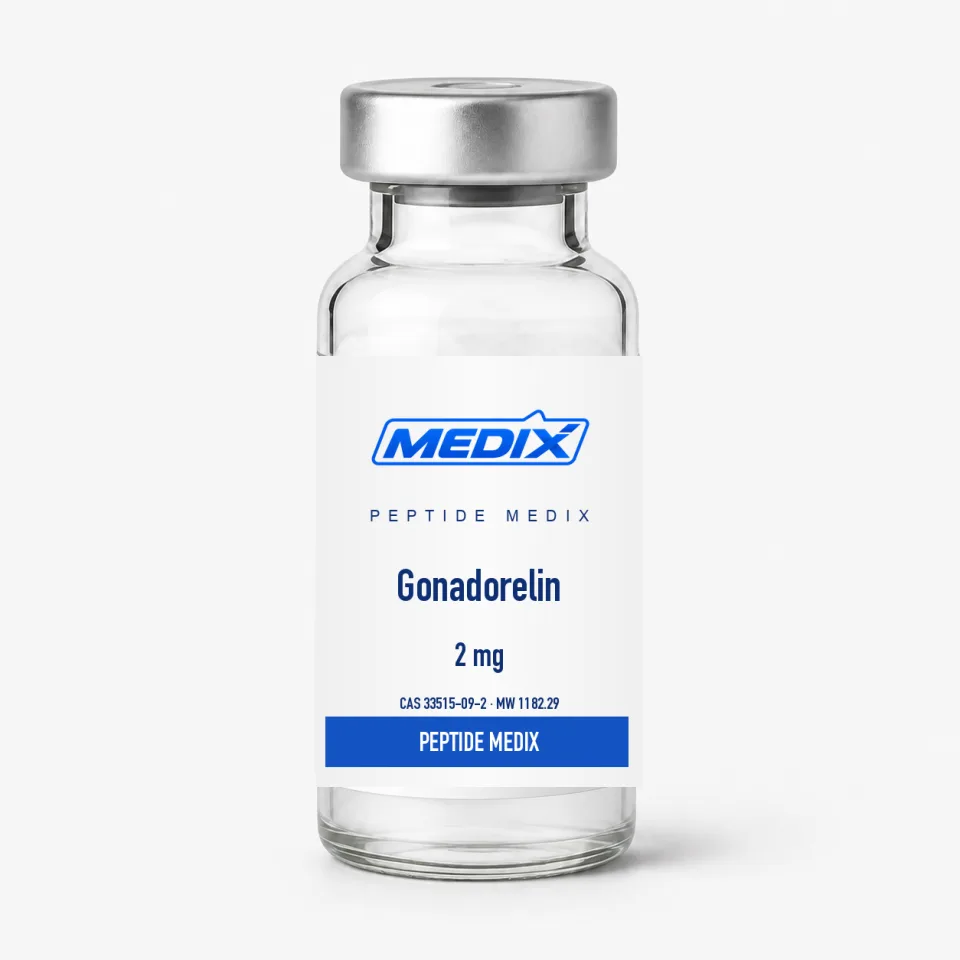
- ≥99% by HPLC
- Lot-matched certificate of analysis
- Ships next business day, tracked
Gonadorelin
Synthetic GnRH — the native hypothalamic decapeptide
- FormLyophilized white powder, sealed glass vial
- Mol. weight1182.29 g/mol
- Research areasHPG-axis regulation, pulsatile versus continuous receptor signalling, gonadotroph physiology
Overview
Gonadorelin is synthetic gonadotropin-releasing hormone — the native decapeptide itself, not an analogue. Its sequence, pGlu-His-Trp-Ser-Tyr-Gly-Leu-Arg-Pro-Gly-NH2, is identical to the hypothalamic hormone isolated and characterised by Schally and Guillemin, work recognised with a Nobel Prize in 1977. The pyroglutamate at the N-terminus and the amide at the C-terminus both protect against exopeptidase attack, though the peptide is still cleared rapidly, with a circulating half-life measured in minutes.
That short half-life is not a defect in a research context — it is the defining feature. GnRH is released from hypothalamic neurons in discrete pulses, and pituitary gonadotrophs respond to the pattern rather than to the average concentration. Pulsatile stimulation sustains luteinising hormone and follicle-stimulating hormone output, whereas continuous exposure downregulates and desensitises the GnRH receptor, ultimately suppressing gonadotropin release. Gonadorelin's rapid clearance makes it the natural tool for reproducing physiological pulsatility, in direct contrast to long-acting analogues such as triptorelin.
Specifications
Identity
- CAS number
- 33515-09-2
- Molecular formula
- C55H75N17O13
- Molecular weight
- 1182.29 g/mol
- Amino acid sequence
- pGlu-His-Trp-Ser-Tyr-Gly-Leu-Arg-Pro-Gly-NH2
- Peptide class
- Linear amidated decapeptide; hypothalamic releasing hormone
Supply & purity
- Form
- Lyophilized white powder, sealed glass vial
- Purity
- ≥99% by HPLC; lot-matched COA
- Available sizes
- 2 mg, 5 mg, 10 mg
- Solubility
- Soluble in water and bacteriostatic water; dilute acetic acid assists difficult lots
Handling & storage
- Storage (lyophilized)
- −20 °C, desiccated and protected from light
- Storage (reconstituted)
- 2–8 °C for short-term use; aliquot and freeze for longer holds
Additional detail
- Receptor target
- GnRH receptor (GnRHR) on pituitary gonadotrophs, Gq/11-coupled
- Research areas
- HPG-axis regulation, pulsatile versus continuous receptor signalling, gonadotroph physiology
Working out the concentration
The vial sizes above — 2 mg, 5 mg, 10 mg — describe a mass of material, not a strength. Choose a diluent volume, work it out with the reconstitution calculator, and you have the concentration for your own vial of Gonadorelin plus the volume that carries any mass you want to withdraw.
For work specified in µM or nM rather than mg/mL, feed 1182.29 g/mol and your volume into the peptide molarity calculator.
Certificate of analysis
Every lot of Gonadorelin is released against a certificate of analysis: the batch-specific laboratory data for that lot, not a generic document for the compound. The lot number on the certificate matches the lot number printed on the label you receive — the vial label itself, where the product is vialled — so the record and the material it describes can always be reconciled.
Purity: ≥99% by HPLC — the specification for this listing. The figure for the lot you receive is the one reported on that lot’s certificate.
No lot certificate is on display on this page at the moment. That is a publishing state and not a testing one: lots are released and documented as described above whether or not the document is posted here, and we will send what exists for the lot in stock, or for a lot already on your bench, by its number.
Certificates are available on request before you order as well as after, with no account and no charge. Request the certificate for this listing, read the testing and documentation policy in full, or see how to read a peptide COA.
Questions about Gonadorelin
Is gonadorelin the same thing as GnRH?
Yes. Gonadorelin is synthetic gonadotropin-releasing hormone with the native decapeptide sequence, unmodified. Analogues such as triptorelin or leuprolide carry substitutions that extend half-life; gonadorelin does not, which is why it clears within minutes and behaves differently in experiments.
Why does pulsatile versus continuous exposure matter so much?
Pituitary gonadotrophs read the temporal pattern of GnRH, not just its concentration. Intermittent stimulation sustains LH and FSH output while continuous exposure downregulates and desensitises the receptor, suppressing release. That distinction underpins most experimental design in this area.
How does gonadorelin compare with Kisspeptin-10?
They act at different levels of the same axis. Kisspeptin-10 stimulates GnRH neurons via KISS1R, one step upstream, whereas gonadorelin acts directly on pituitary GnRH receptors. Researchers often use both to establish where in the cascade an observed effect originates.
Is a certificate of analysis provided?
Yes. Each lot is characterised by reverse-phase HPLC for purity of ≥99% and by mass spectrometry for identity, with a lot-matched COA available on request. The batch number on the vial corresponds to the document, keeping results traceable to a specific analysis.
What vial sizes are available?
Gonadorelin is stocked at 2 mg, 5 mg and 10 mg. Because working concentrations in receptor assays are typically low, the 2 mg vial covers many studies outright; larger sizes suit extended series where keeping one lot across the whole experiment removes batch variability.
How should it be reconstituted and stored?
Use sterile or bacteriostatic water added slowly along the vial wall with gentle swirling. Store sealed lyophilized vials at −20 °C, desiccated and dark. Reconstituted material keeps at 2–8 °C for short-term work; for anything longer, aliquot and freeze to avoid repeated thaw cycles.
Related