- Lot-matched certificate of analysis
- Ships next business day, tracked
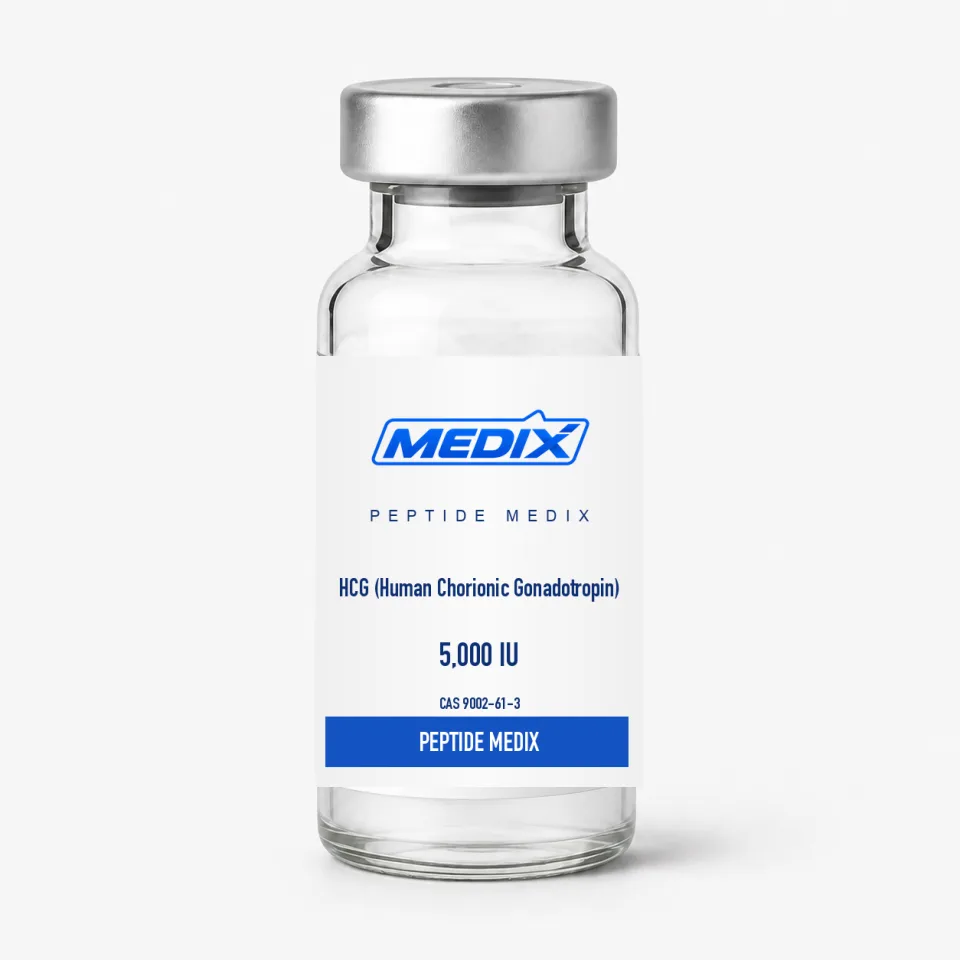
HCG (Human Chorionic Gonadotropin)
Human chorionic gonadotropin — glycoprotein heterodimer, LHCGR agonist
- FormLyophilized powder, sealed glass vial
- Research areasGlycoprotein hormone structure–function, LHCGR signalling, gonadal steroidogenesis models, HPG-axis research
Overview
Human chorionic gonadotropin is not a simple synthetic peptide but a glycoprotein hormone: a heterodimer of a 92-amino-acid alpha subunit and a 145-amino-acid beta subunit, held together non-covalently and extensively decorated with N- and O-linked carbohydrate. That glycosylation is functionally important rather than incidental — it governs folding, dimer stability and, critically, plasma clearance. The alpha subunit is shared with LH, FSH and TSH; the beta subunit confers specificity and carries a C-terminal extension, unique among the glycoprotein hormones, that bears additional O-linked sugars.
Functionally, hCG is an agonist at the luteinising hormone/choriogonadotropin receptor (LHCGR), the same receptor LH acts on. The beta subunit shares extensive homology with LH-beta across its first hundred-odd residues, which explains the shared receptor, while the glycosylated C-terminal extension gives hCG a substantially longer circulating half-life than LH. In reproductive physiology it is produced by placental syncytiotrophoblast and sustains the corpus luteum through early pregnancy; in the laboratory it is the standard long-acting LHCGR agonist and a classic model system for studying glycoprotein hormone structure–function relationships.
Specifications
Identity
- CAS number
- 9002-61-3
Supply & purity
- Form
- Lyophilized powder, sealed glass vial
- Available sizes
- 5,000 IU and 10,000 IU per vial
- Solubility
- Reconstituted with sterile or bacteriostatic water; do not use organic solvents
Handling & storage
- Storage (lyophilized)
- 2–8 °C recommended; −20 °C for extended storage, protected from light and moisture
- Storage (reconstituted)
- 2–8 °C only; solution stability is limited — do not freeze–thaw repeatedly
Additional detail
- Molecular class
- Glycoprotein hormone heterodimer (non-covalently associated α/β subunits)
- Approximate molecular weight
- ≈36–38 kDa including carbohydrate; exact mass varies with glycoform
- Subunit composition
- α subunit 92 residues (shared with LH, FSH, TSH); β subunit 145 residues with a glycosylated C-terminal extension
- Glycosylation
- N-linked sites on both subunits plus O-linked glycans on the β C-terminal peptide
- Receptor target
- LH/choriogonadotropin receptor (LHCGR), Gs-coupled
- Potency expression
- Quantified in international units by bioassay; approximately 10,000 IU per mg for highly purified material
- Research areas
- Glycoprotein hormone structure–function, LHCGR signalling, gonadal steroidogenesis models, HPG-axis research
Working out the concentration
The vial sizes above — 5,000 IU and 10,000 IU per vial — describe a mass of material, not a strength. Choose a diluent volume, work it out with the reconstitution calculator, and you have the concentration for your own vial of HCG (Human Chorionic Gonadotropin) plus the volume that carries any mass you want to withdraw.
Certificate of analysis
Every lot of HCG (Human Chorionic Gonadotropin) is released against its own lot documentation, and where the manufacturer issues a certificate of analysis for it, that certificate is the record for the lot rather than a generic document for the compound. The lot number on the certificate matches the lot number printed on the label you receive — the vial label itself, where the product is vialled — so the record and the material it describes can always be reconciled.
This listing carries no purity percentage, so none is claimed for it here. Where the manufacturer issues analytical documentation for a lot of this item, it is passed on unaltered — ask and we will send whatever exists.
No lot certificate is on display on this page at the moment. That is a publishing state and not a testing one: lots are released and documented as described above whether or not the document is posted here, and we will send what exists for the lot in stock, or for a lot already on your bench, by its number.
Certificates are available on request before you order as well as after, with no account and no charge. Request the certificate for this listing, read the testing and documentation policy in full, or see how to read a peptide COA.
Questions about HCG (Human Chorionic Gonadotropin)
Why is HCG measured in IU rather than milligrams?
Because it is a glycoprotein with heterogeneous glycosylation, equal masses of different preparations do not necessarily carry equal biological activity. International units, assigned by bioassay against an international standard, express activity directly. Work from the assayed IU value on your lot's certificate of analysis.
How does HCG relate to luteinising hormone?
Both act at the same receptor, LHCGR. Their beta subunits are highly homologous and their alpha subunits are identical. The functional difference is duration: hCG's glycosylated beta C-terminal extension slows clearance considerably, so it is often used experimentally as a long-acting LH surrogate.
Is this a peptide like the others in your catalogue?
Not in the same sense. Most catalogue items are chemically synthesised peptide chains of a few dozen residues at most. hCG is a two-subunit glycoprotein of roughly 36 to 38 kilodaltons with extensive carbohydrate, which makes its handling, stability and quantification meaningfully different.
What documentation comes with each lot?
A lot-matched certificate of analysis covering identity and assayed potency in international units. Because glycoprotein characterisation differs from small-peptide HPLC purity analysis, the COA reflects the appropriate methods for this class of molecule. Quote the vial's batch number when requesting it.
Why should the vial not be shaken during reconstitution?
The two subunits are held together non-covalently. Vigorous agitation, foaming, heat or extreme pH can dissociate the dimer, and the free subunits have no activity at LHCGR. Adding solvent slowly down the vial wall and swirling gently preserves the intact heterodimer.
How stable is reconstituted HCG?
Considerably less stable than lyophilized material. Hold solutions at 2–8 °C, avoid freeze–thaw cycling, keep the in-use period short and documented, and discard if the solution becomes cloudy or shows particulates. For extended studies, reconstitute fresh rather than storing a working stock.
Related