- Peptide purity: ≥99% by HPLC before compounding
- Lot-matched certificate of analysis
- Ships next business day, tracked
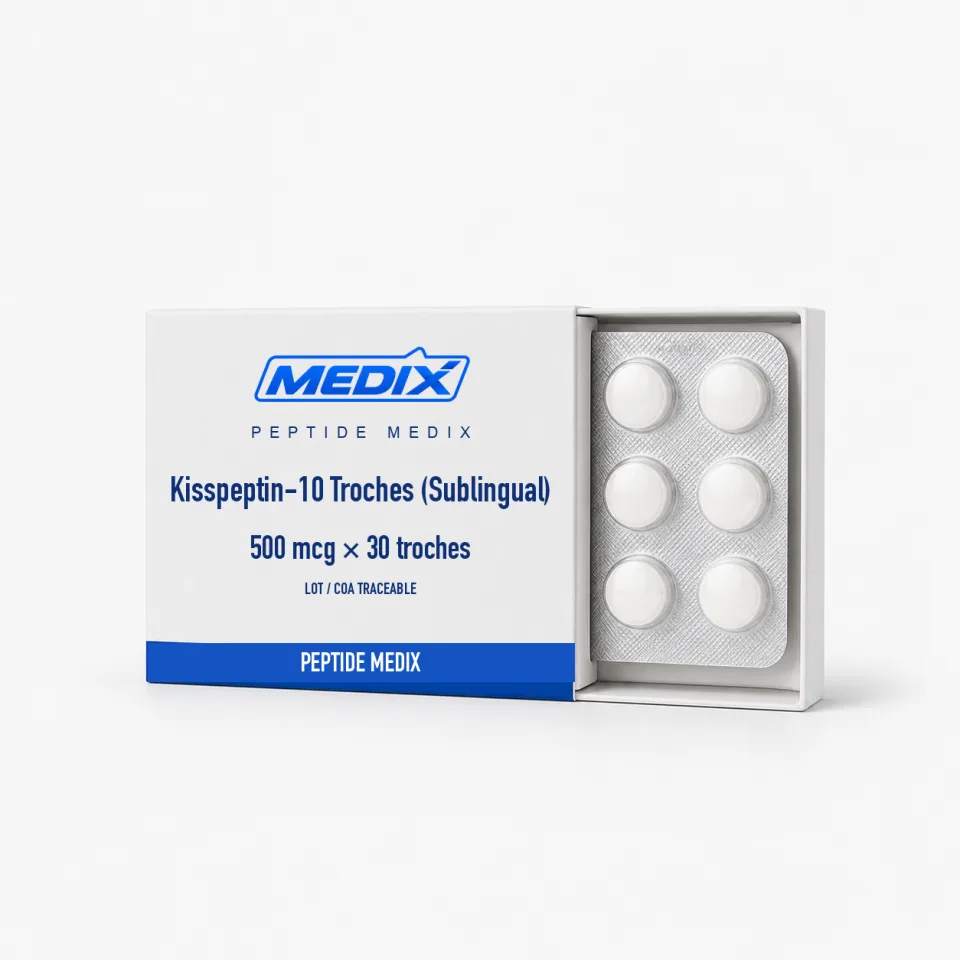
Kisspeptin-10 Troches (Sublingual)
Sublingual troches of the KISS1R decapeptide agonist, 500 mcg per unit
- FormSublingual troche in a slowly dissolving compounding base
- Research areasGnRH pulse generation, HPG-axis regulation, transmucosal peptide delivery, formulation stability
Overview
These sublingual troches supply kisspeptin-10, the ten-residue C-terminal fragment of the KISS1 gene product, in a slowly dissolving base at 500 micrograms per unit with thirty units to the pack. The peptide is the same amidated decapeptide we supply as lyophilized powder — Tyr-Asn-Trp-Asn-Ser-Phe-Gly-Leu-Arg-Phe-NH2 — whose C-terminal Arg-Phe-amide motif is essential for activity at KISS1R, the Gq-coupled receptor originally catalogued as GPR54.
Kisspeptin signalling sits at the top of the reproductive endocrine cascade. Kisspeptin neurons in the hypothalamus drive GnRH release, which in turn governs LH and FSH secretion, and loss-of-function mutations in KISS1R were the genetic finding that established the pathway's necessity for puberty. That upstream position is why the peptide appears in neuroendocrine research rather than in receptor-level work alone.
Specifications
Supply & purity
- Form
- Sublingual troche in a slowly dissolving compounding base
Additional detail
- Peptide content
- 500 mcg kisspeptin-10 per troche
- Available size
- 30 troches per pack
- Active component
- Kisspeptin-10, C-terminal decapeptide fragment of kisspeptin-54 (metastin)
- Amino acid sequence (active)
- Tyr-Asn-Trp-Asn-Ser-Phe-Gly-Leu-Arg-Phe-NH2
- CAS number (active)
- 374675-21-5
- Molecular formula (active)
- C63H83N17O14
- Molecular weight (active)
- 1302.47 g/mol
- Receptor target
- KISS1R (GPR54), a Gq/11-coupled class A GPCR
- Peptide purity
- ≥99% by HPLC before compounding; lot-matched COA available
- Delivery route studied
- Sublingual and buccal mucosal absorption
- Research areas
- GnRH pulse generation, HPG-axis regulation, transmucosal peptide delivery, formulation stability
- Storage
- Cool, dry and dark in the closed pack; refrigeration extends shelf stability
Units and conversions
There is no reconstitution step for a solid oral format: the mass per unit of Kisspeptin-10 Troches (Sublingual) is fixed on the label. Where a published method is written in micrograms and the label is in milligrams, the peptide unit converter does the conversion.
Certificate of analysis
Every lot of Kisspeptin-10 Troches (Sublingual) is released against a certificate of analysis: the batch-specific laboratory data for that lot, not a generic document for the compound. The lot number on the certificate matches the lot number printed on the label you receive — the vial label itself, where the product is vialled — so the record and the material it describes can always be reconciled.
Peptide purity: ≥99% by HPLC before compounding — the specification for this listing. The figure for the lot you receive is the one reported on that lot’s certificate.
No lot certificate is on display on this page at the moment. That is a publishing state and not a testing one: lots are released and documented as described above whether or not the document is posted here, and we will send what exists for the lot in stock, or for a lot already on your bench, by its number.
Certificates are available on request before you order as well as after, with no account and no charge. Request the certificate for this listing, read the testing and documentation policy in full, or see how to read a peptide COA.
Questions about Kisspeptin-10 Troches (Sublingual)
How does this differ from the kisspeptin-10 vial?
The peptide is identical; only the presentation changes. The vial is lyophilized powder that a laboratory reconstitutes to any concentration, while each troche is a fixed 500 mcg unit in a dissolving base intended for transmucosal delivery research.
How does it compare with the nasal spray format?
Both are transmucosal routes but they use different epithelia. Nasal mucosa is thin and highly vascular with a short residence time; sublingual mucosa offers longer contact but a smaller absorptive area. Comparing the two with the same peptide lot is a standard route-comparison design.
What documentation is provided?
The peptide used in manufacture is released at ≥99% purity by reversed-phase HPLC with mass-spectrometric identity confirmation, and a lot-matched certificate of analysis is available. Retain it with your records so results can be traced to the specific peptide lot.
How should the troches be stored?
Keep them sealed, cool, dry and away from light. Heat softens the base and atmospheric moisture is absorbed by it, both of which degrade the units physically and accelerate peptide breakdown. Refrigerated storage in a closed container extends the usable window.
Related