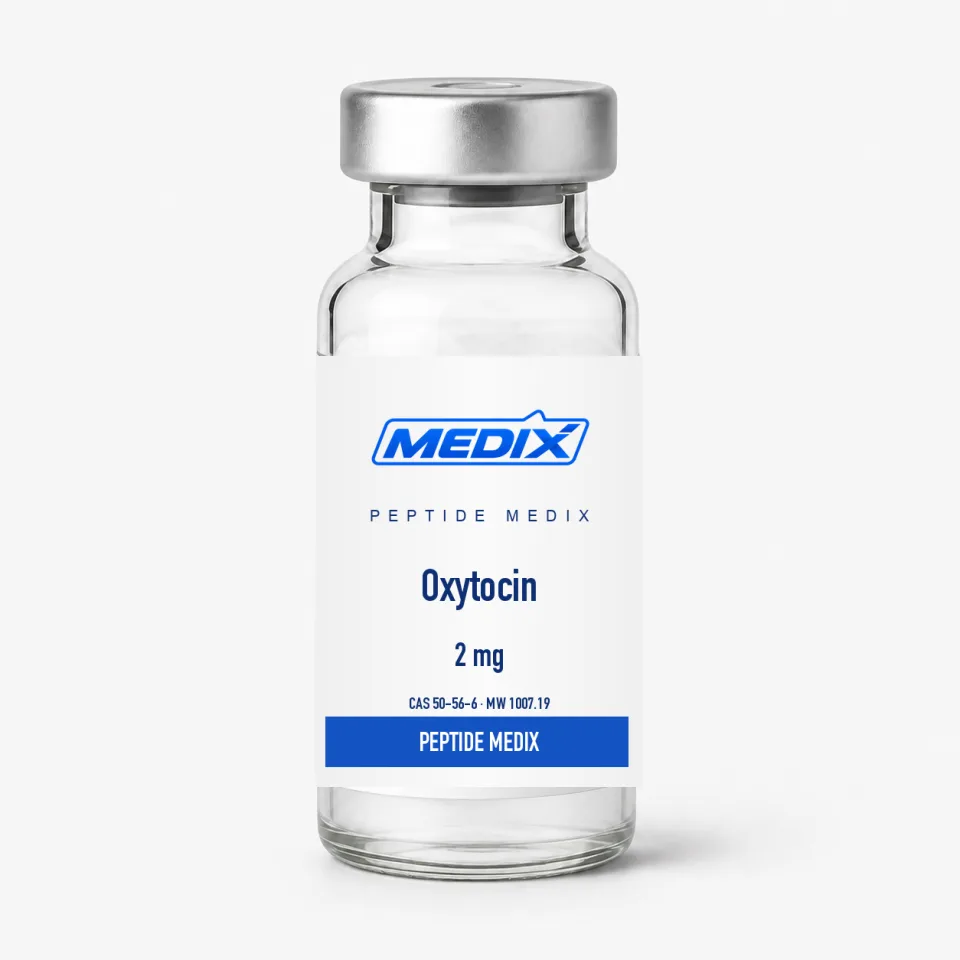
- ≥99% by HPLC
- Lot-matched certificate of analysis
- Ships next business day, tracked
Sexual Health & Hormonal Peptides
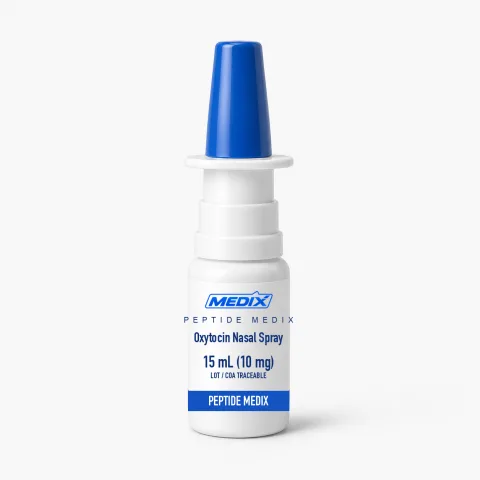
Oxytocin Peptide
Nine-amino-acid neurohypophysial peptide with a disulfide ring
- FormLyophilized white powder, sealed glass vial
- Mol. weight1007.19 g/mol
- Research areasSocial behaviour and bonding models, stress and anxiety research, smooth-muscle physiology, OXTR pharmacology
Overview
Oxytocin is a nonapeptide hormone synthesised in the paraventricular and supraoptic nuclei of the hypothalamus and released from the posterior pituitary. Its structure is a six-residue ring closed by a disulfide bridge between the cysteines at positions 1 and 6, with a three-residue tail terminating in a C-terminal amide. It differs from vasopressin at only two positions, which is why cross-reactivity at vasopressin receptors is a recurring consideration in oxytocin research design.
Scientifically, oxytocin occupies two fairly distinct literatures. The peripheral one is classical endocrinology: OXTR-mediated smooth muscle contraction in uterine and mammary tissue, extensively characterised since the peptide was first synthesised in the 1950s — work that earned Vincent du Vigneaud a Nobel Prize and made oxytocin the first polypeptide hormone ever chemically synthesised. The central literature is newer and concerns oxytocinergic projections within the brain, where the peptide has been studied in relation to social recognition, pair bonding, stress reactivity and anxiety-related behaviour in animal models.
Specifications
Identity
- CAS number
- 50-56-6
- Molecular formula
- C43H66N12O12S2
- Molecular weight
- 1007.19 g/mol
- Amino acid sequence
- Cys-Tyr-Ile-Gln-Asn-Cys-Pro-Leu-Gly-NH2 (disulfide bridge Cys1–Cys6)
- Peptide class
- Cyclic nonapeptide; neurohypophysial hormone
Supply & purity
- Form
- Lyophilized white powder, sealed glass vial
- Purity
- ≥99% by HPLC; lot-matched COA
- Available sizes
- 2 mg, 5 mg, 10 mg
- Solubility
- Freely soluble in water and bacteriostatic water; also soluble in dilute acetic acid
Additional detail
- Receptor target
- Oxytocin receptor (OXTR); partial cross-reactivity at vasopressin receptors
- Approximate activity conversion
- Roughly 1 IU ≈ 2 µg of synthetic oxytocin (see COA for lot-specific values)
- Research areas
- Social behaviour and bonding models, stress and anxiety research, smooth-muscle physiology, OXTR pharmacology
- Storage
- Lyophilized: −20 °C, desiccated and protected from light. Reconstituted: 2–8 °C, aliquoted to avoid repeated freeze–thaw
Working out the concentration
A lyophilized vial carries a mass on the label and no concentration anywhere, so the first calculation of any protocol is the reconstitution one. The peptide concentration calculator converts vial mass plus diluent volume into mg/mL, and back into the draw volume for a given mass.
Where a method is written in molar terms instead, the molecular weight above — 1007.19 g/mol — is the input the molarity calculator needs.
Certificate of analysis
Every lot of Oxytocin is released against a certificate of analysis: the batch-specific laboratory data for that lot, not a generic document for the compound. The lot number on the certificate matches the lot number printed on the label you receive — the vial label itself, where the product is vialled — so the record and the material it describes can always be reconciled.
Purity: ≥99% by HPLC — the specification for this listing. The figure for the lot you receive is the one reported on that lot’s certificate.
No lot certificate is on display on this page at the moment. That is a publishing state and not a testing one: lots are released and documented as described above whether or not the document is posted here, and we will send what exists for the lot in stock, or for a lot already on your bench, by its number.
Certificates are available on request before you order as well as after, with no account and no charge. Request the certificate for this listing, read the testing and documentation policy in full, or see how to read a peptide COA.
Questions about Oxytocin
What form does the oxytocin arrive in?
It ships as a lyophilized powder in a sealed, desiccated glass vial at 2 mg, 5 mg or 10 mg. Lyophilized peptide is far more stable than solution, so the material tolerates transit at ambient temperature and should be stored dry at −20 °C until you are ready to reconstitute it.
Is the purity independently verified?
Yes. Each lot is analysed by reverse-phase HPLC for purity of ≥99% and confirmed by mass spectrometry, with a lot-matched certificate of analysis available on request. The batch number printed on the vial matches the COA so your data stays traceable to a specific analysis.
What makes oxytocin more fragile than other peptides?
Its disulfide bridge between Cys1 and Cys6 defines the active ring, and that bond can be reduced or scrambled by reducing agents, alkaline pH or trace metal contamination. Keeping solutions cold, mildly acidic, metal-free and freshly prepared is the usual precaution.
How does oxytocin differ from vasopressin?
The two nonapeptides differ at only two residues, positions 3 and 8, yet they signal through separate receptor families. The similarity means cross-reactivity at vasopressin receptors is a real consideration, so selectivity controls and receptor-specific antagonists are standard in careful oxytocin experiments.
Which solvents work for reconstitution?
Sterile or bacteriostatic water dissolves oxytocin readily; dilute acetic acid is an option where a lower pH improves stability for the assay in question. Add solvent slowly down the vial wall, swirl gently, and use low-binding tubes for dilute working solutions to limit surface adsorption.
Related