- ≥99% by HPLC
- Lot-matched certificate of analysis
- Ships next business day, tracked
Sexual Health & Hormonal Peptides
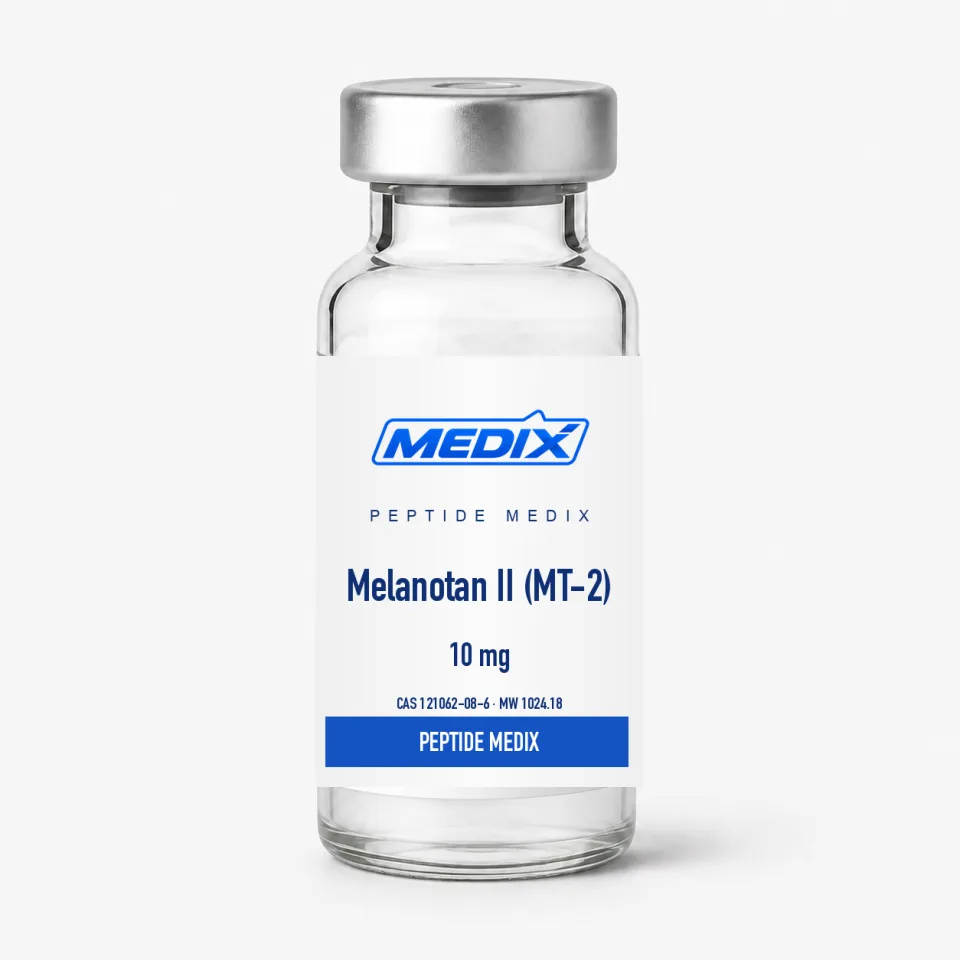
Melanotan II (MT-2)
Cyclic α-MSH analogue with broad melanocortin receptor activity
- FormLyophilized white to off-white powder, sealed glass vial
- Mol. weight1024.18 g/mol
- Research areasMelanogenesis and pigmentation, appetite and energy balance, melanocortin receptor selectivity
Overview
Melanotan II (MT-2) is a synthetic cyclic lactam analogue of α-melanocyte-stimulating hormone, first developed in academic work on melanocortin structure–activity relationships. Cyclisation between the aspartate and lysine side chains locks the pharmacophore into a bioactive conformation, while N-terminal acetylation, the norleucine substitution and the D-phenylalanine residue slow proteolytic breakdown. The result is a compact heptapeptide that is far more stable and more potent than native α-MSH.
Unlike its metabolite PT-141, Melanotan II retains its C-terminal amide and behaves as a broad, relatively non-selective agonist across the melanocortin family — MC1R, MC3R, MC4R and MC5R. That breadth is exactly why it became a workhorse research tool: MC1R activity connects it to melanogenesis and pigmentation studies, while MC3R and MC4R activity connects it to central work on feeding behaviour, energy expenditure and arousal pathways. Few single molecules give investigators access to that many receptor subtypes at once.
Specifications
Identity
- CAS number
- 121062-08-6
- Molecular formula
- C50H69N15O9
- Molecular weight
- 1024.18 g/mol
- Amino acid sequence
- Ac-Nle-cyclo[Asp-His-D-Phe-Arg-Trp-Lys]-NH2
- Peptide class
- Cyclic heptapeptide; α-MSH (melanocortin) analogue
Supply & purity
- Form
- Lyophilized white to off-white powder, sealed glass vial
- Purity
- ≥99% by HPLC; lot-matched COA
- Available sizes
- 10 mg, 20 mg
- Solubility
- Soluble in bacteriostatic or sterile water; also soluble in dilute acetic acid
Handling & storage
- Storage (lyophilized)
- −20 °C, protected from light and moisture
- Storage (reconstituted)
- 2–8 °C, protected from light; aliquot to limit freeze–thaw
Additional detail
- Receptor targets
- Non-selective agonist at MC1R, MC3R, MC4R and MC5R
- Research areas
- Melanogenesis and pigmentation, appetite and energy balance, melanocortin receptor selectivity
Working out the concentration
Reconstitution is where the arithmetic lives. The same vial made up with 1 mL or with 3 mL of diluent gives three-fold different numbers, which is why a reconstitution volume calculator is more use here than a fixed table: enter the vial mass and your diluent volume and read the concentration back.
For work specified in µM or nM rather than mg/mL, feed 1024.18 g/mol and your volume into the peptide molarity calculator.
Certificate of analysis
Every lot of Melanotan II (MT-2) is released against a certificate of analysis: the batch-specific laboratory data for that lot, not a generic document for the compound. The lot number on the certificate matches the lot number printed on the label you receive — the vial label itself, where the product is vialled — so the record and the material it describes can always be reconciled.
Purity: ≥99% by HPLC — the specification for this listing. The figure for the lot you receive is the one reported on that lot’s certificate.
No lot certificate is on display on this page at the moment. That is a publishing state and not a testing one: lots are released and documented as described above whether or not the document is posted here, and we will send what exists for the lot in stock, or for a lot already on your bench, by its number.
Certificates are available on request before you order as well as after, with no account and no charge. Request the certificate for this listing, read the testing and documentation policy in full, or see how to read a peptide COA.
Questions about Melanotan II (MT-2)
How does Melanotan II differ from Melanotan I?
Melanotan I (afamelanotide) is a linear, MC1R-selective α-MSH analogue, whereas Melanotan II is cyclic and non-selective, hitting MC1R, MC3R, MC4R and MC5R. Researchers choose MT-1 when they want pigmentation pathways in isolation and MT-2 when broader melanocortin activity is the point of the experiment.
Is your Melanotan II tested, and is a COA available?
Yes. Each lot is characterised by reverse-phase HPLC for purity of ≥99% and by mass spectrometry for identity, and a lot-matched certificate of analysis is available on request. The batch number on the vial corresponds to the document so results stay traceable.
What sizes can I buy?
Melanotan II is stocked as 10 mg and 20 mg lyophilized vials. A 10 mg vial suits short assay series or method development, while the 20 mg size lets a longer study run entirely on one lot, which removes batch-to-batch variability as a confounder.
How is it reconstituted and stored?
Bacteriostatic or sterile water dissolves the powder readily; add solvent slowly along the vial wall and swirl rather than shake. Store sealed lyophilized vials at −20 °C protected from light and moisture, and hold reconstituted solution at 2–8 °C, aliquoted to avoid repeated freeze–thaw.
Why is Melanotan II studied alongside PT-141?
PT-141 is the deaminated free-acid metabolite of Melanotan II. Comparing the pair isolates the contribution of the C-terminal amide: MT-2 keeps strong MC1R activity, PT-141 largely loses it. That makes them a natural matched set in receptor-selectivity experiments.
Related