- Lot-matched certificate of analysis
- Ships next business day, tracked
Sexual Health & Hormonal Peptides
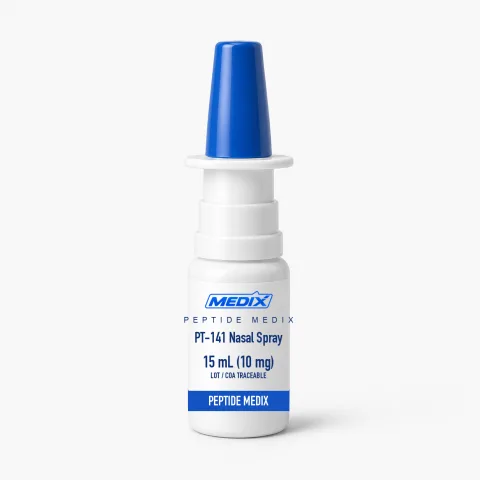
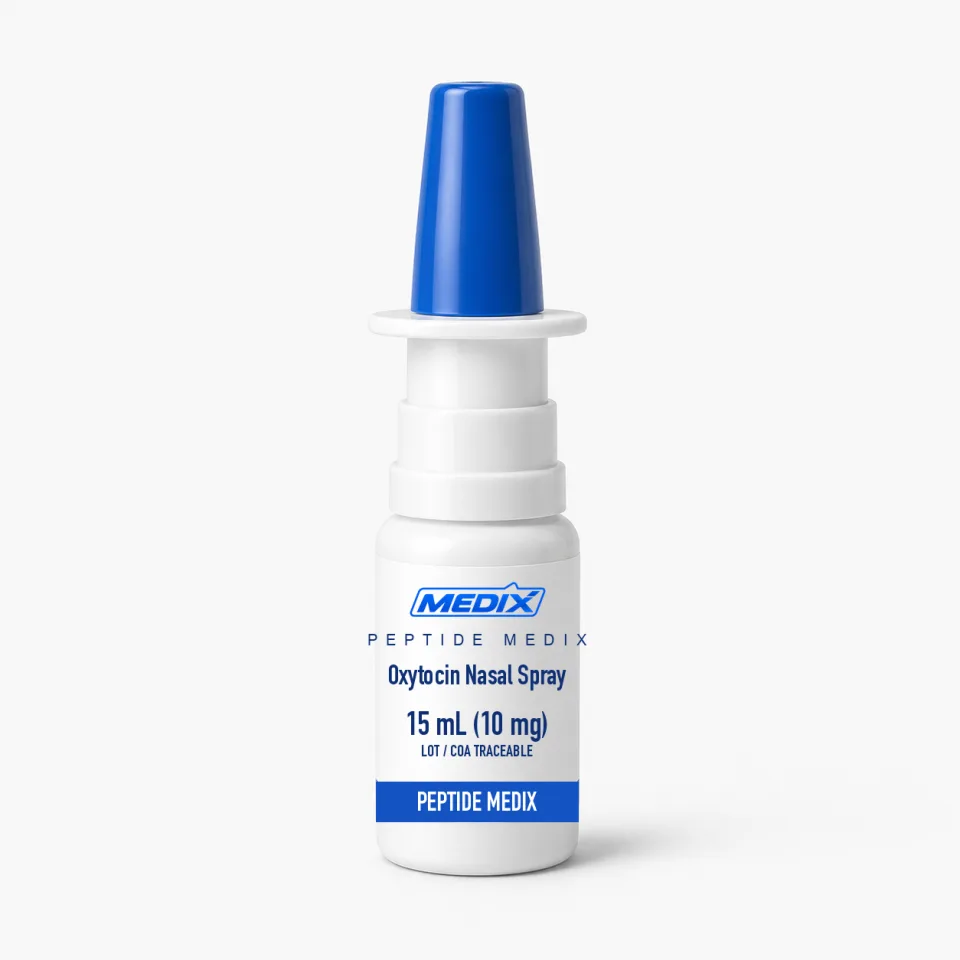
Oxytocin Nasal Spray
Pre-mixed oxytocin solution in a 15 mL metered nasal pump
- FormAqueous solution, 15 mL amber bottle with metered nasal pump
- Research areasIntranasal delivery and nose-to-brain transport, social behaviour paradigms, formulation stability
Overview
This product presents synthetic oxytocin as a ready-mixed aqueous solution in a 15 mL amber bottle with a metered nasal pump. The peptide is identical to the material in our lyophilized vials — the cyclic nonapeptide with a Cys1–Cys6 disulfide bridge — but supplied pre-dissolved so that investigators studying intranasal delivery can work with a consistent, prepared article rather than reconstituting powder and filling bottles themselves.
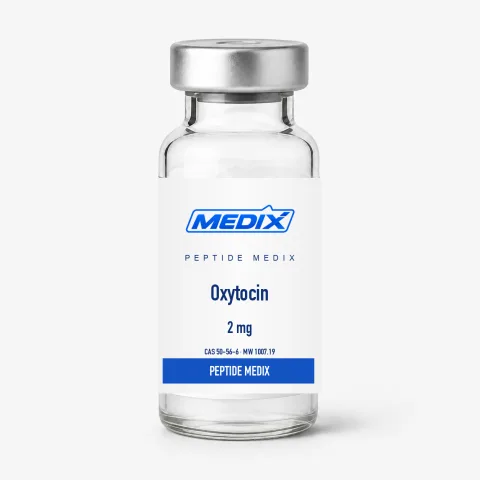
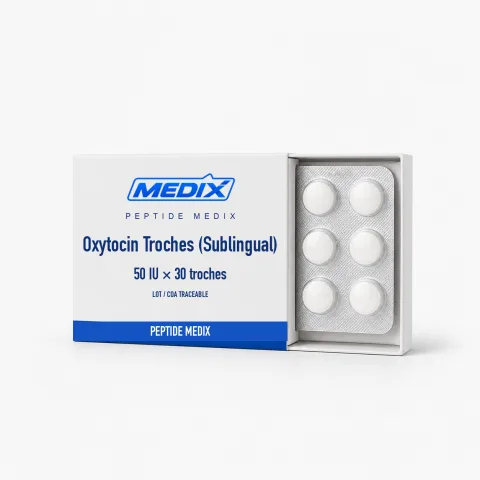
Loading is the only difference between the two fills, 10 mg or 20 mg in the same 15 mL volume, about 0.67 and 1.33 mg/mL, which on the conventional 1 IU ≈ 2 µg basis corresponds to roughly 5,000 and 10,000 IU. Solution-phase chemistry is the limiting factor. The Cys1–Cys6 disulfide can undergo thiol-disulfide exchange, and the peptide is documented as prone to deamidation and to dimerisation on storage, all of which proceed faster in water than in a lyophilized cake, hence upright refrigerated storage, light protection and no freezing. Within the same subcategory the troche presents the identical nonapeptide for sublingual rather than nasal exposure, while the lyophilized vial remains the cleaner starting material wherever the investigator sets the concentration.
Specifications
Identity
- Peptide class
- Cyclic nonapeptide neurohypophysial hormone; OXTR agonist
Supply & purity
- Form
- Aqueous solution, 15 mL amber bottle with metered nasal pump
- Available sizes
- 15 mL containing 10 mg; 15 mL containing 20 mg
Additional detail
- Nominal concentration
- ≈0.67 mg/mL (10 mg fill) or ≈1.33 mg/mL (20 mg fill)
- Active component
- Synthetic oxytocin, ≥99% by HPLC
- CAS number (active)
- 50-56-6
- Molecular formula (active)
- C43H66N12O12S2
- Molecular weight (active)
- 1007.19 g/mol
- Amino acid sequence (active)
- Cys-Tyr-Ile-Gln-Asn-Cys-Pro-Leu-Gly-NH2 (Cys1–Cys6 disulfide)
- Approximate activity conversion
- Roughly 1 IU ≈ 2 µg oxytocin; a 10 mg fill corresponds to approximately 5,000 IU
- Vehicle
- Preserved aqueous solution; clear and colourless when fresh
- Research areas
- Intranasal delivery and nose-to-brain transport, social behaviour paradigms, formulation stability
- Storage
- 2–8 °C upright, protected from light; do not freeze the filled bottle
Units and conversions
This is a pre-mixed presentation: the strength is fixed at fill, and the only arithmetic between the label and the bench is a change of units. The peptide unit converter moves between mg, mcg, mL and µL without the decimal-point slip that costs a whole run.
Certificate of analysis
Every lot of Oxytocin Nasal Spray is released against its own lot documentation, and where the manufacturer issues a certificate of analysis for it, that certificate is the record for the lot rather than a generic document for the compound. The lot number on the certificate matches the lot number printed on the label you receive — the vial label itself, where the product is vialled — so the record and the material it describes can always be reconciled.
This listing carries no purity percentage, so none is claimed for it here. Where the manufacturer issues analytical documentation for a lot of this item, it is passed on unaltered — ask and we will send whatever exists.
No lot certificate is on display on this page at the moment. That is a publishing state and not a testing one: lots are released and documented as described above whether or not the document is posted here, and we will send what exists for the lot in stock, or for a lot already on your bench, by its number.
Certificates are available on request before you order as well as after, with no account and no charge. Request the certificate for this listing, read the testing and documentation policy in full, or see how to read a peptide COA.
Questions about Oxytocin Nasal Spray
How much oxytocin does each bottle contain?
Both options hold 15 mL of solution; one is filled with 10 mg of oxytocin and the other with 20 mg, giving roughly 0.67 mg/mL and 1.33 mg/mL. Using the conventional 1 IU ≈ 2 µg conversion, those fills correspond to approximately 5,000 IU and 10,000 IU respectively.
Is the peptide the same as the lyophilized vials you sell?
Yes. The same ≥99% HPLC-purity synthetic oxytocin is used, with identical CAS number, formula and sequence. Only the presentation differs — this arrives pre-dissolved in a metered nasal pump rather than as a dry cake requiring reconstitution.
Do you supply a certificate of analysis?
Each bottle traces to a lot-matched COA covering the peptide used in the fill, with HPLC purity of ≥99% and mass-spectrometric identity confirmation. Quote the lot number on the bottle label when requesting it and we will send the matching document.
Why is intranasal oxytocin such a debated research topic?
Central penetration after nasal delivery is small and hard to measure directly, and behavioural effect sizes in social paradigms tend to be modest. Differences in device, deposition, volume and formulation plausibly account for much of the inconsistency between published studies, which keeps the methodology under active discussion.
How should it be stored and how long is it usable?
Keep it upright at 2–8 °C away from light and never freeze it. Solution-phase oxytocin degrades faster than lyophilized powder, so define an in-use period in your protocol, verify concentration analytically for long studies, and discard the bottle if the liquid clouds or discolours.
Can I use this personally because it looks like a normal nasal spray?
No. The familiar packaging does not change what this is: a research chemical supplied for laboratory investigation only. It is not a supplement or veterinary product.
Related