- Lot-matched certificate of analysis
- Ships next business day, tracked
Prescription Biologics (Reference Listings)
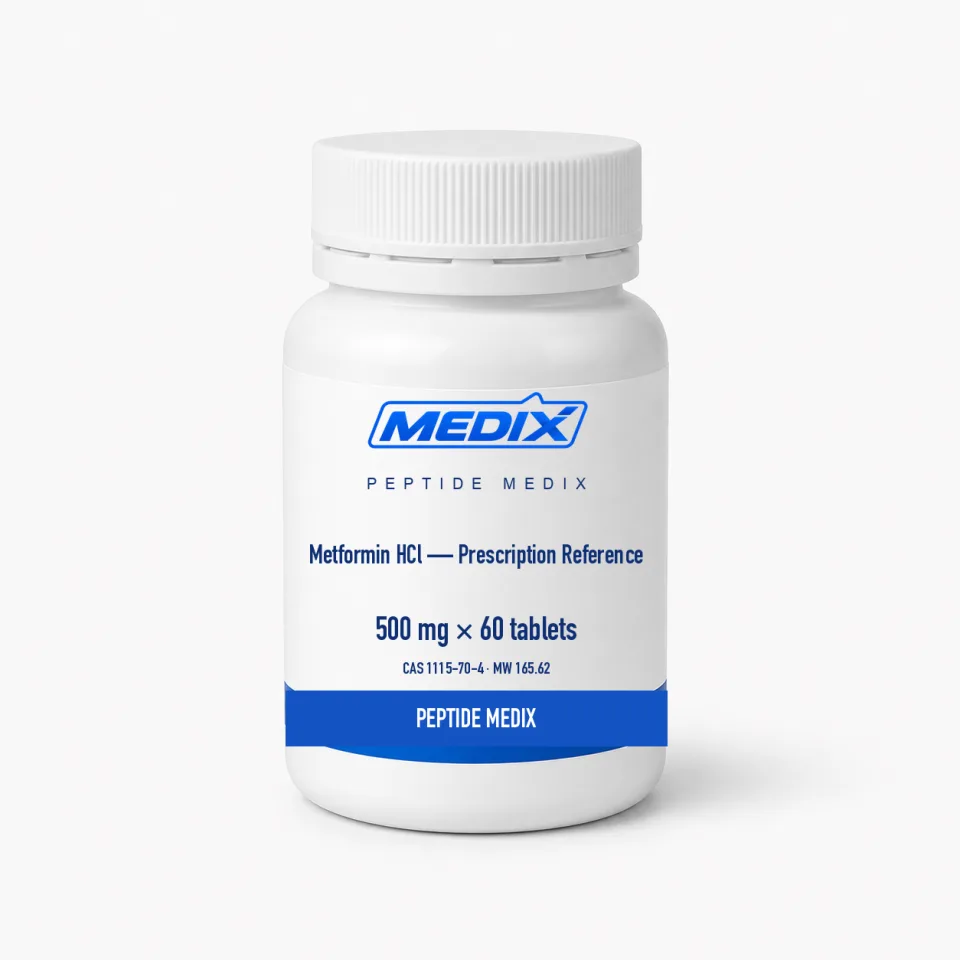
Metformin HCl — Prescription Reference
Biguanide antihyperglycaemic agent — prescription-only reference listing
- Mol. weight165.62 g/mol (hydrochloride); 129.16 g/mol (free base)
Overview
Prescription-only reference listing. Metformin hydrochloride is a prescription medicine. It appears in this institutional catalogue as a reference entry so that clinics, pharmacies and laboratories can identify the compound, its chemistry, its approved indication and its storage requirements. It is supplied only against a valid prescription or documented institutional authorisation, and no dosing, titration or sourcing guidance is given here.
Chemically it is among the smallest molecules in this catalogue: 1,1-dimethylbiguanide hydrochloride, C4H11N5 with HCl, 165.62 g/mol as the salt and 129.16 g/mol as the free base, a white crystalline solid that is freely soluble in water and strongly basic. That polarity accounts for its disposition. It is not metabolised at all, and its movement into hepatocytes and its clearance through the kidney depend on the organic cation transporters OCT1 and OCT2 and on the MATE efflux proteins rather than on passive diffusion, which is also why it recurs in transporter-pharmacogenetics work. Its place in the nutrient-sensing and ageing-biology literature follows from the proposed mechanism at mitochondrial complex I and the consequent shift in cellular AMP to ATP ratio.
Specifications
Identity
- CAS number
- 1115-70-4 (hydrochloride); 657-24-9 (free base)
- Molecular formula
- C4H11N5 · HCl
- Molecular weight
- 165.62 g/mol (hydrochloride); 129.16 g/mol (free base)
Additional detail
- Regulatory status
- Prescription-only medicine (Rx); supplied solely against valid prescription or institutional authorisation
- Generic name
- Metformin hydrochloride
- Chemical name
- 1,1-Dimethylbiguanide hydrochloride
- Drug class
- Biguanide antihyperglycaemic agent
- Appearance
- White to off-white crystalline powder, freely soluble in water
- Proposed mechanism
- Suppression of hepatic gluconeogenesis, associated with mitochondrial complex I inhibition, altered cellular AMP:ATP ratio and AMPK activation
- Transport and elimination
- Substrate of OCT1, OCT2 and MATE transporters; not metabolised, excreted unchanged in urine
- Reference size listed
- 500 mg × 60 tablets
- Storage
- Controlled room temperature, 20–25 °C, in the original container, protected from moisture
- Intended use
- Reference listing only — prescription medicine, not supplied for non-prescribed use
Certificate of analysis
Every lot of Metformin HCl — Prescription Reference is released against its own lot documentation, and where the manufacturer issues a certificate of analysis for it, that certificate is the record for the lot rather than a generic document for the compound. The lot number on the certificate matches the lot number printed on the label you receive — the vial label itself, where the product is vialled — so the record and the material it describes can always be reconciled.
This listing carries no purity percentage, so none is claimed for it here. Where the manufacturer issues analytical documentation for a lot of this item, it is passed on unaltered — ask and we will send whatever exists.
No lot certificate is on display on this page at the moment. That is a publishing state and not a testing one: lots are released and documented as described above whether or not the document is posted here, and we will send what exists for the lot in stock, or for a lot already on your bench, by its number.
Certificates are available on request before you order as well as after, with no account and no charge. Request the certificate for this listing, read the testing and documentation policy in full, or see how to read a peptide COA.
Questions about Metformin HCl — Prescription Reference
Is metformin available without a prescription?
No. Metformin hydrochloride is a prescription-only medicine in the United States and in most other jurisdictions. This page is a reference listing in an institutional catalogue, describing the compound and its regulatory status; product is supplied only against a valid prescription or documented institutional authorisation.
How does metformin lower blood glucose?
Mainly by suppressing hepatic glucose production. The leading account is mild inhibition of mitochondrial complex I, which raises the AMP:ATP ratio and activates AMPK while restraining gluconeogenic flux; inhibition of mitochondrial glycerophosphate dehydrogenase alters cytosolic redox. Gut-based effects on GLP-1 and the microbiome are also studied.
Why does the labelling carry a boxed warning?
Because of lactic acidosis, a rare but serious accumulation-related event. Risk rises with renal impairment, hepatic impairment, hypoxaemic conditions, acute illness and excess alcohol intake. Metformin is not metabolised and is cleared unchanged by the kidney, so renal function determines exposure and drives the labelled eGFR limits.
Why is it catalogued with NMN and rapamycin?
By research theme only: all three recur in nutrient-sensing and ageing-biology literature. The grouping reflects shared subject matter in published work rather than any recommendation to combine them, and metformin's prescription status and approved indication are unaffected by that adjacency.
Related