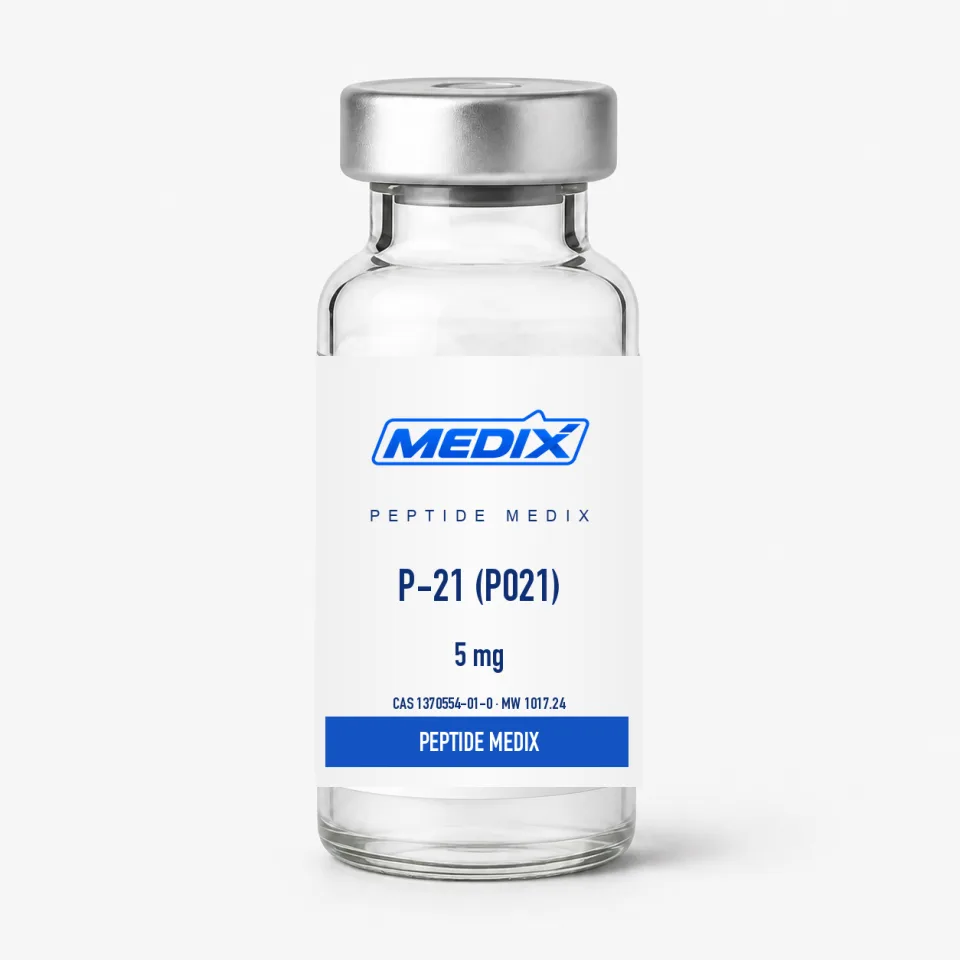
- ≥99% by HPLC
- Lot-matched certificate of analysis
- Ships next business day, tracked
P-21 (P021) Peptide
CNTF-derived peptide mimetic studied in neurogenesis and BDNF signaling models
- FormLyophilized powder in a sealed glass vial
- Research areasAdult hippocampal neurogenesis, BDNF and CREB signaling, tau pathology models
Overview
P-21, also written P021, is a small synthetic compound derived from the biologically active region of ciliary neurotrophic factor (CNTF). Rather than reproducing the full 200-residue protein, its designers reduced the active motif to a short tetrapeptide core, acetylated the N-terminus, amidated the C-terminus and attached an adamantane group. Each of those changes serves a practical purpose: blocking exopeptidase cleavage and raising lipophilicity so the molecule behaves very differently from an unmodified peptide fragment.
The adamantane cage is the design element that separates P-21 from an ordinary tetrapeptide fragment. It is a rigid, strongly lipophilic hydrocarbon that raises the partition coefficient sharply and is essentially inert metabolically, a group borrowed from medicinal chemistry for exactly that combination of properties. Reported work is in rodent neurobiology: adult hippocampal neurogenesis measured by BrdU or doublecortin labelling, BDNF expression and CREB phosphorylation, dendritic spine density, and tau-pathology models where the compound is given chronically. The single 5 mg vial is sized to that pattern of use, since working concentrations are low and material is delivered from a co-solvent stock. Published structural identifiers for the compound differ between sources, so the lot certificate is the authoritative description of what is supplied.
Specifications
Identity
- CAS number
- 1370554-01-0
Supply & purity
- Form
- Lyophilized powder in a sealed glass vial
- Purity
- ≥99% by HPLC; lot-matched COA available
- Solubility
- Limited aqueous solubility; a co-solvent step is commonly used before dilution
Handling & storage
- Storage (lyophilized)
- −20 °C, protected from light and moisture
Additional detail
- Available size
- 5 mg
- Also known as
- P021, CNTF-derived peptide mimetic
- Core structure
- Ac-Asp-Gly-Gly-Leu-Ag-NH2, where Ag denotes an adamantylated glycine residue
- Parent protein
- Ciliary neurotrophic factor (CNTF)
- Compound class
- Adamantylated neurotrophic peptide mimetic
- Research areas
- Adult hippocampal neurogenesis, BDNF and CREB signaling, tau pathology models
- Synthesis
- Solid-phase peptide synthesis with preparative HPLC purification
- Storage (in solution)
- 2–8 °C short term; aliquot and freeze for longer storage
Working out the concentration
The vial sizes above — 5 mg — describe a mass of material, not a strength. Choose a diluent volume, work it out with the reconstitution calculator, and you have the concentration for your own vial of P-21 (P021) plus the volume that carries any mass you want to withdraw.
Certificate of analysis
Every lot of P-21 (P021) is released against a certificate of analysis: the batch-specific laboratory data for that lot, not a generic document for the compound. The lot number on the certificate matches the lot number printed on the label you receive — the vial label itself, where the product is vialled — so the record and the material it describes can always be reconciled.
Purity: ≥99% by HPLC — the specification for this listing. The figure for the lot you receive is the one reported on that lot’s certificate.
No lot certificate is on display on this page at the moment. That is a publishing state and not a testing one: lots are released and documented as described above whether or not the document is posted here, and we will send what exists for the lot in stock, or for a lot already on your bench, by its number.
Certificates are available on request before you order as well as after, with no account and no charge. Request the certificate for this listing, read the testing and documentation policy in full, or see how to read a peptide COA.
Questions about P-21 (P021)
What is P-21 derived from?
It is a synthetic mimetic based on the active region of ciliary neurotrophic factor. The design reduces the parent protein to a short peptide core and adds an acetyl cap, a C-terminal amide and an adamantane group to resist enzymatic breakdown and increase lipophilicity.
Is a certificate of analysis available?
Yes. Each lot is HPLC-tested for purity and mass-spec confirmed for identity, with a lot-matched COA available on request. This matters more than usual for P-21, since published structural identifiers for the compound differ between suppliers and reference databases.
How is P-21 dissolved for laboratory work?
The adamantylated structure limits aqueous solubility, so a concentrated stock is typically made in a compatible organic solvent and then diluted into buffer just before use. Check the working dilution for precipitation and keep solvent content within the tolerance of your assay system.
What size is available?
P-21 ships as a single 5 mg lyophilized vial. That quantity is sized for in vitro assay panels and small animal studies where the compound is used at low working concentrations from a co-solvent stock.
How does P-21 compare with Dihexa?
Both are small, chemically modified molecules derived from peptide research and both are studied for neurotrophic-type signaling, but their origins differ: P-21 derives from CNTF, while Dihexa derives from angiotensin IV and is described as acting through HGF/c-Met. Laboratories sometimes run them in parallel for that reason.
Related