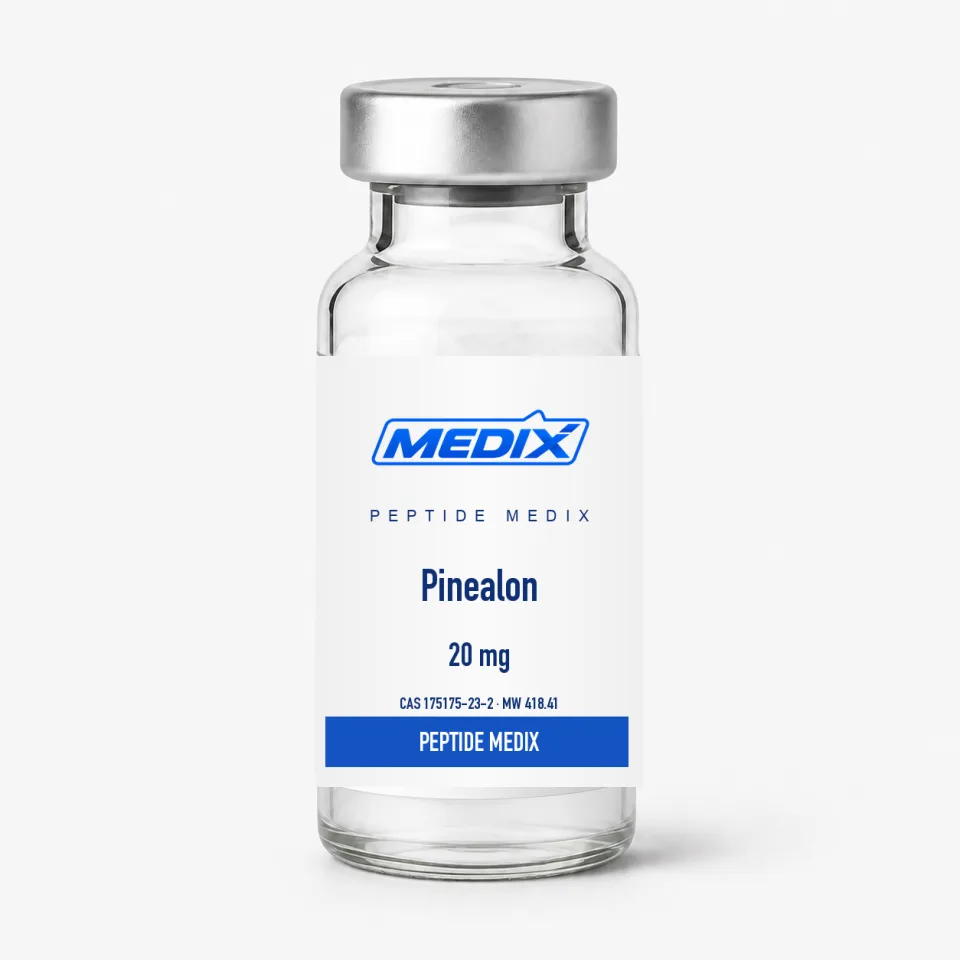
- ≥99% by HPLC
- Lot-matched certificate of analysis
- Ships next business day, tracked
Pinealon
Glu-Asp-Arg (EDR) short-peptide bioregulator used in neuronal research models
- FormLyophilized powder in a sealed glass vial
- Mol. weight418.41 g/mol
- Research areasNeuronal survival, oxidative and hypoxic stress, chromatin and gene expression, ageing of nervous tissue
Overview
Pinealon is a synthetic tripeptide with the sequence glutamyl-aspartyl-arginine (Glu-Asp-Arg, or EDR in one-letter code). It belongs to the family of ultrashort peptide bioregulators developed at the St. Petersburg Institute of Bioregulation and Gerontology, a programme that began with tissue-derived peptide extracts and later moved to fully synthetic analogues built from two to four amino acids. Within that series Pinealon is the sequence associated with brain and pineal tissue preparations, and it is one of the most frequently cited members in the neurobiological literature.
Scientific interest in EDR rests on the proposal that peptides this small can cross cell and nuclear membranes without a carrier and interact directly with double-stranded DNA and histone proteins. Work published by the Khavinson group and collaborators has described sequence-selective binding of short peptides to specific promoter regions and measurable shifts in chromatin condensation in cultured cells. These remain laboratory observations in defined model systems rather than established mechanisms in living humans.
Specifications
Identity
- CAS number
- 175175-23-2
- Molecular formula
- C15H26N6O8
- Molecular weight
- 418.41 g/mol
- Amino acid sequence
- Glu-Asp-Arg (EDR)
- Peptide class
- Khavinson short-peptide bioregulator (tripeptide)
Supply & purity
- Form
- Lyophilized powder in a sealed glass vial
- Purity
- ≥99% by HPLC; lot-matched COA available
- Available sizes
- 20 mg
- Solubility
- Bacteriostatic or sterile water; readily soluble in aqueous buffers
Handling & storage
- Storage (lyophilized)
- −20 °C, sealed and protected from light and moisture
- Storage (reconstituted)
- 2–8 °C, protected from light; use within the study window
Additional detail
- Tissue association
- Brain and pineal peptide preparations
- Research areas
- Neuronal survival, oxidative and hypoxic stress, chromatin and gene expression, ageing of nervous tissue
Working out the concentration
The vial sizes above — 20 mg — describe a mass of material, not a strength. Choose a diluent volume, work it out with the reconstitution calculator, and you have the concentration for your own vial of Pinealon plus the volume that carries any mass you want to withdraw.
For work specified in µM or nM rather than mg/mL, feed 418.41 g/mol and your volume into the peptide molarity calculator.
Certificate of analysis
Every lot of Pinealon is released against a certificate of analysis: the batch-specific laboratory data for that lot, not a generic document for the compound. The lot number on the certificate matches the lot number printed on the label you receive — the vial label itself, where the product is vialled — so the record and the material it describes can always be reconciled.
Purity: ≥99% by HPLC — the specification for this listing. The figure for the lot you receive is the one reported on that lot’s certificate.
No lot certificate is on display on this page at the moment. That is a publishing state and not a testing one: lots are released and documented as described above whether or not the document is posted here, and we will send what exists for the lot in stock, or for a lot already on your bench, by its number.
Certificates are available on request before you order as well as after, with no account and no charge. Request the certificate for this listing, read the testing and documentation policy in full, or see how to read a peptide COA.
Questions about Pinealon
Is the purity independently verified?
Yes. Every lot is tested by HPLC to a ≥99% purity specification, and a lot-matched certificate of analysis is available on request. The COA reports purity, identity confirmation, and appearance for the exact batch you receive.
What size is available?
Pinealon is stocked in a single 20 mg lyophilized vial, which is the standard research quantity for this peptide series. The powder is sealed under vacuum in a glass vial and shipped with tamper-evident packaging from a United States facility.
How should it be stored?
Store the unopened lyophilized vial at −20 °C, protected from light and moisture. After reconstitution keep the solution refrigerated at 2–8 °C and use it within the planned study window. Freezing aliquots avoids repeated freeze-thaw cycles.
What is it usually studied alongside?
Laboratories often run Pinealon in parallel with Epitalon, Cortagen, and Vesugen because all four come from the same short-peptide series and are compared for tissue-specific effects in identical assay conditions.
What solvent is used to reconstitute it?
Bacteriostatic or sterile water is the usual choice in laboratory workflows, since the peptide dissolves readily in aqueous media. Buffer selection depends on the assay, and researchers should confirm compatibility and final pH for their own protocol.