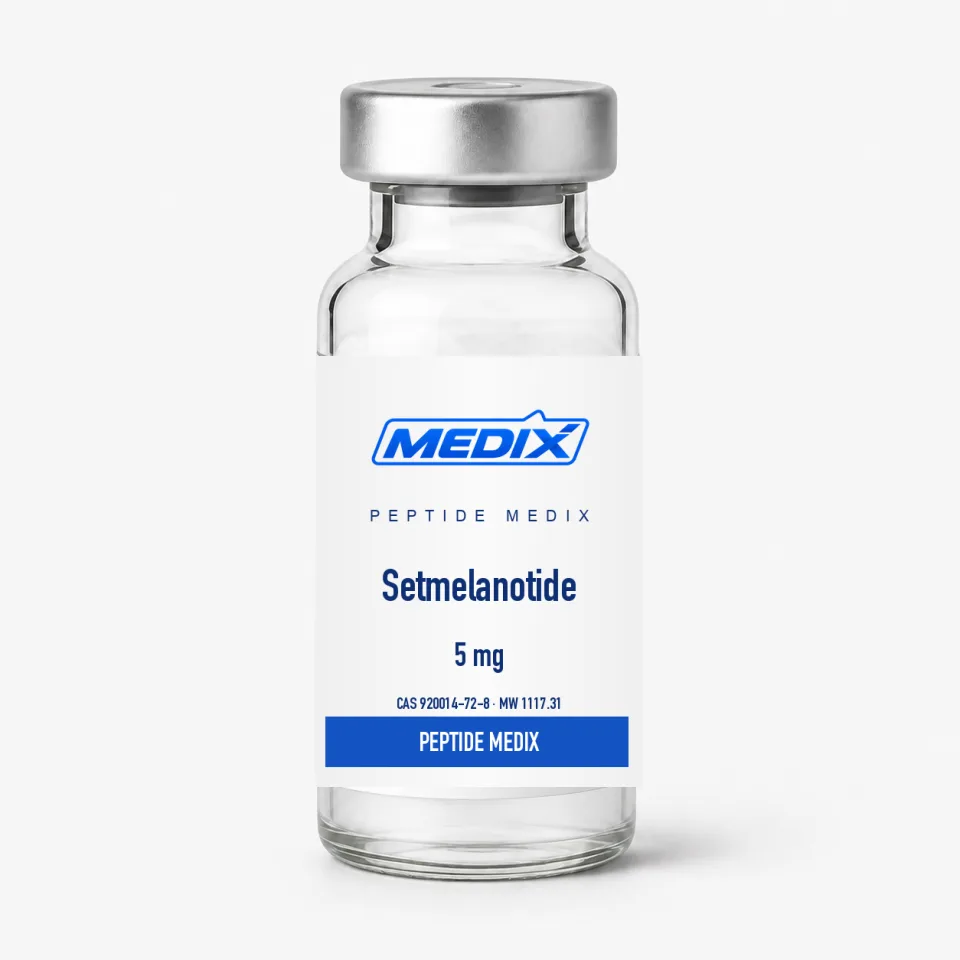
- ≥99% by HPLC
- Lot-matched certificate of analysis
- Ships next business day, tracked
Setmelanotide
Cyclic octapeptide MC4R agonist (RM-493), lyophilized research vials
- FormLyophilized white to off-white powder, sealed glass vial
- Mol. weight1117.31 g/mol
- Research areasEnergy homeostasis, leptin–POMC signalling, hypothalamic feeding circuits, receptor selectivity profiling
Overview
Setmelanotide, also carried in the literature under its development code RM-493, is a cyclic octapeptide agonist at the melanocortin-4 receptor (MC4R). Its structure descends from the melanocortin analogue series that produced melanotan-II, but it was engineered for markedly greater selectivity at MC4R over the related MC1R and MC3R subtypes — a design goal that shaped almost all of the pharmacology written about it.
MC4R sits at a central node of the leptin–proopiomelanocortin pathway in the hypothalamus, the circuit through which peripheral energy-status signals are translated into central regulation of food intake and energy expenditure. Loss-of-function mutations upstream of the receptor — in POMC, PCSK1 or the leptin receptor — leave MC4R itself intact but under-stimulated, which is precisely the situation a selective receptor agonist is used to interrogate in research models.
Specifications
Identity
- CAS number
- 920014-72-8
- Molecular formula
- C49H68N18O9S2
- Molecular weight
- 1117.31 g/mol
- Amino acid sequence
- Ac-Arg-Cys-D-Ala-His-D-Phe-Arg-Trp-Cys-NH2, cyclized Cys2–Cys8
- Chain length
- 8 residues; N-acetylated, C-terminally amidated, disulfide-cyclized
- Peptide class
- Cyclic melanocortin analogue
Supply & purity
- Form
- Lyophilized white to off-white powder, sealed glass vial
- Purity
- ≥99% by HPLC; lot-matched COA available
- Available sizes
- 5 mg, 10 mg
Handling & storage
- Storage (lyophilized)
- −20 °C, desiccated and protected from light
- Storage (reconstituted)
- 2–8 °C for short holds; aliquot at −20 °C or below for longer storage
Additional detail
- Also known as
- RM-493; brand name Imcivree for the approved medicine
- Receptor target
- Melanocortin-4 receptor (MC4R), a Gs-coupled class A GPCR
- Research areas
- Energy homeostasis, leptin–POMC signalling, hypothalamic feeding circuits, receptor selectivity profiling
Working out the concentration
Reconstitution is where the arithmetic lives. The same vial made up with 1 mL or with 3 mL of diluent gives three-fold different numbers, which is why a reconstitution volume calculator is more use here than a fixed table: enter the vial mass and your diluent volume and read the concentration back.
Certificate of analysis
Every lot of Setmelanotide is released against a certificate of analysis: the batch-specific laboratory data for that lot, not a generic document for the compound. The lot number on the certificate matches the lot number printed on the label you receive — the vial label itself, where the product is vialled — so the record and the material it describes can always be reconciled.
Purity: ≥99% by HPLC — the specification for this listing. The figure for the lot you receive is the one reported on that lot’s certificate.
No lot certificate is on display on this page at the moment. That is a publishing state and not a testing one: lots are released and documented as described above whether or not the document is posted here, and we will send what exists for the lot in stock, or for a lot already on your bench, by its number.
Certificates are available on request before you order as well as after, with no account and no charge. Request the certificate for this listing, read the testing and documentation policy in full, or see how to read a peptide COA.
Questions about Setmelanotide
What receptor does setmelanotide act on?
It is an agonist at the melanocortin-4 receptor, MC4R, a Gs-coupled GPCR in hypothalamic circuits that regulate energy balance. It was engineered for selectivity at MC4R over the related MC1R and MC3R subtypes, which is the main pharmacological difference from earlier melanocortin analogues such as melanotan-II.
How does it differ from melanotan-II?
Both are cyclic melanocortin analogues, but melanotan-II binds broadly across the melanocortin receptor family, including MC1R, which drives pigmentation. Setmelanotide was designed for much greater MC4R selectivity, so it is the more common tool compound when a study needs to isolate MC4R signalling.
Is a certificate of analysis provided?
Yes. Every lot is analysed by reverse-phase HPLC to at least 99% purity with mass-spectrometry identity confirmation, and a lot-matched COA is available. Match the lot number printed on the vial to the certificate before recording any experimental data.
Setmelanotide is an approved drug — is this the medicine?
No. An approved prescription product containing this molecule exists, and that is stated here only as public regulatory context. What we supply is research-grade lyophilized peptide for laboratory use, not a pharmaceutical preparation, and it carries no prescribing information.
What are the storage requirements?
Keep sealed vials at −20 °C, desiccated and protected from light. Once reconstituted, hold at 2–8 °C for short periods and store single-use aliquots at −20 °C or below, since repeated freeze–thaw cycles degrade peptides and can compromise the disulfide bridge.
Related