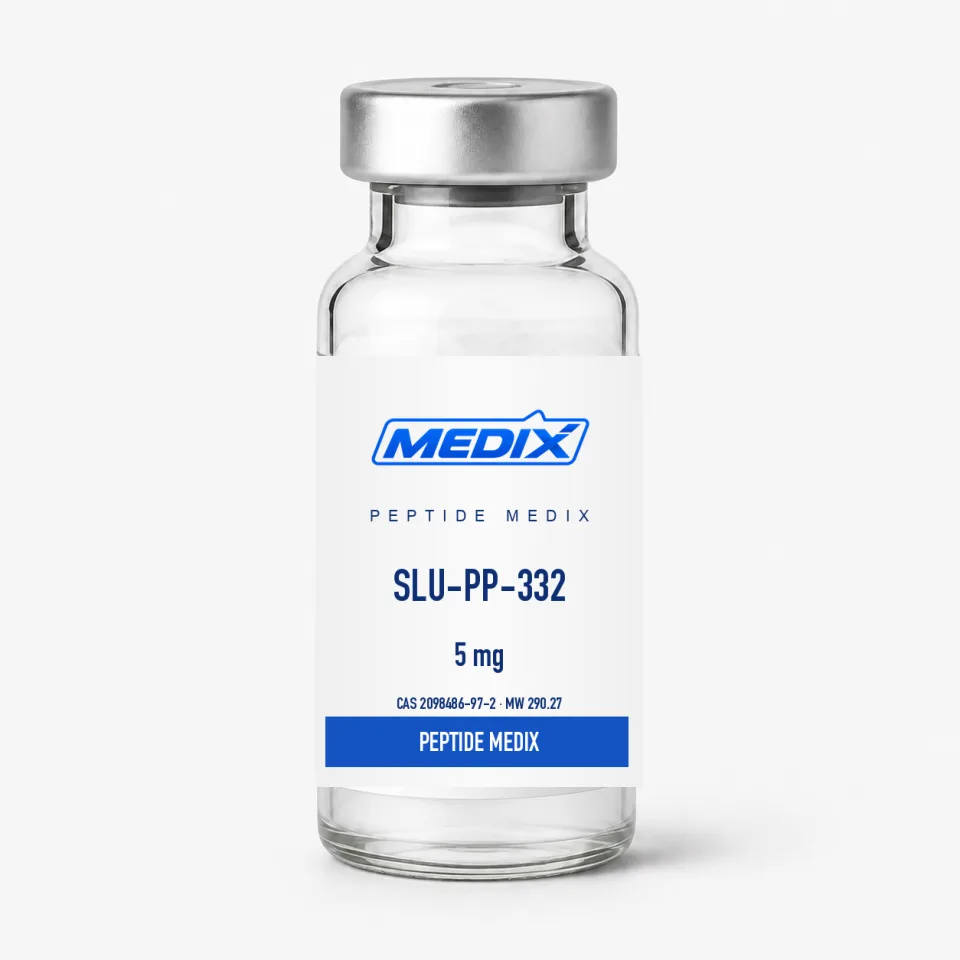
- ≥99% by HPLC
- Lot-matched certificate of analysis
- Ships next business day, tracked
SLU-PP-332
Small-molecule pan-ERR agonist studied as an exercise-mimetic probe
- FormLyophilized powder, sealed glass vial with flip-off seal
- Mol. weight290.27 g/mol
- Research areasMitochondrial biogenesis, fatty-acid oxidation, muscle endurance transcription
Overview
SLU-PP-332 is a synthetic small molecule that acts as an agonist at the estrogen-related receptors (ERR alpha, beta and gamma) — orphan nuclear receptors that regulate the transcriptional program governing mitochondrial biogenesis, oxidative phosphorylation and fatty-acid oxidation in muscle. Despite the name, the receptors are not estrogen receptors and do not bind estradiol; they were named for sequence similarity and act largely through coactivators of the PGC-1 family.
The compound drew attention because ERR activation switches on many of the same genes that endurance exercise induces, which led to it being described in the literature as an exercise mimetic. That framing deserves a caveat researchers state plainly: the published data come from cell systems and mouse studies, and there is no human evidence. That gap is exactly why the molecule is useful as a probe — it lets laboratories ask which parts of the exercise transcriptional response are downstream of ERR signaling and which are not.
Specifications
Identity
- CAS number
- 2098486-97-2
- Molecular weight
- 290.27 g/mol
Supply & purity
- Form
- Lyophilized powder, sealed glass vial with flip-off seal
- Purity
- ≥99% by HPLC; lot-matched COA available
- Available sizes
- 5 mg, 10 mg
- Solubility
- DMSO for concentrated stocks; dilute into assay medium or buffer
Additional detail
- Compound class
- Small-molecule nuclear receptor agonist (non-peptide)
- Molecular target
- Estrogen-related receptors ERR alpha, beta and gamma
- Research areas
- Mitochondrial biogenesis, fatty-acid oxidation, muscle endurance transcription
- Evidence base
- Cell culture and rodent studies only; no human data published
- Storage (solid)
- −20 °C, sealed and protected from light and moisture
- Storage (in solution)
- 2–8 °C, protected from light; use within the study window
Working out the concentration
SLU-PP-332 ships as a lyophilized powder, so nothing on this page can state a concentration: the figure you work with is the one you create when you add diluent. Put the vial mass and the volume you intend to use into the peptide reconstitution calculator and it returns mg/mL, mcg/mL and the mass sitting at each mark on a U-100 syringe.
Where a method is written in molar terms instead, the molecular weight above — 290.27 g/mol — is the input the molarity calculator needs.
Certificate of analysis
Every lot of SLU-PP-332 is released against a certificate of analysis: the batch-specific laboratory data for that lot, not a generic document for the compound. The lot number on the certificate matches the lot number printed on the label you receive — the vial label itself, where the product is vialled — so the record and the material it describes can always be reconciled.
Purity: ≥99% by HPLC — the specification for this listing. The figure for the lot you receive is the one reported on that lot’s certificate.
No lot certificate is on display on this page at the moment. That is a publishing state and not a testing one: lots are released and documented as described above whether or not the document is posted here, and we will send what exists for the lot in stock, or for a lot already on your bench, by its number.
Certificates are available on request before you order as well as after, with no account and no charge. Request the certificate for this listing, read the testing and documentation policy in full, or see how to read a peptide COA.
Questions about SLU-PP-332
Does SLU-PP-332 act on estrogen receptors?
No. The estrogen-related receptors share sequence similarity with estrogen receptors but do not bind estradiol and are functionally distinct. They act as constitutively active orphan nuclear receptors regulating oxidative metabolism genes, mainly through PGC-1 family coactivators.
What purity and documentation are supplied?
Each lot is HPLC tested to at least 99% purity, and a lot-matched certificate of analysis is available. The COA corresponds to the vial number shipped, so purity data stays traceable to the exact material used in your experiments.
Why is DMSO usually used instead of water?
SLU-PP-332 is a small hydrophobic molecule rather than a peptide, so aqueous solubility is limited. Preparing a concentrated DMSO stock and diluting into medium is the standard approach, with vehicle-matched controls run alongside every condition.
How should it be stored?
Keep the sealed solid at −20 °C, protected from light and moisture. Store prepared stocks at 2–8 °C, protected from light, and use within your documented study window. Aliquot so that stocks are not repeatedly warmed and cooled.
Related