- ≥99% by HPLC
- Lot-matched certificate of analysis
- Ships next business day, tracked
AHK-Cu (Copper Tripeptide-3)
Ala-His-Lys copper(II) tripeptide complex studied in hair follicle models
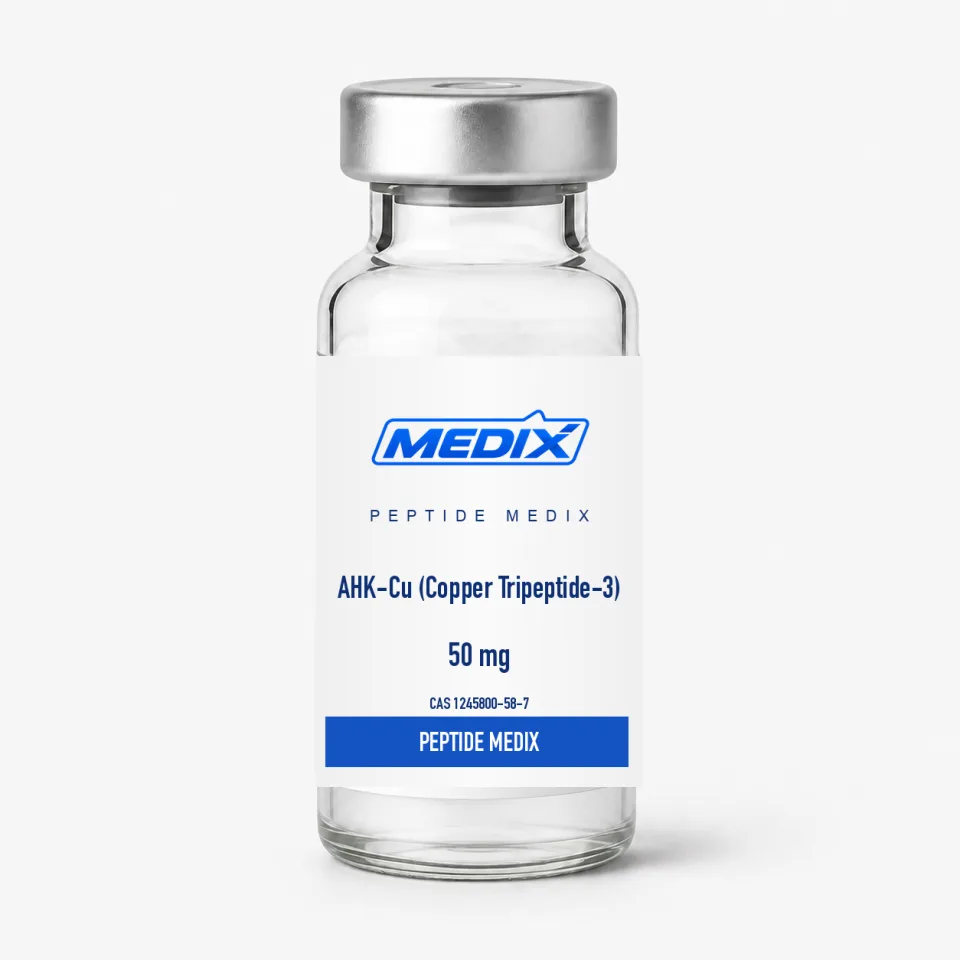
- FormLyophilized blue powder, sealed glass vial with crimped stopper
- Mol. weight≈417.96 g/mol as the copper complex; 354.41 g/mol for the free tripeptide
- Research areasHair follicle biology, dermal papilla cell cultures, angiogenic signalling, topical formulation science
Overview
AHK-Cu is the copper(II) complex of the tripeptide alanyl-histidyl-lysine, listed in cosmetic nomenclature as copper tripeptide-3. It belongs to the same small family of copper-binding matrix peptides as GHK-Cu, differing by a single N-terminal residue: alanine in place of glycine. That change alters the peptide's charge and hydrophobicity slightly while preserving the histidine-lysine motif that chelates divalent copper, and the resulting complex carries the deep blue colour characteristic of copper peptides.
Work with the tripeptide is concentrated in hair biology — dermal papilla cell culture, follicle models and angiogenic marker expression — which is where it meets the wider copper-peptide literature, since copper is a cofactor for lysyl oxidase and features in several angiogenic processes. Handling follows from coordination chemistry rather than peptide chemistry. Strongly acidic media dissociate the complex, as do competing chelators such as EDTA, and either leaves free tripeptide and free copper rather than the species under study; the blue colour is the readout. Vials are 50 mg and 100 mg, larger than typical peptide fills because formulation work consumes material quickly. The neighbouring Pal-AHK listing carries the same tripeptide with a palmitoyl group and no coordinated copper at all.
Specifications
Identity
- CAS number
- 1245800-58-7
- Molecular formula
- C15H26N6O4·Cu (copper(II) complex)
- Molecular weight
- ≈417.96 g/mol as the copper complex; 354.41 g/mol for the free tripeptide
- Amino acid sequence
- Ala-His-Lys (AHK), complexed with copper(II)
- Peptide class
- Copper-binding matrix tripeptide
Supply & purity
- Form
- Lyophilized blue powder, sealed glass vial with crimped stopper
- Purity
- ≥99% by HPLC; lot-matched COA available
- Available sizes
- 50 mg, 100 mg
- Solubility
- Water and bacteriostatic water; avoid strongly acidic media that dissociate the copper complex
Handling & storage
- Storage (lyophilized)
- −20 °C, sealed and protected from light and moisture
- Storage (reconstituted)
- 2–8 °C, protected from light, used within the study window
Additional detail
- INCI name
- Copper tripeptide-3
- Appearance in solution
- Blue to blue-violet, colour intensity tracking copper coordination
- Research areas
- Hair follicle biology, dermal papilla cell cultures, angiogenic signalling, topical formulation science
Working out the concentration
Reconstitution is where the arithmetic lives. The same vial made up with 1 mL or with 3 mL of diluent gives three-fold different numbers, which is why a reconstitution volume calculator is more use here than a fixed table: enter the vial mass and your diluent volume and read the concentration back.
For work specified in µM or nM rather than mg/mL, feed ≈417.96 g/mol as the copper complex and your volume into the peptide molarity calculator.
Certificate of analysis
Every lot of AHK-Cu (Copper Tripeptide-3) is released against a certificate of analysis: the batch-specific laboratory data for that lot, not a generic document for the compound. The lot number on the certificate matches the lot number printed on the label you receive — the vial label itself, where the product is vialled — so the record and the material it describes can always be reconciled.
Purity: ≥99% by HPLC — the specification for this listing. The figure for the lot you receive is the one reported on that lot’s certificate.
No lot certificate is on display on this page at the moment. That is a publishing state and not a testing one: lots are released and documented as described above whether or not the document is posted here, and we will send what exists for the lot in stock, or for a lot already on your bench, by its number.
Certificates are available on request before you order as well as after, with no account and no charge. Request the certificate for this listing, read the testing and documentation policy in full, or see how to read a peptide COA.
Questions about AHK-Cu (Copper Tripeptide-3)
How does AHK-Cu differ from GHK-Cu?
Both are copper-binding tripeptides, but AHK-Cu carries an N-terminal alanine where GHK-Cu carries glycine. The coordination chemistry is similar; the literature differs. GHK-Cu research is concentrated on dermal and matrix biology, while AHK-Cu appears mostly in hair follicle and dermal papilla cell studies.
Why is the powder blue?
The colour comes from copper(II) coordinated by the peptide's histidine imidazole and terminal amine. That visible absorbance is also a practical quality indicator: a preparation that has lost its blue colour has usually lost the copper complex, whether through acidic conditions, chelating excipients or degradation.
What purity documentation is provided?
Each lot is third-party tested by HPLC to at least 99% purity, with a lot-matched certificate of analysis available on request. Keeping the COA with your study record maintains traceability between the material characterised and the data generated from it.
What sizes are available?
AHK-Cu is stocked in 50 mg and 100 mg sealed vials. The 50 mg vial suits single-study cell-culture work, while the 100 mg size is generally chosen for formulation research where larger volumes of stock solution are prepared.
How should it be stored after reconstitution?
Refrigerated at 2–8 °C and protected from light, with the concentration and preparation date recorded on the vial. Copper peptide solutions are not indefinitely stable, so laboratories typically define a working window in the protocol rather than holding stock solutions open-endedly.
Related