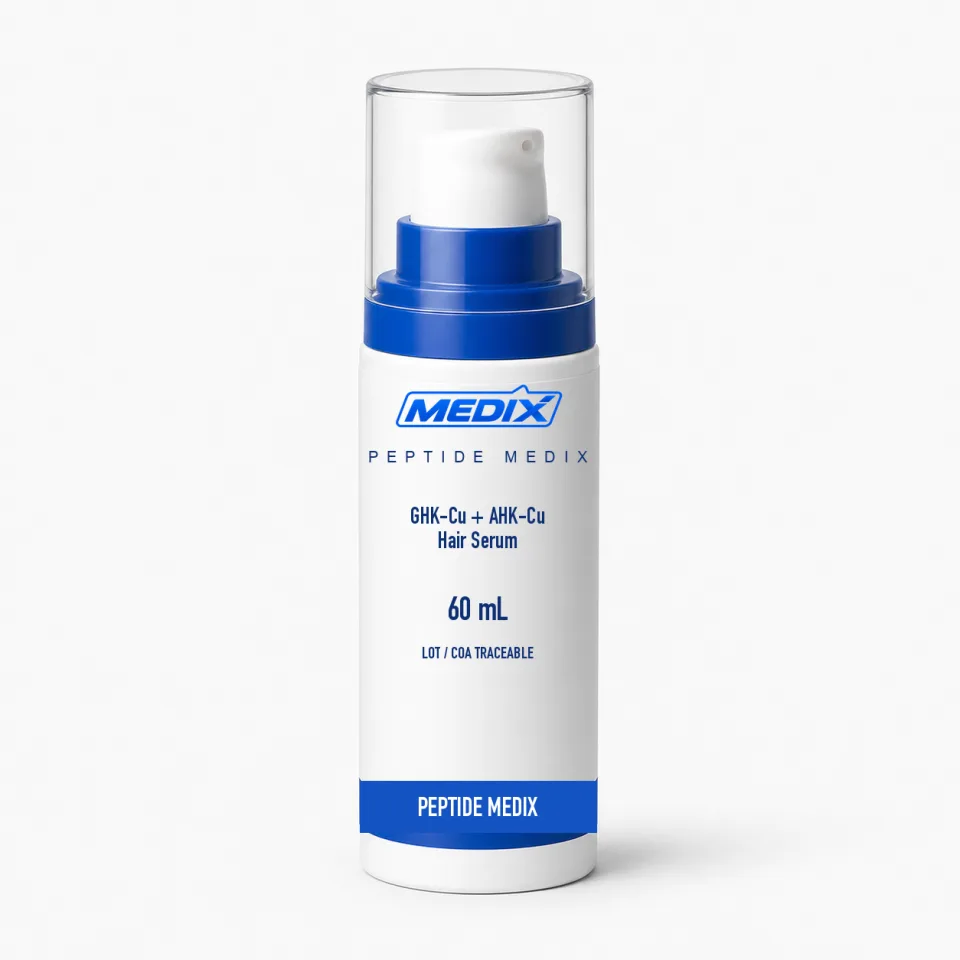
- Peptide purity inputs: ≥99% by HPLC for both actives
- Lot-matched certificate of analysis
- Ships next business day, tracked
GHK-Cu + AHK-Cu Hair Serum
Two-copper-peptide leave-on scalp serum, 60 mL dropper bottle
- FormBlue-tinted aqueous leave-on serum in a dropper bottle
- Research areasDermal papilla cell signalling, follicle-cycle models, angiogenic marker expression, combination formulation studies
Overview
This serum pairs the two copper-binding tripeptides most often used in follicle research — GHK-Cu and AHK-Cu — in a single leave-on scalp preparation supplied in a 60 mL dropper bottle. GHK-Cu is the copper(II) complex of glycyl-L-histidyl-L-lysine, CAS 89030-95-5, formula C14H24N6O4·Cu at 403.93 g/mol, known in cosmetic nomenclature as copper tripeptide-1. AHK-Cu differs by a single residue, alanine in place of glycine, and appears as copper tripeptide-3.
Both peptides carry copper because the His-Lys motif forms a square-planar coordination site for Cu(II) with high affinity — the same chemistry that gives them their characteristic blue colour in powder and in solution. That colour is also the simplest visual indicator that the complex is intact: a serum that has lost its blue tint has lost its copper coordination, whatever the label says about peptide content.
Specifications
Supply & purity
- Form
- Blue-tinted aqueous leave-on serum in a dropper bottle
Additional detail
- Available size
- 60 mL
- Active 1
- GHK-Cu — copper(II) complex of glycyl-L-histidyl-L-lysine (INCI copper tripeptide-1)
- Active 1 identifiers
- CAS 89030-95-5 · C14H24N6O4·Cu · 403.93 g/mol
- Active 2
- AHK-Cu — copper(II) complex of alanyl-L-histidyl-L-lysine (INCI copper tripeptide-3)
- Active 2 identifiers
- CAS 1245800-58-7 · C15H26N6O4·Cu · ≈417.96 g/mol as the copper complex
- Peptide purity inputs
- ≥99% by HPLC for both actives; lot-matched COAs available
- Concentrations
- Printed on the lot label; comparable research serums typically run each copper tripeptide near 1%
- Vehicle
- Lightweight aqueous leave-on base, low residue, no added fragrance or colourant
- Colour
- Blue to blue-violet — colour intensity tracks intact copper coordination
- Research areas
- Dermal papilla cell signalling, follicle-cycle models, angiogenic marker expression, combination formulation studies
- Storage
- 2–8 °C preferred, protected from light; keep the dropper closure tight
- Compatibility note
- Reducing agents and strong chelators dissociate copper from both tripeptides
Units and conversions
Because this is supplied at a stated strength, the question is rarely how much diluent to add — it is what that strength looks like in the units your method is written in. Convert mcg to mg, mL to µL and back with the unit converter.
Certificate of analysis
Every lot of GHK-Cu + AHK-Cu Hair Serum is released against a certificate of analysis: the batch-specific laboratory data for that lot, not a generic document for the compound. The lot number on the certificate matches the lot number printed on the label you receive — the vial label itself, where the product is vialled — so the record and the material it describes can always be reconciled.
Peptide purity inputs: ≥99% by HPLC for both actives — the specification for this listing. The figure for the lot you receive is the one reported on that lot’s certificate.
No lot certificate is on display on this page at the moment. That is a publishing state and not a testing one: lots are released and documented as described above whether or not the document is posted here, and we will send what exists for the lot in stock, or for a lot already on your bench, by its number.
Certificates are available on request before you order as well as after, with no account and no charge. Request the certificate for this listing, read the testing and documentation policy in full, or see how to read a peptide COA.
Questions about GHK-Cu + AHK-Cu Hair Serum
What is in this serum?
Two copper-binding tripeptides in one leave-on aqueous base: GHK-Cu, the copper(II) complex of glycyl-L-histidyl-L-lysine, and AHK-Cu, the alanine analogue. Both are supplied at ≥99% HPLC purity as inputs, and the concentration of each is printed on the lot label.
How do GHK-Cu and AHK-Cu differ?
By a single amino acid. GHK begins with glycine and AHK with alanine; both share the His-Lys motif that forms the square-planar copper coordination site. That structural closeness is why they are studied as a pair, and why matched single-active controls are important in combination work.
Why is the serum blue?
The blue colour comes from copper(II) coordinated by the tripeptide, and its intensity tracks how much of the complex remains intact. If a copper-peptide preparation fades toward colourless or turns green-brown, the coordination has been disturbed and the material is no longer the same active.
What purity documentation is available?
Both peptide inputs are tested by reversed-phase HPLC to at least 99% purity, and lot-matched certificates of analysis are available on request. The finished serum's lot label records the concentration of each active for that batch.
What should not be mixed with it?
Reducing agents such as ascorbic acid, thiol compounds, strong chelators like EDTA and strongly acidic media all disturb copper coordination. In cell work, media copper content also matters, since free copper ions behave quite differently from the coordinated complex.
How should it be stored?
Refrigerated at 2–8 °C is preferred, upright, tightly closed and out of direct light. Dispense into a clean vessel with the dropper and never return unused liquid to the bottle, since aqueous leave-on bases are vulnerable to contamination once opened.
Related