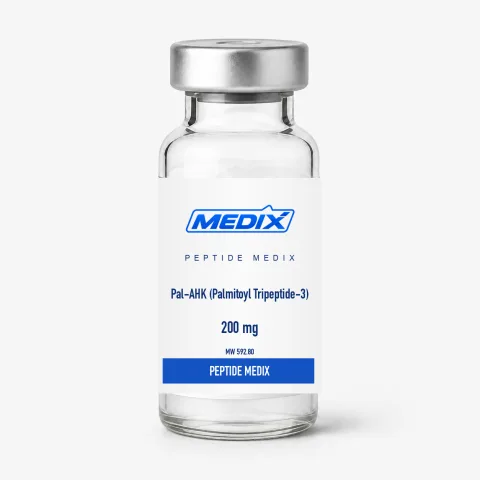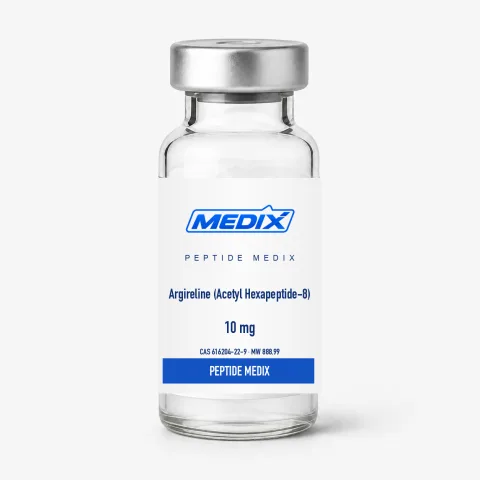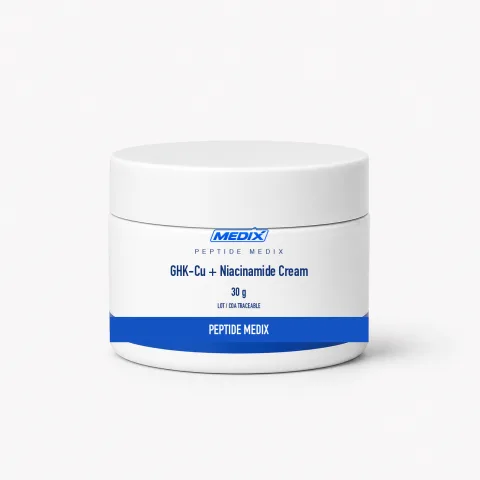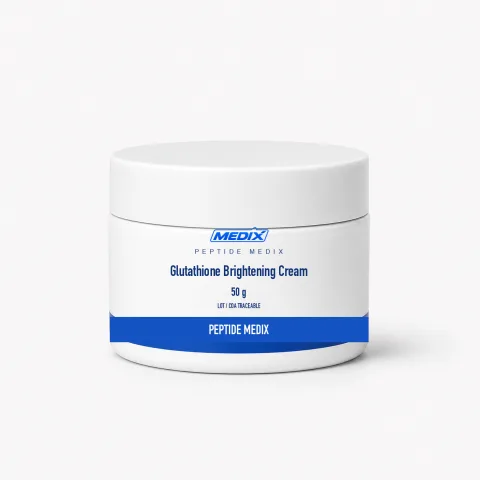
- Peptide purity input: ≥99% by HPLC
- Lot-matched certificate of analysis
- Ships next business day, tracked
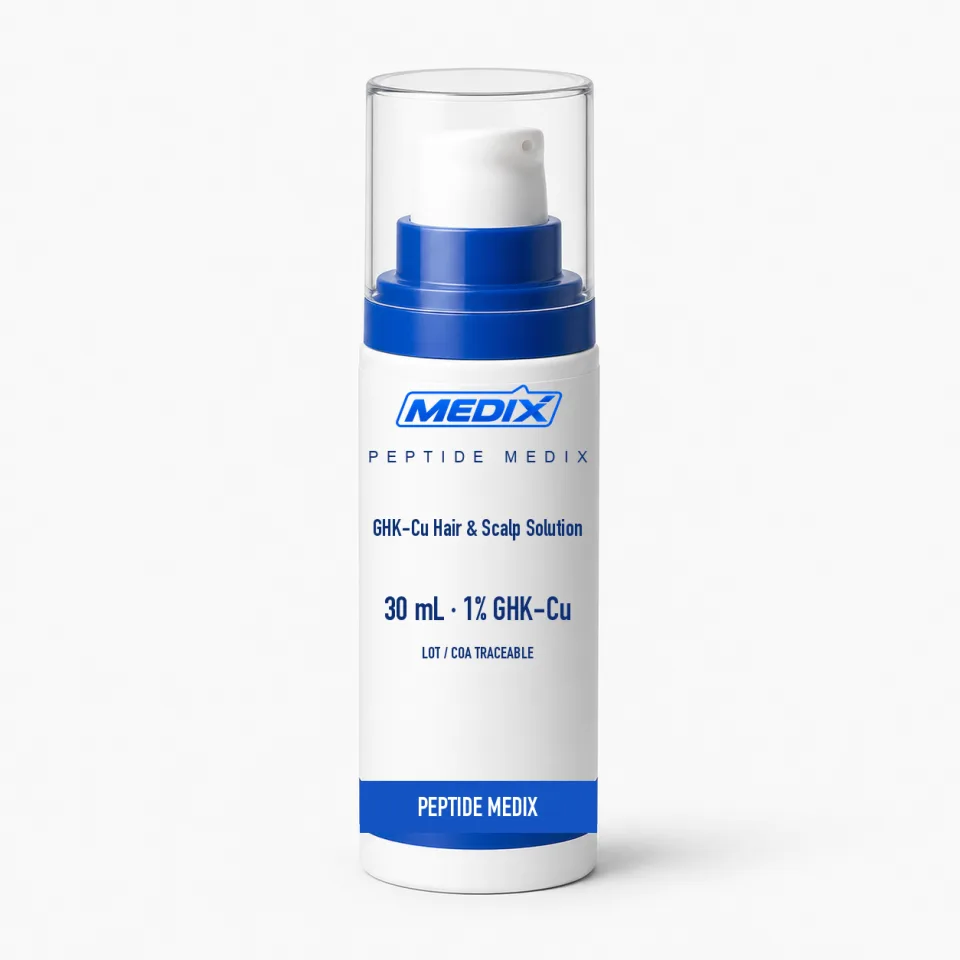
GHK-Cu Hair & Scalp Solution
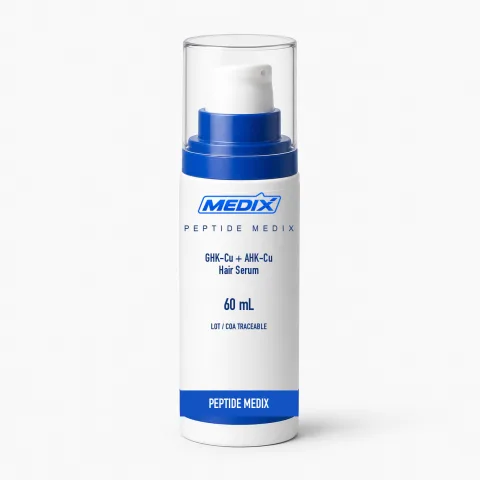
1% GHK-Cu leave-on scalp solution in 30 mL and 60 mL dropper bottles
- FormClear blue aqueous solution in a dropper bottle
- Research areasDermal papilla signalling, follicle-cycle models, angiogenic marker expression
Overview
Interest in copper peptides for follicle research rests on a few strands of published work: GHK-Cu has been reported to influence expression of angiogenic factors including VEGF in dermal papilla cells, to interact with matrix-remodelling enzymes, and in some reports to affect 5-alpha reductase activity. The dermal papilla is the signalling hub that governs the follicular growth cycle, so agents that change papilla-cell behaviour in culture are routinely followed into explant and rodent models.
At 1% w/v the solution carries 10 mg of GHK-Cu per millilitre, so the 30 mL bottle holds about 300 mg of the complex and the 60 mL bottle about 600 mg — quantities that suit repeated application across a long follicle study rather than assay work, for which the powder is the better starting point. The blue colour is the copper complex itself and doubles as a stability check, since reducing agents and chelating excipients disturb the coordination and a solution that has lost its colour has lost the species being studied. The vehicle is a low-residue leave-on aqueous base without added fragrance, chosen so that viscosity and occlusion do not become uncontrolled variables when this format is compared against the powder or the face serum.
Specifications
Supply & purity
- Form
- Clear blue aqueous solution in a dropper bottle
- Available sizes
- 30 mL · 1% GHK-Cu; 60 mL · 1% GHK-Cu
Additional detail
- Active concentration
- 1% w/v GHK-Cu, 10 mg per mL
- Active
- GHK-Cu, copper(II) complex of glycyl-L-histidyl-L-lysine
- INCI name of active
- Copper Tripeptide-1
- CAS number (active)
- 89030-95-5
- Molecular formula (active)
- C14H24N6O4·Cu
- Molecular weight (active)
- 403.93 g/mol
- Peptide purity input
- ≥99% by HPLC; lot-matched COA available
- Vehicle
- Leave-on aqueous base, low residue, no added fragrance
- Research areas
- Dermal papilla signalling, follicle-cycle models, angiogenic marker expression
- Storage
- 2–8 °C preferred, protected from light; keep the dropper closure tight
- Compatibility note
- Reducing agents and chelators can disturb copper coordination in solution
Units and conversions
This is a pre-mixed presentation: the strength is fixed at fill, and the only arithmetic between the label and the bench is a change of units. The peptide unit converter moves between mg, mcg, mL and µL without the decimal-point slip that costs a whole run.
Certificate of analysis
Every lot of GHK-Cu Hair & Scalp Solution is released against a certificate of analysis: the batch-specific laboratory data for that lot, not a generic document for the compound. The lot number on the certificate matches the lot number printed on the label you receive — the vial label itself, where the product is vialled — so the record and the material it describes can always be reconciled.
Peptide purity input: ≥99% by HPLC — the specification for this listing. The figure for the lot you receive is the one reported on that lot’s certificate.
No lot certificate is on display on this page at the moment. That is a publishing state and not a testing one: lots are released and documented as described above whether or not the document is posted here, and we will send what exists for the lot in stock, or for a lot already on your bench, by its number.
Certificates are available on request before you order as well as after, with no account and no charge. Request the certificate for this listing, read the testing and documentation policy in full, or see how to read a peptide COA.
Questions about GHK-Cu Hair & Scalp Solution
What is in the hair and scalp solution?
It is a 1% w/v solution of GHK-Cu, the copper(II) complex of glycyl-histidyl-lysine, at 10 mg per mL in a leave-on aqueous base with no added fragrance. It is supplied in 30 mL and 60 mL dropper bottles that differ only in fill volume.
Why is a thin solution used rather than a cream?
Scalp and follicle models need material that reaches follicular openings without leaving an occlusive film over hair. A low-residue aqueous vehicle keeps viscosity and occlusion from becoming uncontrolled variables and makes repeated dosing across a long study period practical.
Is the peptide in this formulation tested, and is a COA available?
Yes. The peptide input is released against a ≥99% HPLC purity specification with mass-spectrometric identity confirmation, and the lot-matched certificate of analysis is available on request. Each finished container is labelled with its own lot number so bench records can be tied back to the raw-material certificate.
How should the solution be stored?
Refrigerate at 2–8 °C where possible, keep the closure tight and protect the bottle from light. Dispense into a clean vessel instead of returning liquid to the bottle, and record the lot number and opening date so results stay traceable to a particular fill.
How does it relate to GHK-Cu powder and the face serum?
All three use the same peptide specification. The powder lets a laboratory build its own vehicle, the face serum is a facial-model aqueous base, and this solution is the scalp-oriented leave-on format. Using matched material keeps vehicle comparisons free of raw-material variation.
Related