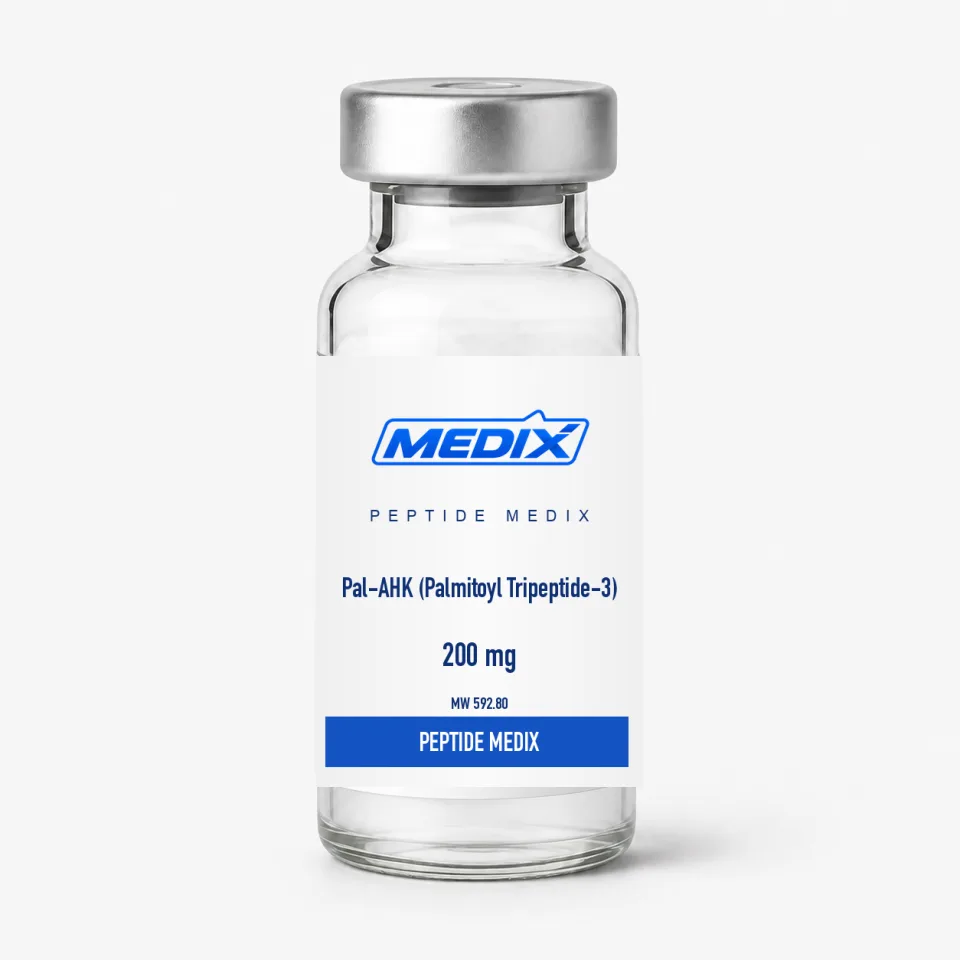
- ≥99% by HPLC
- Lot-matched certificate of analysis
- Ships next business day, tracked
Pal-AHK (Palmitoyl Tripeptide-3)
Lipidated Ala-His-Lys tripeptide for follicle and formulation research
- FormLyophilized amphiphilic peptide powder, sealed glass vial
- Mol. weight592.80 g/mol
- Research areasDermal-papilla cell models, follicle biology, extracellular-matrix signaling and topical peptide partitioning
Overview
Pal-AHK is the N-palmitoylated form of the tripeptide Ala-His-Lys, commonly cataloged as Palmitoyl Tripeptide-3. A sixteen-carbon fatty-acid chain is attached to the peptide's N terminus, changing a small water-soluble tripeptide into an amphiphilic molecule that partitions more readily into lipid phases and interfaces. Palmitic acid is a fully saturated C16 fatty acid and the linkage it forms is a stable amide, so the lipid behaves as a structural part of the molecule rather than a removable additive.
The underlying AHK sequence is closely related to the copper-binding peptide AHK-Cu. In the free tripeptide the terminal amine and the histidine imidazole are what make copper coordination possible, and acylating that terminal amine removes one of those anchors. Pal-AHK is supplied without coordinated copper and is studied mainly as a lipidated signal peptide in dermal-papilla, follicle and topical-delivery models. Evidence specific to Pal-AHK is much thinner than the literature for AHK-Cu or GHK-Cu, so experiments should not transfer mechanisms or outcomes from those compounds without direct controls.
The 200 mg vial contains lyophilized Pal-Ala-His-Lys with formula C31H56N6O5 and molecular weight 592.80 g/mol. Because the material is amphiphilic rather than freely water-soluble, dissolution behaviour deserves as much attention as the weighed mass. The material is HPLC tested with a lot-matched COA available and is supplied only for laboratory formulation and cell-model research—not as a cosmetic, drug or personal-use product.
Specifications
Identity
- Molecular formula
- C31H56N6O5
- Molecular weight
- 592.80 g/mol
- Peptide class
- N-terminally lipidated signal tripeptide
Supply & purity
- Form
- Lyophilized amphiphilic peptide powder, sealed glass vial
- Purity
- ≥99% by HPLC; lot-matched COA available
- Solubility
- Poorly water-soluble; commonly evaluated with a validated co-solvent or surfactant vehicle
Additional detail
- Available size
- 200 mg
- Sequence
- Palmitoyl-Ala-His-Lys-OH (Pal-AHK)
- Also known as
- Pal-AHK, Palmitoyl AHK, Palmitoyl Tripeptide-3
- Copper status
- No coordinated copper added; not AHK-Cu
- Research areas
- Dermal-papilla cell models, follicle biology, extracellular-matrix signaling and topical peptide partitioning
- Storage
- −20 °C lyophilized, protected from light and moisture
Working out the concentration
A lyophilized vial carries a mass on the label and no concentration anywhere, so the first calculation of any protocol is the reconstitution one. The peptide concentration calculator converts vial mass plus diluent volume into mg/mL, and back into the draw volume for a given mass.
For work specified in µM or nM rather than mg/mL, feed 592.80 g/mol and your volume into the peptide molarity calculator.
Certificate of analysis
Every lot of Pal-AHK (Palmitoyl Tripeptide-3) is released against a certificate of analysis: the batch-specific laboratory data for that lot, not a generic document for the compound. The lot number on the certificate matches the lot number printed on the label you receive — the vial label itself, where the product is vialled — so the record and the material it describes can always be reconciled.
Purity: ≥99% by HPLC — the specification for this listing. The figure for the lot you receive is the one reported on that lot’s certificate.
No lot certificate is on display on this page at the moment. That is a publishing state and not a testing one: lots are released and documented as described above whether or not the document is posted here, and we will send what exists for the lot in stock, or for a lot already on your bench, by its number.
Certificates are available on request before you order as well as after, with no account and no charge. Request the certificate for this listing, read the testing and documentation policy in full, or see how to read a peptide COA.
Questions about Pal-AHK (Palmitoyl Tripeptide-3)
Is Pal-AHK the same as AHK-Cu?
No. Pal-AHK is Ala-His-Lys with an N-terminal palmitoyl chain and no added copper. AHK-Cu is the copper(II) complex of the unlipidated tripeptide. They differ in mass, solubility, color and coordination chemistry.
Why is Pal-AHK assigned to Hair Peptides?
Current specialist catalogs and the limited research discussion place it primarily beside AHK-Cu in dermal-papilla and follicle-model work. The category reflects research context, not a claim that the raw peptide produces a hair outcome.
Does Pal-AHK have a standardized CAS number?
No universally reliable CAS identity was confirmed for the exact Pal-Ala-His-Lys-OH form, so this catalog intentionally identifies it by sequence, formula and molecular weight rather than adding an uncertain registry number.
Related