- Purity inputs: Pharmaceutical-grade amino acids
- Lot-matched certificate of analysis
- Ships next business day, tracked
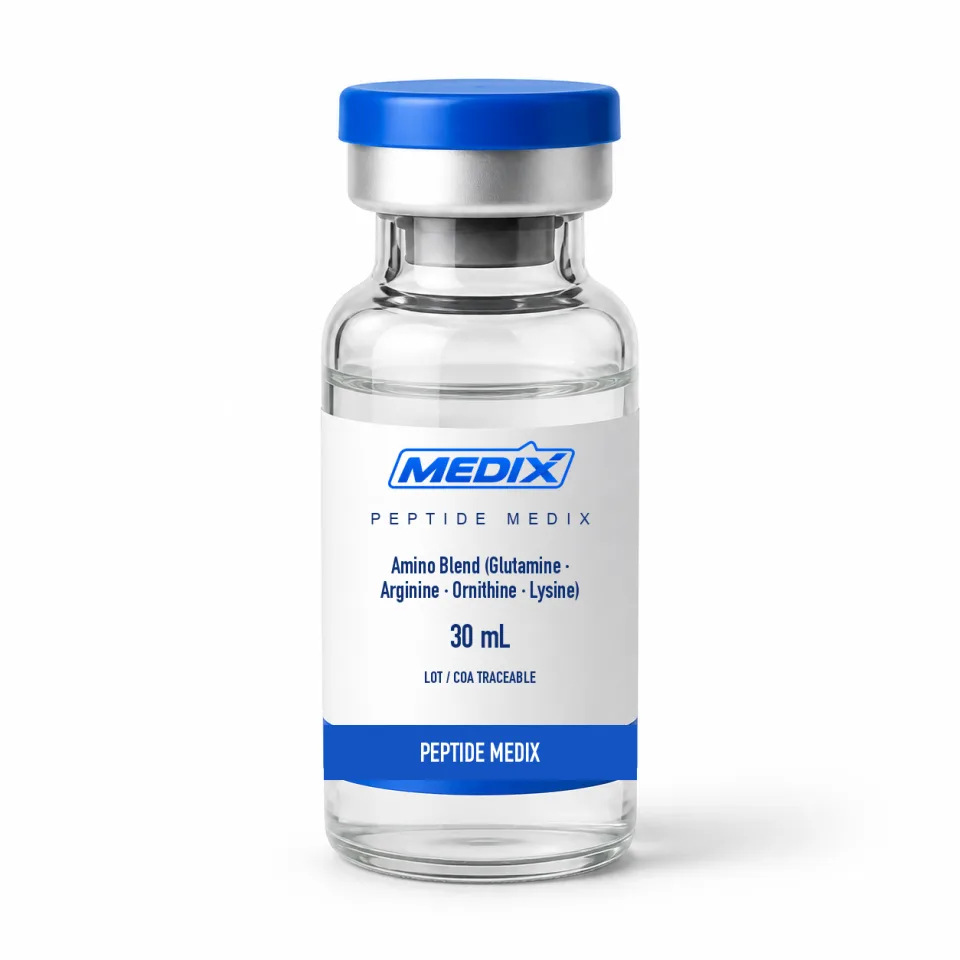
Amino Blend (Glutamine · Arginine · Ornithine · Lysine)
Four-amino-acid sterile solution in a 30 mL multi-dose research vial
- Research areasNitrogen balance, urea cycle flux, GH secretagogue physiology, gut barrier and immune cell fuel studies
Overview
Each component is well characterised chemically. L-glutamine is C5H10N2O3 at 146.14 g/mol, L-arginine C6H14N4O2 at 174.20 g/mol, L-ornithine C5H12N2O2 at 132.16 g/mol and L-lysine C6H14N2O2 at 146.19 g/mol. All four are supplied as pharmaceutical-grade material, and the finished solution is preserved so the vial can be entered repeatedly across a study rather than discarded after a single draw.
What binds the four together is a metabolic network rather than a shared function. Arginase converts arginine to ornithine and urea, ornithine feeds ornithine decarboxylase and the polyamine pathway, lysine and arginine compete for the same cationic amino acid transporters, and glutamine is the principal nitrogen donor feeding into both. Studies using mixtures of this kind look at nitrogen balance and protein turnover, urea-cycle and polyamine flux, glutamine as a fuel for enterocytes and lymphocytes, and arginine as a reference stimulus in growth hormone secretagogue physiology. The article is a single 30 mL preserved solution with per-component concentrations printed on the lot label and no reconstitution step; the benzyl alcohol in the vehicle means a vehicle-only arm is worth building into the design.
Units and conversions
This is a pre-mixed presentation: the strength is fixed at fill, and the only arithmetic between the label and the bench is a change of units. The peptide unit converter moves between mg, mcg, mL and µL without the decimal-point slip that costs a whole run.
Certificate of analysis
Every lot of Amino Blend (Glutamine · Arginine · Ornithine · Lysine) is released against a certificate of analysis: the batch-specific laboratory data for that lot, not a generic document for the compound. The lot number on the certificate matches the lot number printed on the label you receive — the vial label itself, where the product is vialled — so the record and the material it describes can always be reconciled.
Purity inputs: Pharmaceutical-grade amino acids — the specification for this listing. The figure for the lot you receive is the one reported on that lot’s certificate.
No lot certificate is on display on this page at the moment. That is a publishing state and not a testing one: lots are released and documented as described above whether or not the document is posted here, and we will send what exists for the lot in stock, or for a lot already on your bench, by its number.
Certificates are available on request before you order as well as after, with no account and no charge. Request the certificate for this listing, read the testing and documentation policy in full, or see how to read a peptide COA.
Questions about Amino Blend (Glutamine · Arginine · Ornithine · Lysine)
Why are these four combined?
Their metabolism interlocks. Arginine is converted to ornithine by arginase, ornithine feeds polyamine synthesis, lysine shares transporters with arginine, and glutamine is the body's main nitrogen shuttle. Studying them together lets researchers look at that network rather than one node at a time.
Is a certificate of analysis available?
Yes. Each lot is documented with identity and content for the amino acid components and sterility of the finished solution, and a certificate matched to the lot number on your vial is available on request before or after purchase.
How should the vial be stored and handled?
Keep it upright at 2–8 °C away from light and do not freeze. Swab the stopper before each entry, use a fresh sterile needle every time, and note the first-entry date. Discard the vial if the solution becomes hazy, discoloured or shows particulates.
Does the solution contain a preservative?
Yes. Benzyl alcohol is included so the vial can be entered more than once during a study without the diluent supporting microbial growth. That also means the vehicle is not inert, so vehicle-only control arms are worth including in experimental designs.
What research uses does it have?
It is used in nitrogen balance and protein turnover work, gut barrier and immune cell fuel studies involving glutamine, urea cycle and polyamine flux experiments, and as a reference stimulus arm in growth hormone secretagogue physiology.
Related