- Lot-matched certificate of analysis
- Ships next business day, tracked
Biotin (Vitamin B7)
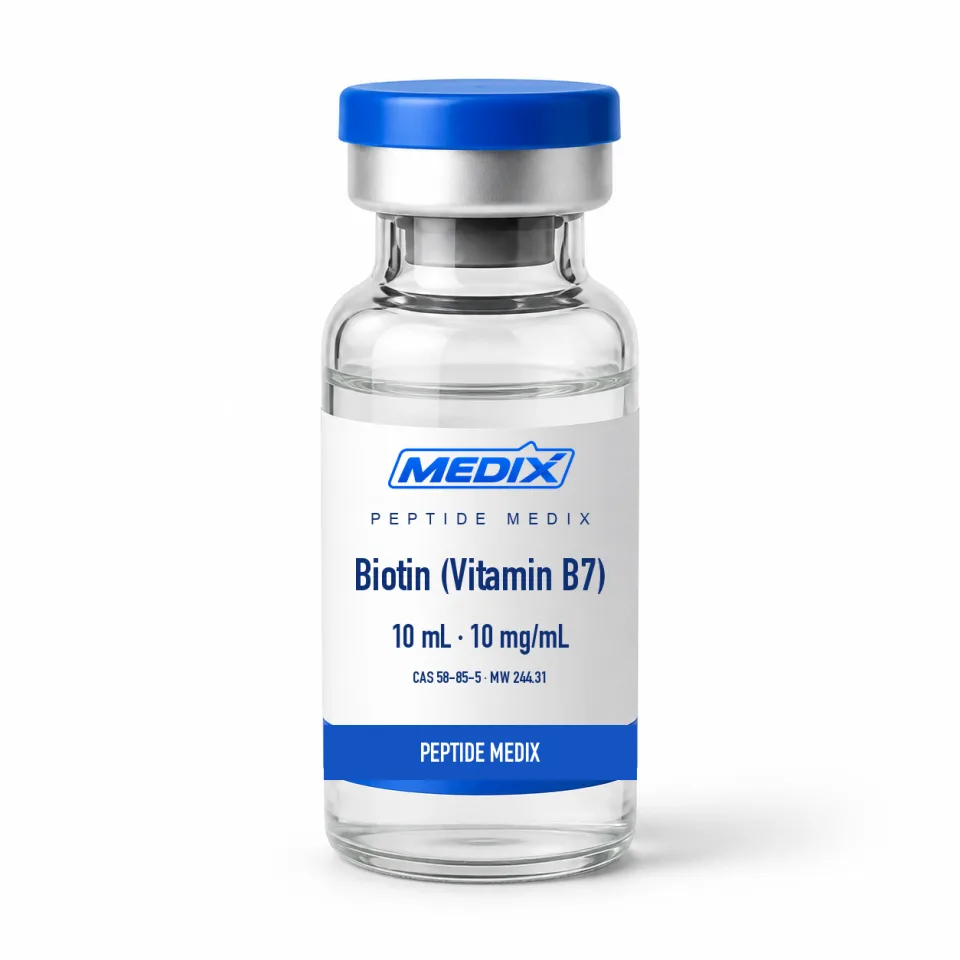
Biotin solution at 10 mg/mL in a 10 mL research vial
- FormClear aqueous solution in a sealed vial
- Mol. weight244.31 g/mol
- Research areasCarboxylase biochemistry, biotinylation and affinity capture, assay interference studies, hair and skin models
Overview
Biotin, also called vitamin B7 or vitamin H, is a bicyclic compound consisting of a ureido ring fused to a tetrahydrothiophene ring carrying a valeric acid side chain. That side-chain carboxyl is the attachment point through which biotin is covalently linked to lysine residues on carboxylase enzymes, forming the biocytin linkage that makes the vitamin function as a mobile carboxyl carrier.
In mammalian metabolism, biotin serves as the prosthetic group for five carboxylases: acetyl-CoA carboxylase 1 and 2 in fatty acid synthesis and oxidation control, pyruvate carboxylase in gluconeogenesis, propionyl-CoA carboxylase in odd-chain fatty acid and amino acid catabolism, and methylcrotonyl-CoA carboxylase in leucine breakdown. Holocarboxylase synthetase attaches it and biotinidase recycles it, a cycle studied in inherited metabolic disorder models.
Beyond metabolism, biotin is one of the most important reagents in molecular biology because of its extraordinarily tight, non-covalent binding to avidin and streptavidin — among the strongest such interactions known. That property underlies biotinylation labeling, affinity purification, ELISA detection systems and countless assay architectures. Supplied as a 10 mg/mL solution in a 10 mL vial with a lot-matched COA.
Specifications
Identity
- CAS number
- 58-85-5
- Molecular formula
- C10H16N2O3S
- Molecular weight
- 244.31 g/mol
Supply & purity
- Form
- Clear aqueous solution in a sealed vial
Additional detail
- Concentration
- 10 mg/mL biotin
- Vial size
- 10 mL
- Also known as
- Vitamin B7, vitamin H, coenzyme R
- Chemical class
- Bicyclic ureido-thiophene water-soluble vitamin
- Enzyme role
- Prosthetic group for acetyl-CoA, pyruvate, propionyl-CoA and methylcrotonyl-CoA carboxylases
- Binding partners
- Avidin and streptavidin, with femtomolar-range dissociation constants
- Research areas
- Carboxylase biochemistry, biotinylation and affinity capture, assay interference studies, hair and skin models
- Storage
- 2–8 °C, protected from light; do not freeze
- Assay note
- Excess free biotin saturates streptavidin capture and can distort immunoassay results
Units and conversions
This is a pre-mixed presentation: the strength is fixed at fill, and the only arithmetic between the label and the bench is a change of units. The peptide unit converter moves between mg, mcg, mL and µL without the decimal-point slip that costs a whole run.
Certificate of analysis
Every lot of Biotin (Vitamin B7) is released against its own lot documentation, and where the manufacturer issues a certificate of analysis for it, that certificate is the record for the lot rather than a generic document for the compound. The lot number on the certificate matches the lot number printed on the label you receive — the vial label itself, where the product is vialled — so the record and the material it describes can always be reconciled.
This listing carries no purity percentage, so none is claimed for it here. Where the manufacturer issues analytical documentation for a lot of this item, it is passed on unaltered — ask and we will send whatever exists.
No lot certificate is on display on this page at the moment. That is a publishing state and not a testing one: lots are released and documented as described above whether or not the document is posted here, and we will send what exists for the lot in stock, or for a lot already on your bench, by its number.
Certificates are available on request before you order as well as after, with no account and no charge. Request the certificate for this listing, read the testing and documentation policy in full, or see how to read a peptide COA.
Questions about Biotin (Vitamin B7)
What is biotin?
Biotin, or vitamin B7, is a water-soluble bicyclic vitamin that acts as the prosthetic group for five carboxylase enzymes in mammalian metabolism. It is also the ligand half of the biotin-streptavidin pair used throughout molecular biology.
What concentration is supplied?
The solution is supplied at 10 mg/mL in a 10 mL vial, ready to use with no weighing or reconstitution. Biotin has modest solubility in neutral aqueous media, so a prepared solution avoids the dissolution difficulties of the free acid powder.
How should biotin be stored?
Keep the vial refrigerated at 2–8 °C, protected from light, and do not freeze. If crystals appear after cold storage, warming to room temperature with gentle mixing usually restores a clear solution before use.
Is this lot tested?
Yes. Each lot ships with a lot-matched Certificate of Analysis documenting identity, concentration and purity, available for review before purchase so the material can be assessed against your own acceptance criteria.
Related