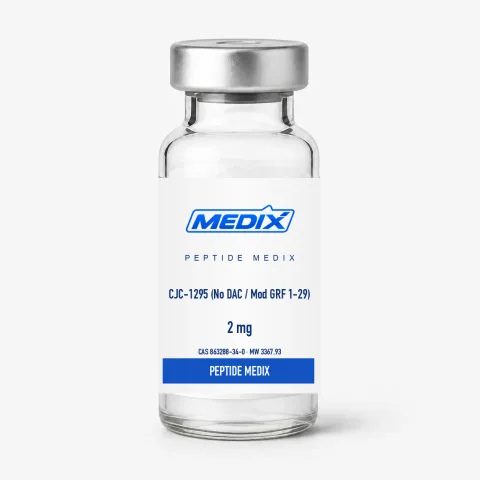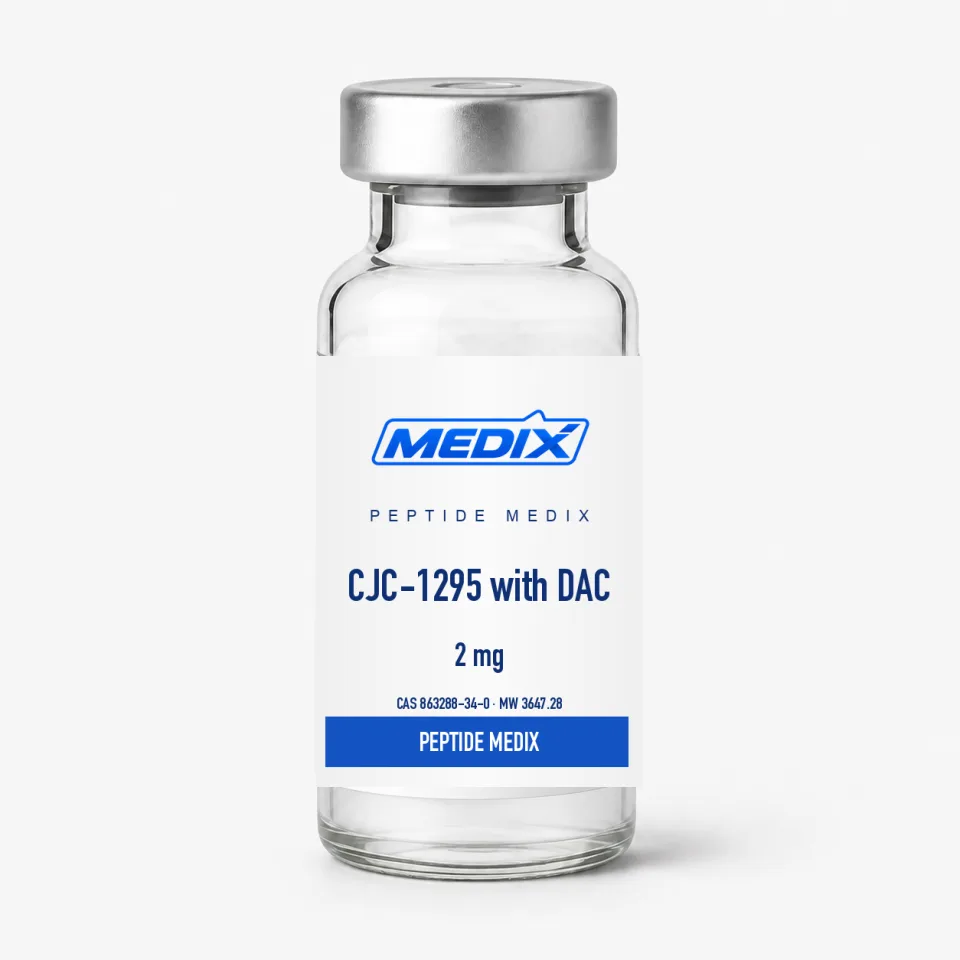
- ≥99% by HPLC
- Lot-matched certificate of analysis
- Ships next business day, tracked
CJC-1295 with DAC Peptide
Albumin-binding GHRH analogue with drug affinity complex
- FormLyophilized powder, sealed glass vial
- Mol. weight3647.28 g/mol
- Research areasSustained secretagogue signalling, receptor desensitisation, IGF-1 dynamics
Overview
CJC-1295 with DAC is a synthetic growth hormone-releasing hormone analogue built on the Modified GRF 1-29 backbone and extended with a lysine at position 30 that carries a maleimidopropionyl group — the drug affinity complex, or DAC. That maleimide reacts with the free cysteine-34 thiol of circulating serum albumin, forming a covalent conjugate that shields the peptide from renal clearance and peptidase attack.
The chemistry is the whole point of the molecule. Where unconjugated GHRH fragments disappear within minutes, the albumin-bound form has been reported to persist for days in animal models, producing sustained rather than pulsatile receptor exposure. Researchers therefore use it as a long-acting comparator when they want to isolate what continuous GHRH receptor occupancy does to somatotroph signalling, receptor desensitisation and downstream IGF-1 levels.
Specifications
Identity
- CAS number
- 863288-34-0
- Molecular formula
- C165H269N47O46
- Molecular weight
- 3647.28 g/mol
- Peptide class
- Long-acting GHRH analogue (GHRH-R agonist)
Supply & purity
- Form
- Lyophilized powder, sealed glass vial
- Purity
- ≥99% by HPLC; lot-matched COA available
- Available sizes
- 2 mg, 5 mg, 10 mg
Handling & storage
- Storage (lyophilized)
- −20 °C, sealed and protected from light and moisture
- Storage (reconstituted)
- 2–8 °C, used within the study window
Additional detail
- Also known as
- CJC-1295 DAC, DAC:GRF, drug affinity complex GHRH analogue
- Structure
- Modified GRF 1-29 (D-Ala2, Gln8, Ala15, Leu27) extended with Lys30-maleimidopropionamide
- Conjugation chemistry
- Maleimide–thiol addition to cysteine-34 of serum albumin
- Research areas
- Sustained secretagogue signalling, receptor desensitisation, IGF-1 dynamics
Working out the concentration
Because CJC-1295 with DAC arrives dry, its concentration is a decision rather than a specification. Run the numbers through the reconstitution calculator — vial mass in, diluent volume in, mg/mL and mass per syringe unit out.
Certificate of analysis
Every lot of CJC-1295 with DAC is released against a certificate of analysis: the batch-specific laboratory data for that lot, not a generic document for the compound. The lot number on the certificate matches the lot number printed on the label you receive — the vial label itself, where the product is vialled — so the record and the material it describes can always be reconciled.
Purity: ≥99% by HPLC — the specification for this listing. The figure for the lot you receive is the one reported on that lot’s certificate.
No lot certificate is on display on this page at the moment. That is a publishing state and not a testing one: lots are released and documented as described above whether or not the document is posted here, and we will send what exists for the lot in stock, or for a lot already on your bench, by its number.
Certificates are available on request before you order as well as after, with no account and no charge. Request the certificate for this listing, read the testing and documentation policy in full, or see how to read a peptide COA.
Questions about CJC-1295 with DAC
What does DAC mean in CJC-1295 with DAC?
DAC stands for drug affinity complex. It refers to the maleimidopropionyl group attached to the C-terminal lysine, which reacts with cysteine-34 on serum albumin. The resulting covalent conjugate protects the peptide from clearance and greatly extends its residence time in animal models.
Which buffers should be avoided during reconstitution?
Avoid any solvent containing free thiols or reducing agents such as DTT, TCEP or beta-mercaptoethanol. These react with the maleimide group and destroy the albumin-binding chemistry. Bacteriostatic or sterile water is the standard choice for laboratory reconstitution.
Is a Certificate of Analysis available?
Yes. Every lot is third-party tested by HPLC for ≥99% purity and identity, with a lot-matched Certificate of Analysis available on request. Verify that the lot number on your vial matches the certificate before recording the material in your laboratory inventory.
Related