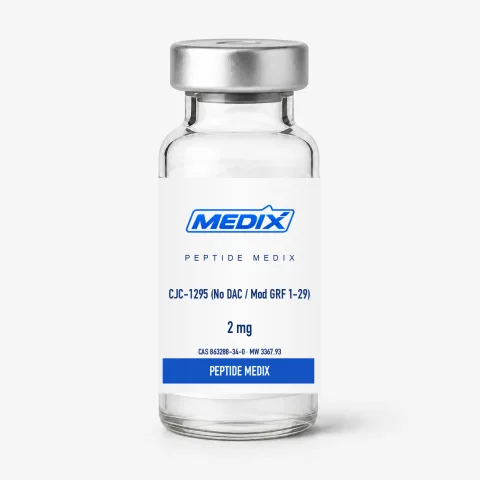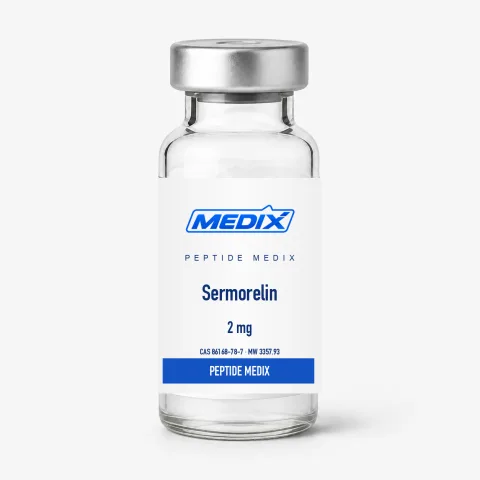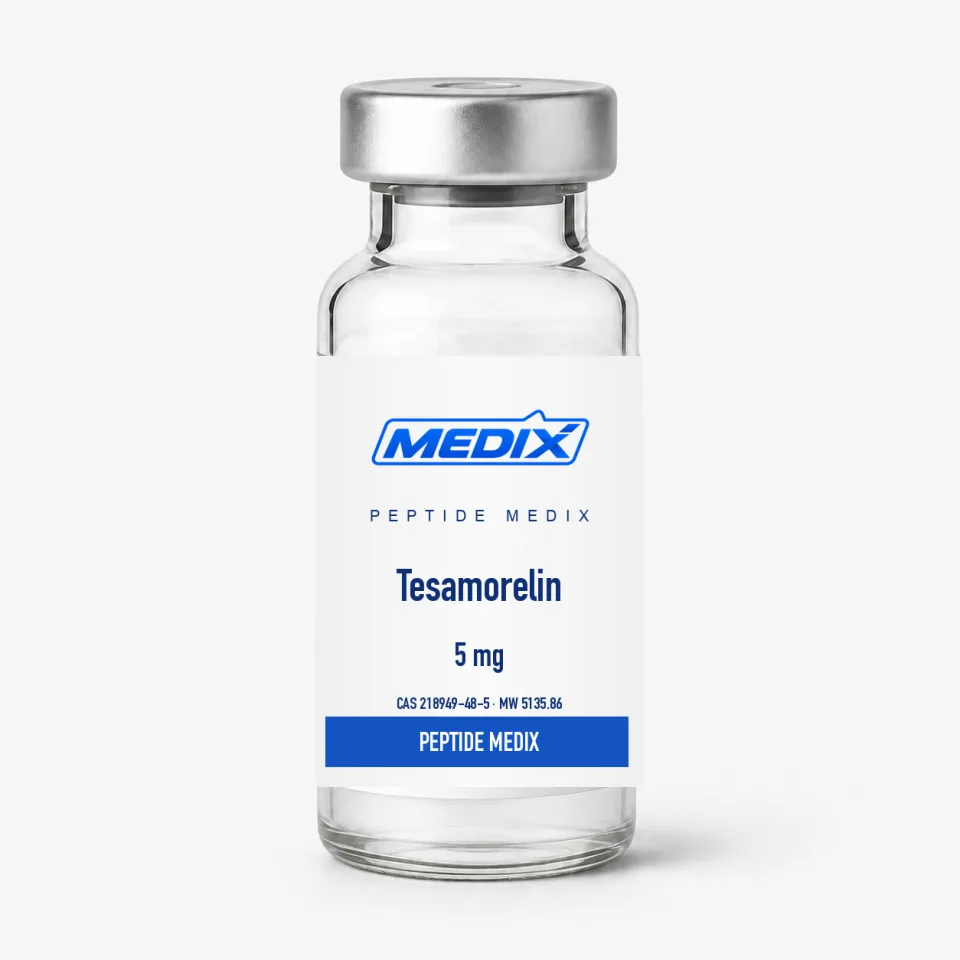
- ≥99% by HPLC
- Lot-matched certificate of analysis
- Ships next business day, tracked
Tesamorelin Peptide
Trans-3-hexenoyl GHRH (1–44) analogue research peptide
- FormLyophilized powder, sealed glass vial
- Mol. weight5135.86 g/mol
- Research areasSomatotropic axis signalling, visceral adipose metabolism, peptide stability
Overview
Tesamorelin is a synthetic analogue of human growth hormone-releasing hormone in which the full 44-residue GHRH sequence carries a trans-3-hexenoyl group attached to the N-terminal tyrosine. That single lipophilic modification is the point of the molecule: the unprotected N-terminus of native GHRH is rapidly clipped by dipeptidyl peptidase-4, and acylation at this position is studied for how it slows that degradation while preserving receptor recognition.
With a molecular weight of roughly 5136 g/mol it is one of the larger GHRH-family peptides offered for laboratory work, and considerably longer than truncated fragments such as sermorelin or modified GRF 1-29. It is produced by solid-phase synthesis, purified by reversed-phase HPLC and supplied as a lyophilized powder. In research settings it is used as a stable, well-characterised GHRH receptor agonist for endocrine signalling studies and for comparative work on adipose tissue metabolism in animal models.
Specifications
Identity
- CAS number
- 218949-48-5
- Molecular formula
- C221H366N72O67S
- Molecular weight
- 5135.86 g/mol
- Amino acid sequence
- trans-3-hexenoyl-Tyr-Ala-Asp-Ala-Ile-Phe-Thr-Asn-Ser-Tyr-Arg-Lys-Val-Leu-Gly-Gln-Leu-Ser-Ala-Arg-Lys-Leu-Leu-Gln-Asp-Ile-Met-Ser-Arg-Gln-Gln-Gly-Glu-Ser-Asn-Gln-Glu-Arg-Gly-Ala-Arg-Ala-Arg-Leu-NH2
- Chain length
- 44 amino acids, N-terminally acylated, C-terminal amide
- Peptide class
- GHRH analogue (GHRH-R agonist)
Supply & purity
- Form
- Lyophilized powder, sealed glass vial
- Purity
- ≥99% by HPLC; lot-matched COA available
- Available sizes
- 5 mg, 10 mg, 20 mg
Handling & storage
- Storage (lyophilized)
- −20 °C, sealed and protected from light and moisture
- Storage (reconstituted)
- 2–8 °C, used within the study window
Additional detail
- Key modification
- trans-3-hexenoyl group on the N-terminal tyrosine
- Research areas
- Somatotropic axis signalling, visceral adipose metabolism, peptide stability
Working out the concentration
Because Tesamorelin arrives dry, its concentration is a decision rather than a specification. Run the numbers through the reconstitution calculator — vial mass in, diluent volume in, mg/mL and mass per syringe unit out.
Certificate of analysis
Every lot of Tesamorelin is released against a certificate of analysis: the batch-specific laboratory data for that lot, not a generic document for the compound. The lot number on the certificate matches the lot number printed on the label you receive — the vial label itself, where the product is vialled — so the record and the material it describes can always be reconciled.
Purity: ≥99% by HPLC — the specification for this listing. The figure for the lot you receive is the one reported on that lot’s certificate.
No lot certificate is on display on this page at the moment. That is a publishing state and not a testing one: lots are released and documented as described above whether or not the document is posted here, and we will send what exists for the lot in stock, or for a lot already on your bench, by its number.
Certificates are available on request before you order as well as after, with no account and no charge. Request the certificate for this listing, read the testing and documentation policy in full, or see how to read a peptide COA.
Questions about Tesamorelin
What is Tesamorelin?
Tesamorelin is a synthetic analogue of the full 44-amino-acid growth hormone-releasing hormone sequence, modified with a trans-3-hexenoyl group at the N-terminus. Laboratories use it as a stabilised GHRH receptor agonist in endocrine signalling and metabolic research models.
How does Tesamorelin differ from Sermorelin?
Sermorelin is the unmodified 1–29 fragment of GHRH, whereas tesamorelin is the full 1–44 sequence carrying an N-terminal acyl group. Researchers compare the two to study how chain length and N-terminal protection affect enzymatic stability and receptor activation in vitro.
Is a Certificate of Analysis provided?
Yes. Each lot is third-party tested by HPLC for ≥99% purity and identity, and a lot-matched COA is available on request. Cross-check the lot number on the vial label against the certificate so your laboratory records refer to the exact batch you received.
How stable is the reconstituted peptide?
Once dissolved, tesamorelin is far less stable than the dry powder. Keep the solution at 2–8 °C, shielded from light, and use it within the window your laboratory has validated. Aliquoting before storage avoids the degradation caused by repeated freeze–thaw cycles.
Related