- Lot-matched certificate of analysis
- Ships next business day, tracked
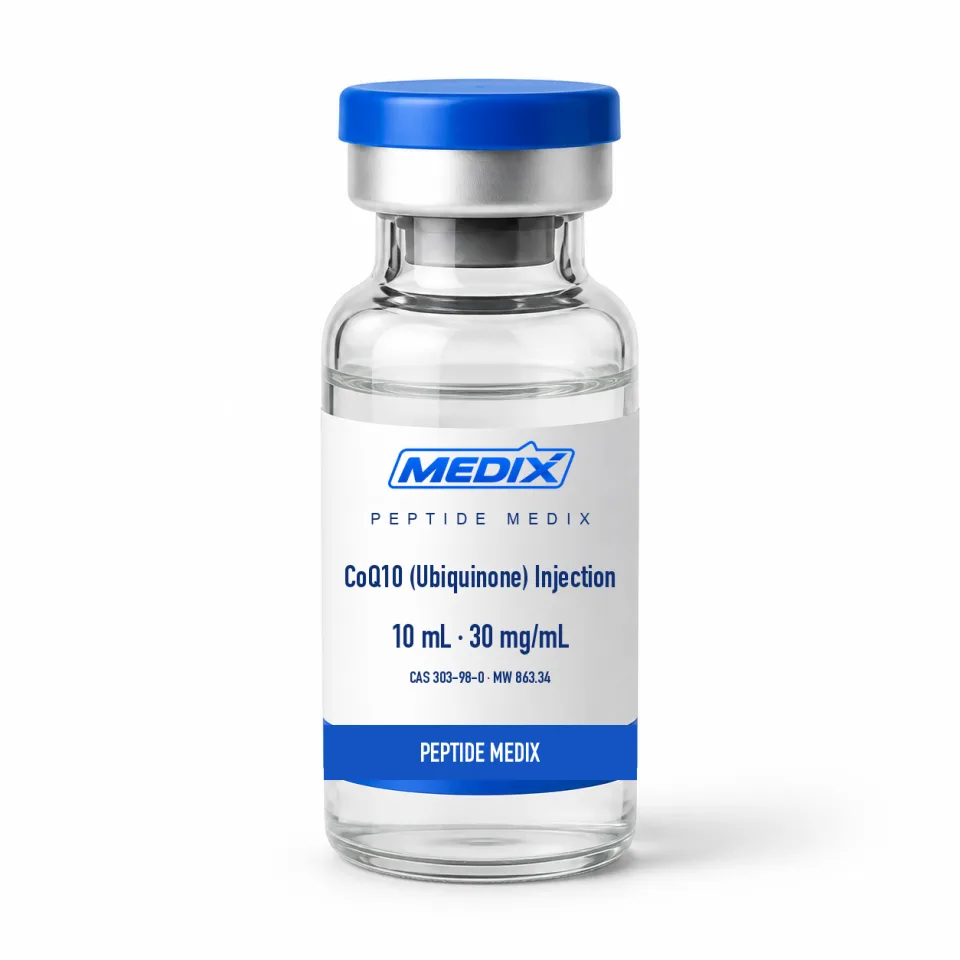
CoQ10 (Ubiquinone) Injection
Solubilized ubiquinone at 30 mg/mL in a 10 mL vial for mitochondrial research
- Mol. weight863.34 g/mol
- Research areasMitochondrial bioenergetics, oxidative stress and lipid peroxidation, statin-associated CoQ10 depletion, mitochondrial myopathy models
Overview
Coenzyme Q10, chemically 2,3-dimethoxy-5-methyl-6-decaprenyl-1,4-benzoquinone, is the lipid-soluble electron carrier that shuttles electrons from complexes I and II to complex III in the mitochondrial respiratory chain. Its benzoquinone head cycles between the oxidised ubiquinone form supplied here, the ubisemiquinone radical and the fully reduced ubiquinol, while a ten-unit polyisoprenoid tail anchors it inside the inner mitochondrial membrane.
Supplied as a single 10 mL vial at 30 mg/mL, the fill holds 300 mg of ubiquinone in total. The presentation is the practical problem the listing solves: coenzyme Q10 is practically insoluble in water, so aqueous work requires a solubilising carrier, and preparing one in-house from bulk powder is a recurring source of variation between laboratories. The vehicle is therefore part of the article, and vehicle-only control arms are worth carrying through any design that uses it. Published work in this area covers mitochondrial bioenergetics and respirometry, lipid peroxidation and oxidative-stress endpoints, statin-associated coenzyme Q10 depletion, and mitochondrial myopathy models. Storage is refrigerated at 2–8 °C, tightly sealed and shielded from light, since the benzoquinone head group is photolabile and its degradation shows as a colour change.
Specifications
Identity
- CAS number
- 303-98-0
- Molecular formula
- C59H90O4
- Molecular weight
- 863.34 g/mol
Supply & purity
- Solubility
- Practically insoluble in water; formulated with a solubilising carrier for aqueous use
Additional detail
- Concentration
- 30 mg/mL ubiquinone
- Vial size
- 10 mL (300 mg total content)
- Also known as
- Coenzyme Q10, ubiquinone, ubidecarenone, CoQ10
- Chemical class
- 1,4-benzoquinone with a ten-unit polyisoprenoid side chain
- Redox states
- Ubiquinone (oxidised) ⇄ ubisemiquinone ⇄ ubiquinol (reduced)
- Biochemical role
- Electron carrier between respiratory complexes I/II and III; membrane-phase antioxidant
- Research areas
- Mitochondrial bioenergetics, oxidative stress and lipid peroxidation, statin-associated CoQ10 depletion, mitochondrial myopathy models
- Storage
- 2–8 °C preferred, tightly sealed and protected from light; do not freeze
Units and conversions
CoQ10 (Ubiquinone) Injection arrives already made up, so there is no diluent volume to choose and no reconstitution step. What is left is unit work — percent to mg/mL, milligrams to micrograms, millilitres to microlitres — and the mcg to mg converter does all three.
Certificate of analysis
Every lot of CoQ10 (Ubiquinone) Injection is released against its own lot documentation, and where the manufacturer issues a certificate of analysis for it, that certificate is the record for the lot rather than a generic document for the compound. The lot number on the certificate matches the lot number printed on the label you receive — the vial label itself, where the product is vialled — so the record and the material it describes can always be reconciled.
This listing carries no purity percentage, so none is claimed for it here. Where the manufacturer issues analytical documentation for a lot of this item, it is passed on unaltered — ask and we will send whatever exists.
No lot certificate is on display on this page at the moment. That is a publishing state and not a testing one: lots are released and documented as described above whether or not the document is posted here, and we will send what exists for the lot in stock, or for a lot already on your bench, by its number.
Certificates are available on request before you order as well as after, with no account and no charge. Request the certificate for this listing, read the testing and documentation policy in full, or see how to read a peptide COA.
Questions about CoQ10 (Ubiquinone) Injection
Is this ubiquinone or ubiquinol?
This is ubiquinone, the oxidised form, which is the more stable of the two for storage. Ubiquinol is the reduced form and is readily oxidised in air. Cells interconvert the two enzymatically, so the redox state supplied matters mainly for stability and for analytical work.
Why is light protection emphasised?
The benzoquinone head group is photolabile and degrades on exposure to light, which changes both content and the visible colour of the solution. Keeping the vial in its carton or wrapped, and minimising bench time under lighting, preserves the stated concentration over the working window.
What documentation comes with the vial?
A lot-matched certificate of analysis is available covering identity and content of the coenzyme Q10 used. Retaining that COA with your records lets analytical results be traced back to the specific lot the data were generated with.
Related