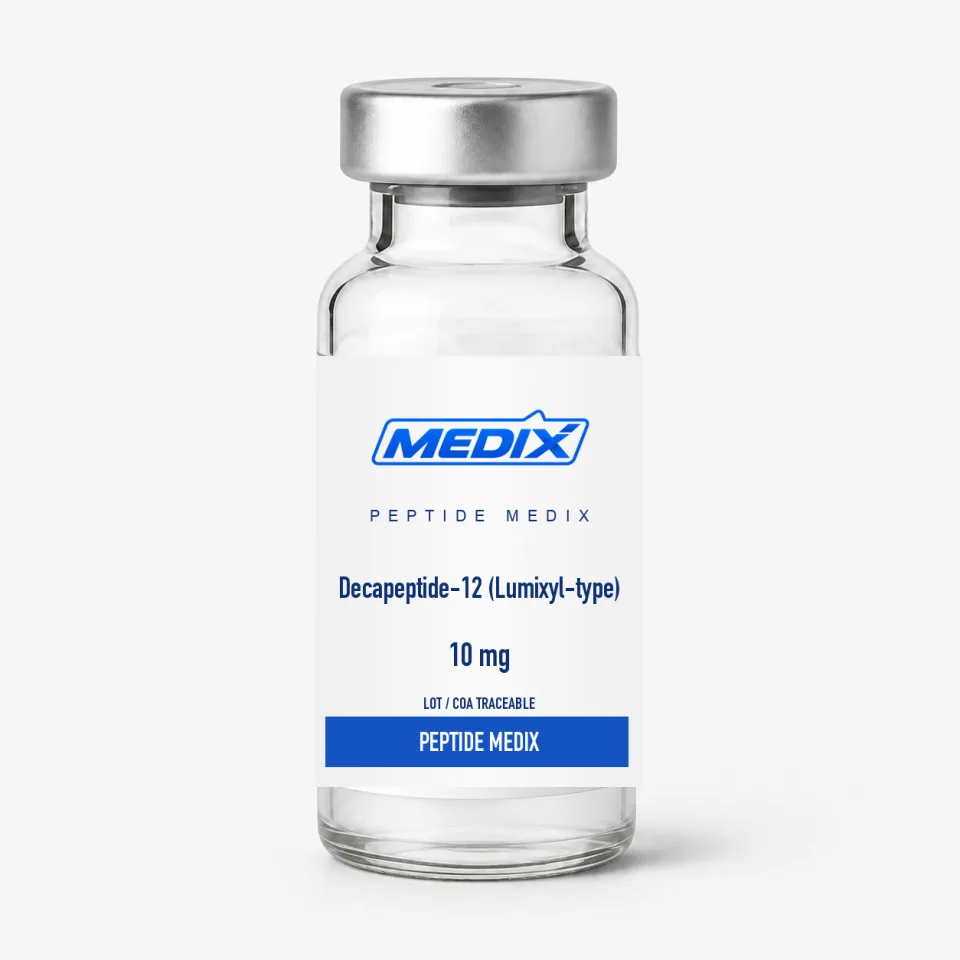
- ≥98% by HPLC
- Lot-matched certificate of analysis
- Ships next business day, tracked
Decapeptide-12 (Lumixyl-type)
Ten-residue tyrosinase-inhibiting peptide used in melanogenesis research
- FormLyophilized white to off-white powder, sealed glass vial
- Research areasMelanogenesis, tyrosinase inhibition kinetics, pigmentation models, comparative depigmenting agent studies, peptide skin permeation
Overview
Decapeptide-12 is a synthetic ten-residue peptide, sequence Tyr-Arg-Ser-Arg-Lys-Tyr-Ser-Ser-Trp-Tyr, identified through screening of combinatorial peptide libraries for sequences that bind and inhibit tyrosinase. It is the active behind the Lumixyl-type cosmetic systems and is listed under the INCI name Decapeptide-12. Peptide Medix supplies it as a lyophilized research powder in 10 mg and 50 mg vials rather than as a finished cosmetic formulation.
Tyrosinase is the rate-limiting enzyme of melanin synthesis, catalysing the hydroxylation of L-tyrosine to L-DOPA and the subsequent oxidation to dopaquinone. Most non-peptide inhibitors used in this field — hydroquinone, kojic acid, arbutin — act as substrate analogues or chelate the enzyme's binuclear copper centre. A peptide inhibitor is mechanistically different: it presents a defined sequence that interacts with the enzyme surface, and because it is a peptide it carries a distinct stability and permeation profile from those small molecules.
Specifications
Identity
- Amino acid sequence
- Tyr-Arg-Ser-Arg-Lys-Tyr-Ser-Ser-Trp-Tyr
- Chain length
- 10 amino acids (decapeptide)
- Peptide class
- Synthetic cosmetic decapeptide, enzyme-inhibitor type
Supply & purity
- Form
- Lyophilized white to off-white powder, sealed glass vial
- Purity
- ≥98% by HPLC; lot-matched COA available
- Available sizes
- 10 mg, 50 mg
- Solubility
- Water-soluble; solutions are commonly buffered near neutral pH for enzyme assays
Handling & storage
- Storage (lyophilized)
- −20 °C, sealed and protected from light and moisture
- Storage (reconstituted)
- 2–8 °C, protected from light, used within the study window
Additional detail
- INCI name
- Decapeptide-12
- Also known as
- Lumixyl peptide; oligopeptide tyrosinase inhibitor
- Molecular target
- Tyrosinase, the rate-limiting enzyme of melanin biosynthesis
- Notable residues
- Three tyrosines and one tryptophan — aromatic and light-sensitive; two arginines and a lysine give a net positive charge at neutral pH
- Research areas
- Melanogenesis, tyrosinase inhibition kinetics, pigmentation models, comparative depigmenting agent studies, peptide skin permeation
Working out the concentration
Because Decapeptide-12 (Lumixyl-type) arrives dry, its concentration is a decision rather than a specification. Run the numbers through the reconstitution calculator — vial mass in, diluent volume in, mg/mL and mass per syringe unit out.
Certificate of analysis
Every lot of Decapeptide-12 (Lumixyl-type) is released against a certificate of analysis: the batch-specific laboratory data for that lot, not a generic document for the compound. The lot number on the certificate matches the lot number printed on the label you receive — the vial label itself, where the product is vialled — so the record and the material it describes can always be reconciled.
Purity: ≥98% by HPLC — the specification for this listing. The figure for the lot you receive is the one reported on that lot’s certificate.
No lot certificate is on display on this page at the moment. That is a publishing state and not a testing one: lots are released and documented as described above whether or not the document is posted here, and we will send what exists for the lot in stock, or for a lot already on your bench, by its number.
Certificates are available on request before you order as well as after, with no account and no charge. Request the certificate for this listing, read the testing and documentation policy in full, or see how to read a peptide COA.
Questions about Decapeptide-12 (Lumixyl-type)
Is this the same peptide used in Lumixyl products?
It is the same sequence — the decapeptide listed under INCI name Decapeptide-12 that those systems are built around. What we supply is the raw lyophilized peptide in a research vial, not a finished formulation, so there is no cosmetic base, preservative system or added actives.
How is it thought to work?
Published work describes it as an inhibitor of tyrosinase, the rate-limiting enzyme converting L-tyrosine into the precursors of melanin. It was identified by screening peptide libraries for sequences that engage that enzyme, and the standard readouts in its literature are enzyme activity and melanin content in cell models.
What purity documentation is supplied?
Each lot is tested to at least 98% by HPLC and accompanied by a lot-matched certificate of analysis including mass-spectrometric identity confirmation of the ten-residue sequence. Quote the lot number printed on the vial when requesting the document.
Why does the vial need light protection?
The sequence contains one tryptophan and three tyrosine residues, and aromatic side chains of this kind are prone to photo-oxidation. Light exposure can therefore degrade the peptide and shift measured activity, which is why both powder and reconstituted solution should be kept dark.
Related