- Peptide purity: ≥99% by HPLC
- Lot-matched certificate of analysis
- Ships next business day, tracked
Epitalon Capsules
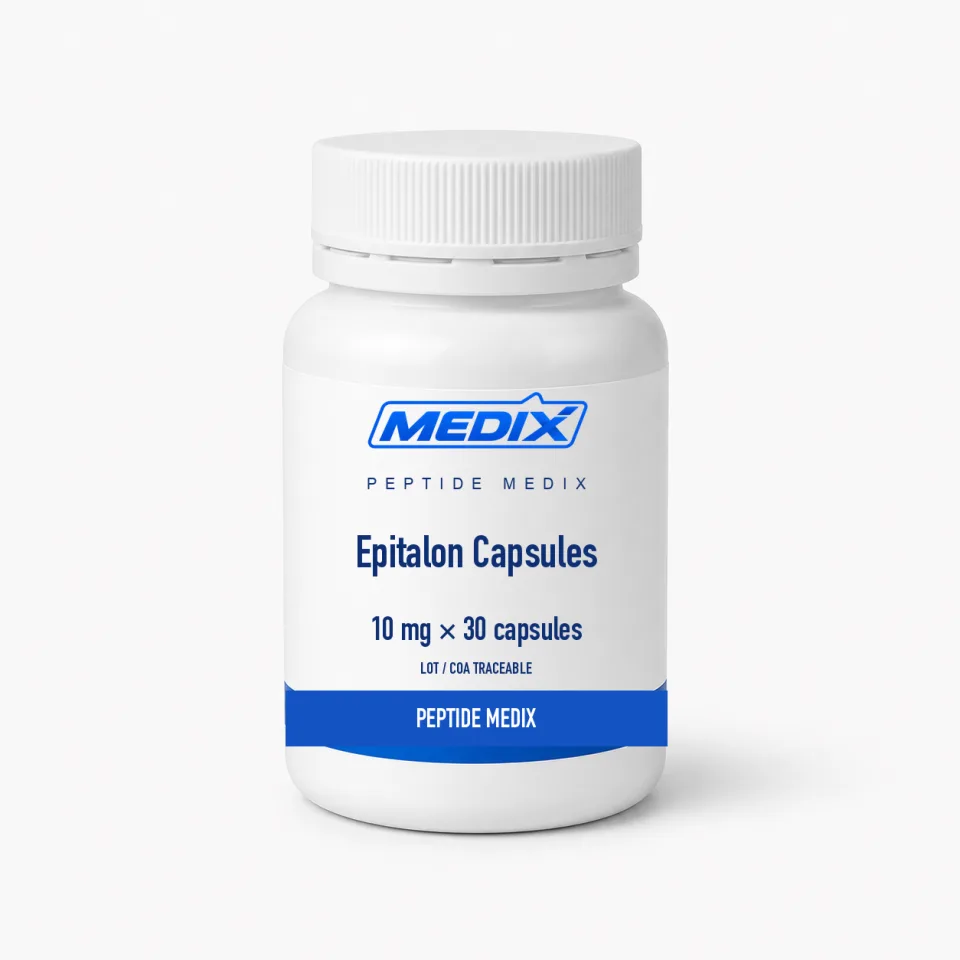
Oral Epitalon research capsules, 10 mg per capsule, 30 per bottle
- FormOral capsule in a sealed bottle with tamper-evident closure
- Mol. weight390.35 g/mol
- Research areasGastrointestinal peptide stability, oral bioavailability, telomerase expression, circadian and pineal signalling, cellular senescence models
Overview
These capsules contain 10 mg of Epitalon each, thirty to a bottle, for 300 mg of peptide in total. The active is the synthetic tetrapeptide Ala-Glu-Asp-Gly — also written epithalon or AEDG — CAS 307297-39-8, molecular formula C14H22N4O9, molecular weight 390.35 g/mol. It is the same material we supply as lyophilized powder and as a metered nasal solution, built from ≥99% HPLC-purity peptide with a lot-matched certificate of analysis.
Epitalon originates from the Khavinson bioregulator programme, where it was developed as a defined synthetic counterpart to Epithalamin, a pineal-derived polypeptide extract. It is one of the most studied peptides in that family, appearing in work on telomerase expression in cultured human fibroblasts, on melatonin rhythm and pineal signalling, and on lifespan and tumour incidence endpoints in rodents.
Specifications
Identity
- CAS number
- 307297-39-8
- Molecular formula
- C14H22N4O9
- Molecular weight
- 390.35 g/mol
- Amino acid sequence
- H-Ala-Glu-Asp-Gly-OH
Supply & purity
- Form
- Oral capsule in a sealed bottle with tamper-evident closure
Additional detail
- Peptide per capsule
- 10 mg Epitalon
- Available size
- 10 mg × 30 capsules (300 mg total peptide)
- Peptide purity
- ≥99% by HPLC; lot-matched COA available
- Active peptide
- Epitalon (epithalon), synthetic tetrapeptide bioregulator
- Also known as
- Epithalon, AEDG peptide, synthetic analogue of Epithalamin
- Research areas
- Gastrointestinal peptide stability, oral bioavailability, telomerase expression, circadian and pineal signalling, cellular senescence models
- Storage
- Cool, dry and dark in the sealed bottle; refrigeration extends shelf stability
- Preparation required
- None — fixed unit content, no reconstitution step
Units and conversions
Capsule and troche strengths are stated per unit, so the figure a method needs is usually a conversion rather than a dilution. The mcg to mg converter handles the milligram-to-microgram step, and the millilitre arithmetic if you are working from a solution format instead.
Certificate of analysis
Every lot of Epitalon Capsules is released against a certificate of analysis: the batch-specific laboratory data for that lot, not a generic document for the compound. The lot number on the certificate matches the lot number printed on the label you receive — the vial label itself, where the product is vialled — so the record and the material it describes can always be reconciled.
Peptide purity: ≥99% by HPLC — the specification for this listing. The figure for the lot you receive is the one reported on that lot’s certificate.
No lot certificate is on display on this page at the moment. That is a publishing state and not a testing one: lots are released and documented as described above whether or not the document is posted here, and we will send what exists for the lot in stock, or for a lot already on your bench, by its number.
Certificates are available on request before you order as well as after, with no account and no charge. Request the certificate for this listing, read the testing and documentation policy in full, or see how to read a peptide COA.
Questions about Epitalon Capsules
How much peptide is in each capsule?
Each capsule contains 10 mg of Epitalon, and a bottle holds thirty, giving 300 mg of peptide in total. The material used in manufacture is analysed to ≥99% purity by HPLC and documented on the lot-matched certificate of analysis.
How does this compare with the Epitalon vials?
The molecule is identical. The vial supplies lyophilized powder for reconstitution at whatever concentration a study requires; the capsule fixes the unit content and removes the preparation step, which is what makes it suitable for oral-route and dissolution work.
Do peptides survive oral administration?
Generally very poorly. Gastric acid, intestinal peptidases and hepatic first-pass metabolism all act on small unprotected peptides, and intact oral bioavailability is typically low. That constraint is the research question this format is built around rather than a limitation to be assumed away.
Is a certificate of analysis available?
Yes. The Epitalon used in each capsule lot is analysed by reverse-phase HPLC for ≥99% purity with mass-spectrometric identity confirmation, and a lot-matched COA is available on request. Quote the batch code printed on the bottle.
Do the capsules need refrigeration?
Not strictly. Cool, dry, dark storage in the sealed bottle is sufficient, and humidity control matters more than temperature. Refrigeration extends useful life, but allow the bottle to equilibrate to room temperature before opening to avoid condensation on the capsules.
Related