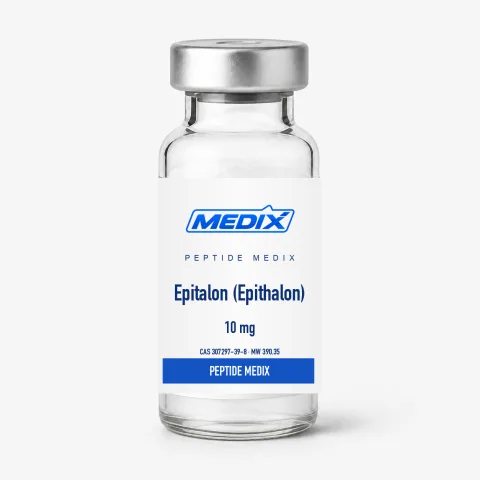
- ≥99% by HPLC
- Lot-matched certificate of analysis
- Ships next business day, tracked
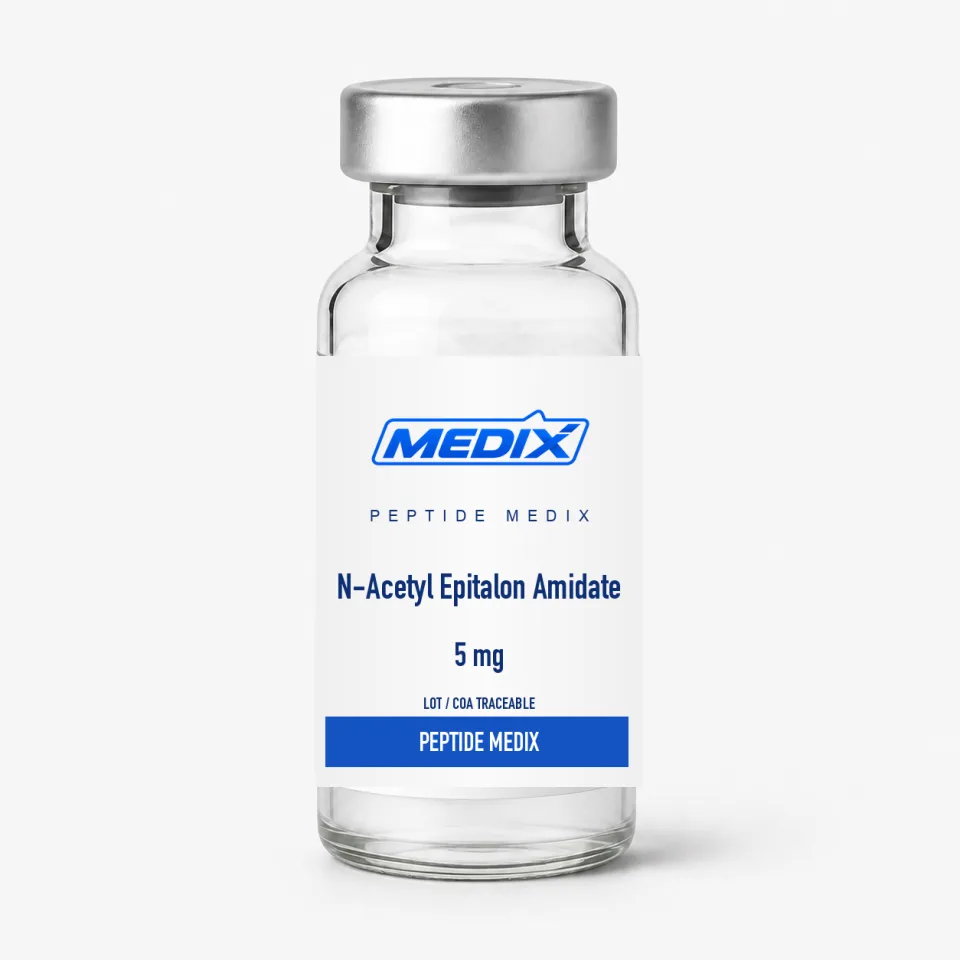
N-Acetyl Epitalon Amidate
Terminally protected epitalon analog: Ac-Ala-Glu-Asp-Gly-NH2 research vials
- FormLyophilized white to off-white powder in a sealed glass vial
- Mol. weight≈431.4 g/mol
- Research areasPeptide stability and degradation kinetics, telomerase and senescence models, circadian and pineal signalling
Overview
N-Acetyl Epitalon Amidate is a chemically protected version of epitalon, the Ala-Glu-Asp-Gly tetrapeptide first developed as a synthetic analogue of the pineal preparation epithalamin. Two modifications are made to the parent sequence and neither changes the residue order: an acetyl group caps the free N-terminal amine, and the C-terminal carboxyl is converted to a primary amide, giving Ac-Ala-Glu-Asp-Gly-NH2.
Both changes are standard medicinal-chemistry protection strategies. Free termini are the preferred substrates of aminopeptidases and carboxypeptidases, so capping them removes the most accessible points of enzymatic attack. Blocking the charged termini also alters the net charge and polarity of an already very small, highly hydrophilic peptide, which is why terminally protected analogues appear in permeability and mucosal-transit experiments as well as in straightforward stability work.
Specifications
Identity
- Molecular formula
- C16H25N5O9
- Molecular weight
- ≈431.4 g/mol
- Amino acid sequence
- Ac-Ala-Glu-Asp-Gly-NH2
- Peptide class
- Terminally protected synthetic bioregulator tetrapeptide
Supply & purity
- Form
- Lyophilized white to off-white powder in a sealed glass vial
- Purity
- ≥99% by HPLC; lot-matched COA available
- Available sizes
- 5 mg, 10 mg
- Solubility
- Readily soluble in sterile or bacteriostatic water
Handling & storage
- Storage (lyophilized)
- −20 °C, sealed and protected from light and moisture
- Storage (reconstituted)
- 2–8 °C; aliquot to avoid repeated freeze-thaw cycles
Additional detail
- Parent peptide
- Epitalon (epithalon, AEDG), CAS 307297-39-8, 390.35 g/mol
- Modifications
- N-terminal acetyl cap; C-terminal carboxyl converted to a primary amide
- Synthesis
- Solid-phase peptide synthesis with preparative reversed-phase HPLC purification
- Research areas
- Peptide stability and degradation kinetics, telomerase and senescence models, circadian and pineal signalling
Working out the concentration
N-Acetyl Epitalon Amidate ships as a lyophilized powder, so nothing on this page can state a concentration: the figure you work with is the one you create when you add diluent. Put the vial mass and the volume you intend to use into the peptide reconstitution calculator and it returns mg/mL, mcg/mL and the mass sitting at each mark on a U-100 syringe.
If the protocol asks for a molar concentration, the molar concentration calculator converts between ≈431.4 g/mol, the mass you weigh out and the volume you dissolve it in.
Certificate of analysis
Every lot of N-Acetyl Epitalon Amidate is released against a certificate of analysis: the batch-specific laboratory data for that lot, not a generic document for the compound. The lot number on the certificate matches the lot number printed on the label you receive — the vial label itself, where the product is vialled — so the record and the material it describes can always be reconciled.
Purity: ≥99% by HPLC — the specification for this listing. The figure for the lot you receive is the one reported on that lot’s certificate.
No lot certificate is on display on this page at the moment. That is a publishing state and not a testing one: lots are released and documented as described above whether or not the document is posted here, and we will send what exists for the lot in stock, or for a lot already on your bench, by its number.
Certificates are available on request before you order as well as after, with no account and no charge. Request the certificate for this listing, read the testing and documentation policy in full, or see how to read a peptide COA.
Questions about N-Acetyl Epitalon Amidate
How does this differ from standard epitalon?
The amino acid sequence is identical — Ala-Glu-Asp-Gly. The difference is chemical protection at both ends: an acetyl group on the N-terminus and a primary amide at the C-terminus. Those caps block exopeptidase attack, which is the reason laboratories choose this analogue for stability-oriented work.
Is the protected analogue more potent?
Not necessarily. Greater metabolic stability and greater intrinsic potency are separate properties, and terminal groups can participate in target binding. The only reliable way to compare is to run both peptides in the same assay with intact-peptide quantification alongside the functional readout.
What purity documentation is provided?
Each lot is released at ≥99% purity by reversed-phase HPLC with mass-spectrometric identity confirmation, and a lot-matched certificate of analysis is available. Keeping the COA with your experimental record preserves traceability between the material and the data generated with it.
What diluent should be used?
The peptide is highly hydrophilic and dissolves readily in sterile or bacteriostatic water; aqueous buffers also work for cell-culture applications. Choose the diluent that matches your assay chemistry, and note that benzyl alcohol in bacteriostatic water is unsuitable for some cell-based systems.
How should reconstituted material be stored?
Refrigerate at 2–8 °C for short working periods and aliquot at −20 °C or below for longer holds. Repeated freeze-thaw cycles and prolonged room-temperature standing are the main causes of measured potency drift in small peptides, so single-use aliquots are preferable.
Related