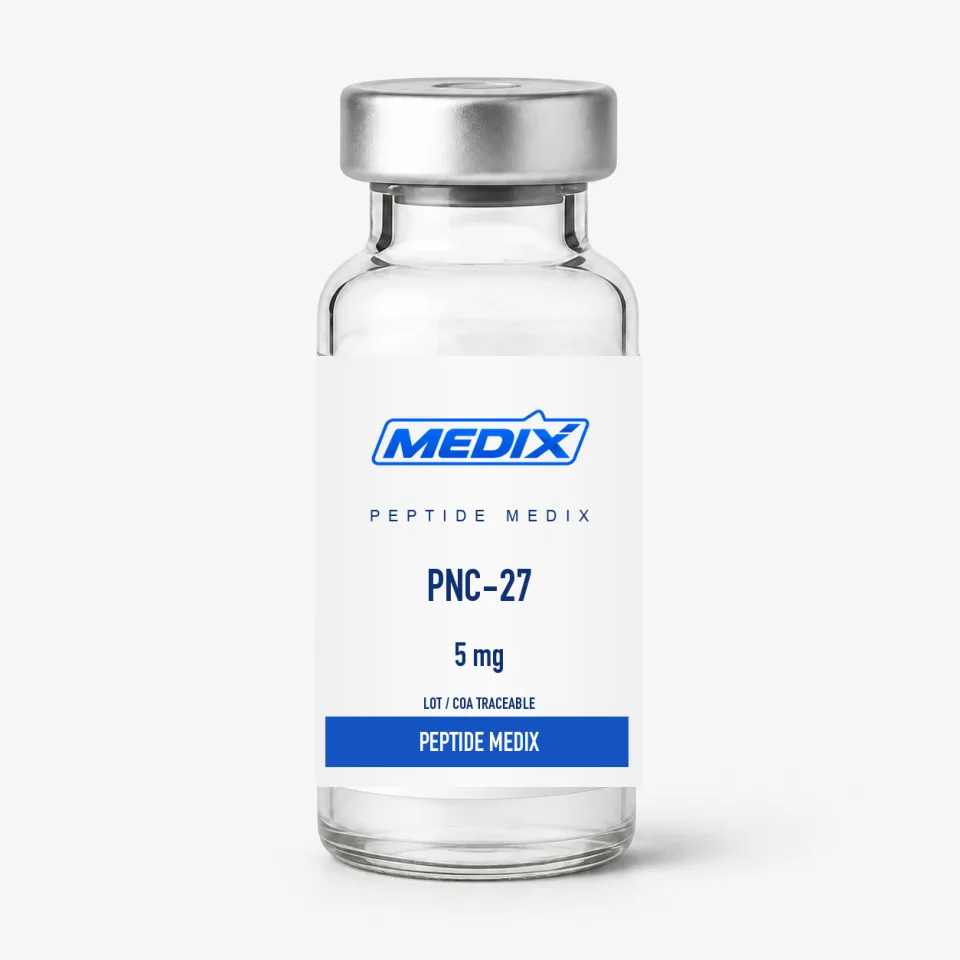
- ≥99% by HPLC
- Lot-matched certificate of analysis
- Ships next business day, tracked
PNC-27 Peptide
32-residue p53-derived chimeric peptide with a membrane-resident domain
- FormLyophilized powder, sealed glass vial with flip-off seal
- Research areasp53–HDM-2 interaction, membrane pore formation, necrosis versus apoptosis in transformed cell lines
Overview
PNC-27 is a synthetic 32-amino-acid chimeric peptide assembled from two functional halves. The N-terminal segment reproduces residues 12–26 of the human p53 tumour-suppressor protein — the stretch that contacts the HDM-2 (human MDM2) oncoprotein — while the C-terminal segment is a membrane-resident peptide (MRP) derived from the leader sequence of HIV-1 gp41. Joining the two produces a molecule designed to be delivered into and held within a lipid bilayer while presenting the p53 recognition motif.
The peptide came out of work by Pincus, Michl and colleagues, who were probing how the p53–HDM-2 interaction behaves when it is forced to occur at a membrane rather than in the nucleus. Reports from that programme describe HDM-2 being detectable in the plasma membrane of transformed cell lines but not in the corresponding untransformed lines, and PNC-27 has been used as a probe for that difference in cell-culture systems.
Specifications
Identity
- Amino acid sequence
- Pro-Pro-Leu-Ser-Gln-Glu-Thr-Phe-Ser-Asp-Leu-Trp-Lys-Leu-Leu-Lys-Lys-Trp-Lys-Met-Arg-Arg-Asn-Gln-Phe-Trp-Val-Lys-Val-Gln-Arg-Gly
- Chain length
- 32 amino acids (chimeric construct)
- Peptide class
- Chimeric p53-derived membrane-active research peptide
Supply & purity
- Form
- Lyophilized powder, sealed glass vial with flip-off seal
- Purity
- ≥99% by HPLC; lot-matched COA available
- Available sizes
- 5 mg, 10 mg
- Solubility
- Sterile or bacteriostatic water; dilute aqueous buffers for assay work
Handling & storage
- Storage (lyophilized)
- −20 °C, sealed and protected from light and moisture
- Storage (reconstituted)
- 2–8 °C, protected from light; use within the study window
Additional detail
- Domain 1
- p53 residues 12–26 — the HDM-2 binding region
- Domain 2
- Membrane-resident peptide (MRP) from the HIV-1 gp41 leader sequence
- Molecular target studied
- HDM-2 (human MDM2), including membrane-associated pools
- Related analogue
- PNC-28, which uses p53 residues 17–26 with the same MRP
- Research areas
- p53–HDM-2 interaction, membrane pore formation, necrosis versus apoptosis in transformed cell lines
Working out the concentration
PNC-27 ships as a lyophilized powder, so nothing on this page can state a concentration: the figure you work with is the one you create when you add diluent. Put the vial mass and the volume you intend to use into the peptide reconstitution calculator and it returns mg/mL, mcg/mL and the mass sitting at each mark on a U-100 syringe.
Certificate of analysis
Every lot of PNC-27 is released against a certificate of analysis: the batch-specific laboratory data for that lot, not a generic document for the compound. The lot number on the certificate matches the lot number printed on the label you receive — the vial label itself, where the product is vialled — so the record and the material it describes can always be reconciled.
Purity: ≥99% by HPLC — the specification for this listing. The figure for the lot you receive is the one reported on that lot’s certificate.
No lot certificate is on display on this page at the moment. That is a publishing state and not a testing one: lots are released and documented as described above whether or not the document is posted here, and we will send what exists for the lot in stock, or for a lot already on your bench, by its number.
Certificates are available on request before you order as well as after, with no account and no charge. Request the certificate for this listing, read the testing and documentation policy in full, or see how to read a peptide COA.
Questions about PNC-27
What exactly is PNC-27 made of?
It is a single 32-residue chain combining two segments: p53 residues 12–26, which form the HDM-2 binding motif, and a membrane-resident peptide taken from the HIV-1 gp41 leader sequence. The MRP half anchors the construct in lipid bilayers so the p53 motif is presented at the membrane.
How does PNC-27 differ from PNC-28?
They share the same membrane-resident peptide but carry different p53 fragments — PNC-27 uses residues 12–26 and PNC-28 the shorter 17–26 region. Both are used in the same class of experiments, and researchers often run them side by side to test how much of the p53 segment is required.
Is PNC-27 third-party tested, and is a COA available?
Yes. Every lot is third-party analysed by HPLC to confirm ≥99% purity along with identity testing, and a lot-matched Certificate of Analysis is available for the batch you receive. Check that the lot number on the vial matches the COA before recording any data.
How should it be stored and reconstituted?
Store the lyophilized powder at −20 °C away from light and moisture. Reconstitute gently with sterile or bacteriostatic water down the vial wall without shaking, then hold the solution at 2–8 °C and use it within your validated study window.
Does PNC-27 kill cancer cells?
Published cell-culture reports describe rapid membrane disruption and non-apoptotic death in several cancer-derived lines, with less effect on untransformed controls. That is a laboratory observation in specific systems, not a demonstrated therapy, and independent confirmation remains limited.
Related