- ≥99% per component by HPLC
- Lot-matched certificate of analysis
- Ships next business day, tracked
Longevity & Cellular Health Peptides
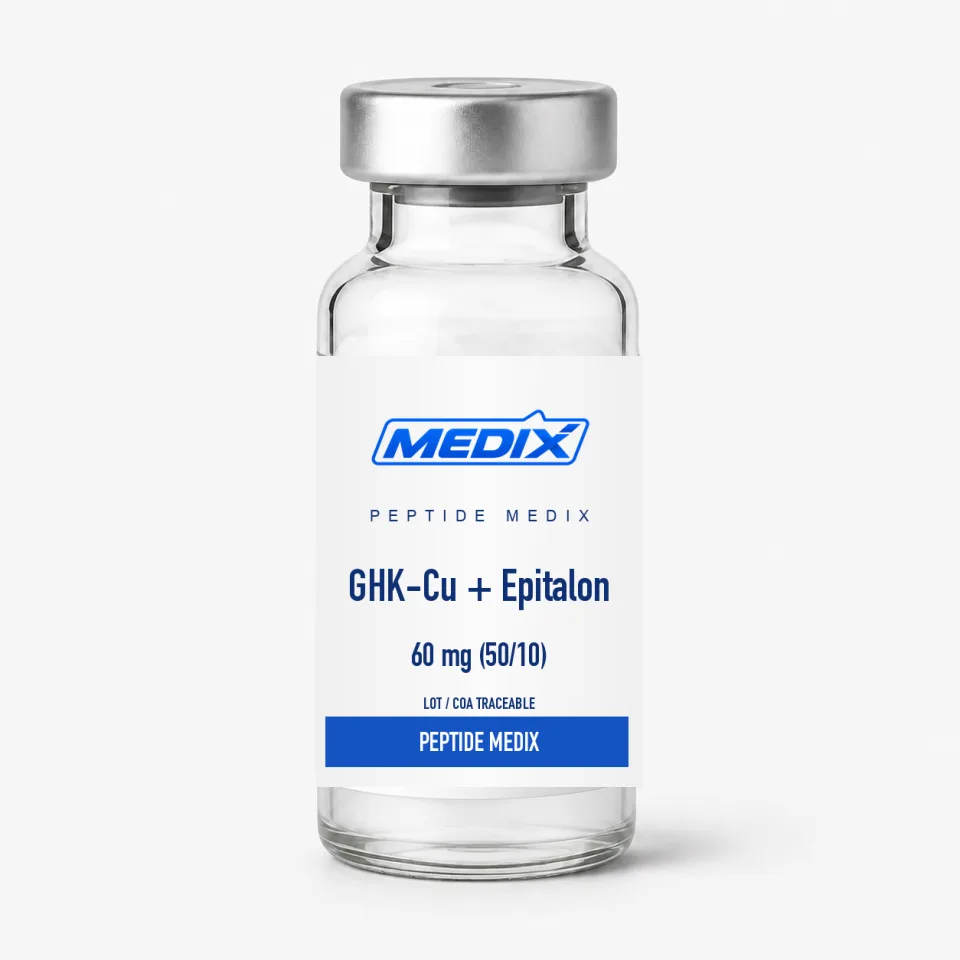
GHK-Cu + Epitalon
Co-formulated blend vial: 50 mg GHK-Cu with 10 mg epitalon
- FormCo-lyophilized powder, sealed glass vial
- Research areasExtracellular matrix remodeling, skin and hair-follicle models, telomerase and senescence research
Overview
This blend supplies two well-characterized research peptides in a single lyophilized vial: 50 mg of GHK-Cu, the copper-binding tripeptide, together with 10 mg of epitalon, the Ala-Glu-Asp-Gly bioregulator tetrapeptide. Laboratories that run parallel skin-remodeling and cellular-aging work often prefer a co-formulated vial because it removes one reconstitution step and keeps the ratio between the two compounds fixed across a study.
GHK-Cu is the copper(II) complex of glycyl-L-histidyl-L-lysine, a tripeptide isolated from human plasma in the 1970s. It is studied for reported effects on collagen and glycosaminoglycan gene expression, wound-model closure and antioxidant enzyme regulation, and it carries copper in a form that fibroblast cultures can take up. Epitalon is a synthetic analogue of the pineal preparation epithalamin, examined in telomerase, chromatin and circadian research.
The two are combined in research settings because they act on different levels of the same broad question: extracellular matrix remodeling on one side and nuclear or telomere-associated processes on the other. Blend content is verified for both components with a lot-matched Certificate of Analysis.
Specifications
Supply & purity
- Form
- Co-lyophilized powder, sealed glass vial
- Purity
- ≥99% per component by HPLC; lot-matched COA
Handling & storage
- Storage (lyophilized)
- −20 °C, protected from light and moisture
Additional detail
- Vial content
- 60 mg total — GHK-Cu 50 mg + epitalon 10 mg
- Component ratio
- 5:1 by mass (GHK-Cu : epitalon)
- GHK-Cu CAS number
- 89030-95-5
- GHK-Cu molecular formula
- C14H24N6O4·Cu
- GHK-Cu molecular weight
- 403.93 g/mol
- GHK-Cu sequence
- Gly-His-Lys, copper(II) complex
- Epitalon CAS number
- 307297-39-8
- Epitalon molecular formula
- C14H22N4O9
- Epitalon sequence
- H-Ala-Glu-Asp-Gly-OH (390.35 g/mol)
- Research areas
- Extracellular matrix remodeling, skin and hair-follicle models, telomerase and senescence research
Working out the concentration
GHK-Cu + Epitalon ships as a lyophilized powder, so nothing on this page can state a concentration: the figure you work with is the one you create when you add diluent. Put the vial mass and the volume you intend to use into the peptide reconstitution calculator and it returns mg/mL, mcg/mL and the mass sitting at each mark on a U-100 syringe.
Certificate of analysis
Every lot of GHK-Cu + Epitalon is released against a certificate of analysis: the batch-specific laboratory data for that lot, not a generic document for the compound. The lot number on the certificate matches the lot number printed on the label you receive — the vial label itself, where the product is vialled — so the record and the material it describes can always be reconciled.
Purity: ≥99% per component by HPLC — the specification for this listing. The figure for the lot you receive is the one reported on that lot’s certificate.
No lot certificate is on display on this page at the moment. That is a publishing state and not a testing one: lots are released and documented as described above whether or not the document is posted here, and we will send what exists for the lot in stock, or for a lot already on your bench, by its number.
Certificates are available on request before you order as well as after, with no account and no charge. Request the certificate for this listing, read the testing and documentation policy in full, or see how to read a peptide COA.
Questions about GHK-Cu + Epitalon
What is in this blend?
Each vial contains 60 mg of co-lyophilized material: 50 mg of GHK-Cu, the copper-binding tripeptide, and 10 mg of epitalon, the Ala-Glu-Asp-Gly tetrapeptide. Both components are verified individually on the lot-matched Certificate of Analysis.
Why is the powder blue?
The color comes from the copper(II) ion coordinated by the GHK tripeptide. A blue to blue-violet cake is expected for any GHK-Cu preparation; loss of that color can indicate reduction or degradation of the copper complex.
Can the two components be varied independently?
Not in this format. Reconstituting a co-lyophilized vial fixes the 5:1 mass ratio, so any dilution changes both concentrations together. Studies that need to vary one compound alone should use separate GHK-Cu and epitalon vials.
Is the blend third-party tested?
Yes. Purity is confirmed by HPLC for each component and identity by mass spectrometry, with a lot-matched Certificate of Analysis available before purchase documenting the content of both peptides in the vial.
What should not be mixed with this blend?
Avoid strong reducing agents and thiol-containing reagents such as dithiothreitol or glutathione, which can reduce copper(II) and destabilize the complex. Also avoid strongly alkaline buffers, which can precipitate copper species out of solution.
Related