- ≥99% by HPLC per component
- Lot-matched certificate of analysis
- Ships next business day, tracked
Longevity & Cellular Health Peptides
NAD+ Longevity Stack (NAD+ · MOTS-c · SS-31)
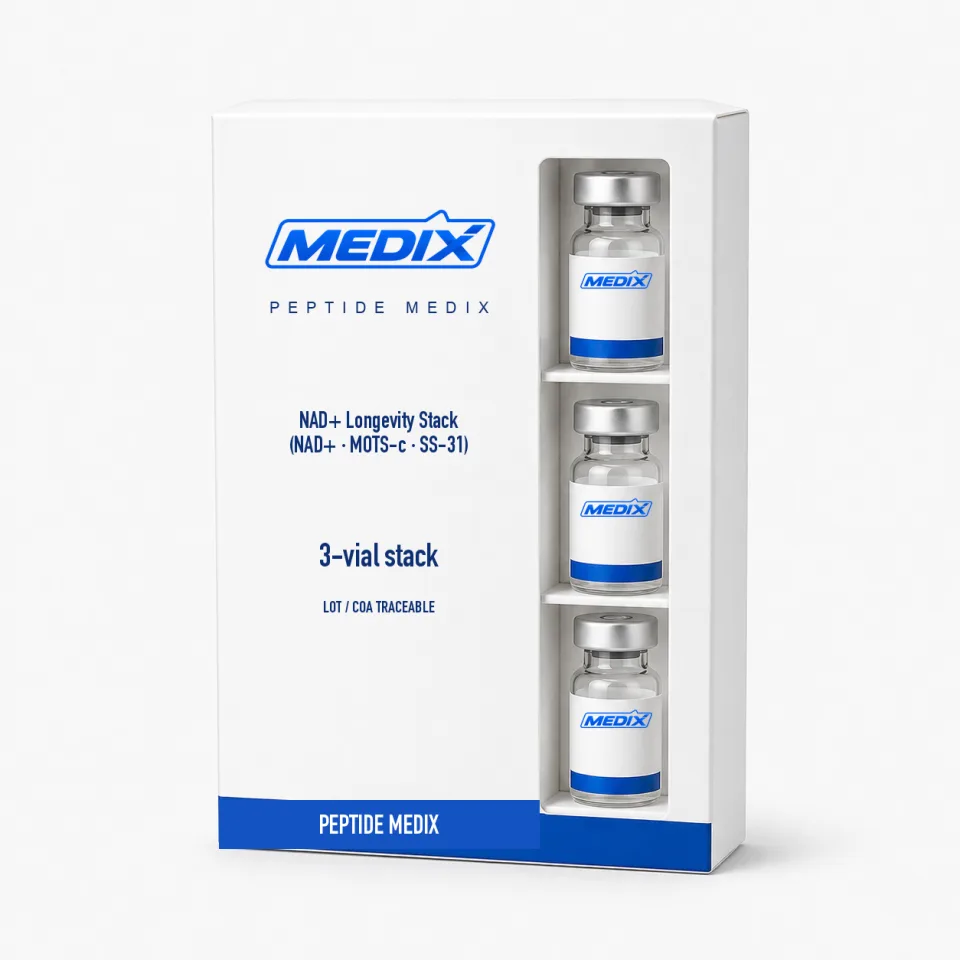
Three-vial research stack: NAD+, MOTS-c and SS-31 in one kit
- FormLyophilized powder in each vial
- Research areasMitochondrial bioenergetics, AMPK signaling, cardiolipin and cristae structure, NAD-dependent enzymes
Overview
The three sit at different points in the same broad research question. NAD+ is the coenzyme that carries reducing equivalents and serves as substrate for sirtuins, PARPs and CD38, making it the central currency in redox and DNA-repair studies. MOTS-c is a 16-residue mitochondrial-derived peptide studied in AMPK and one-carbon metabolism models. SS-31 is a four-residue aromatic-cationic peptide examined for its reported association with cardiolipin in the inner mitochondrial membrane and its effects on cristae structure.
Together they cover coenzyme supply, metabolic signaling and membrane-level mitochondrial structure, which is why laboratories comparing bioenergetic interventions frequently run them side by side. Every vial carries its own lot-matched Certificate of Analysis.
Specifications
Supply & purity
- Form
- Lyophilized powder in each vial
- Purity
- ≥99% by HPLC per component; lot-matched COA for each vial
Handling & storage
- Storage (lyophilized)
- −20 °C, protected from light and moisture
- Storage (reconstituted)
- 2–8 °C, aliquoted and used within the study window
Additional detail
- Kit contents
- 3 separately sealed lyophilized vials — NAD+, MOTS-c, SS-31
- NAD+ profile
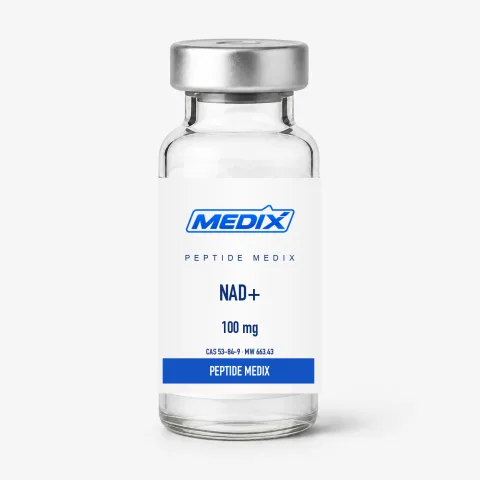
- CAS 53-84-9, C21H27N7O14P2, 663.43 g/mol — dinucleotide coenzyme
- MOTS-c profile
- CAS 1627580-64-6, C101H152N28O22S2, 2174.55 g/mol — 16-residue mitochondrial-derived peptide
- SS-31 profile
- CAS 736992-21-5, C32H49N9O5, 639.80 g/mol — D-Arg-Dmt-Lys-Phe-NH2
- Reconstitution
- Each vial dissolved separately in bacteriostatic or sterile water
- Research areas
- Mitochondrial bioenergetics, AMPK signaling, cardiolipin and cristae structure, NAD-dependent enzymes
- Shipping
- Ships as one package from a US facility with tracking
- Documentation
- Individual Certificate of Analysis available for each lot in the kit
Working out the concentration
NAD+ Longevity Stack (NAD+ · MOTS-c · SS-31) ships as a lyophilized powder, so nothing on this page can state a concentration: the figure you work with is the one you create when you add diluent. Put the vial mass and the volume you intend to use into the peptide reconstitution calculator and it returns mg/mL, mcg/mL and the mass sitting at each mark on a U-100 syringe.
Certificate of analysis
Every lot of NAD+ Longevity Stack (NAD+ · MOTS-c · SS-31) is released against a certificate of analysis: the batch-specific laboratory data for that lot, not a generic document for the compound. The lot number on the certificate matches the lot number printed on the label you receive — the vial label itself, where the product is vialled — so the record and the material it describes can always be reconciled.
Purity: ≥99% by HPLC per component — the specification for this listing. The figure for the lot you receive is the one reported on that lot’s certificate.
No lot certificate is on display on this page at the moment. That is a publishing state and not a testing one: lots are released and documented as described above whether or not the document is posted here, and we will send what exists for the lot in stock, or for a lot already on your bench, by its number.
Certificates are available on request before you order as well as after, with no account and no charge. Request the certificate for this listing, read the testing and documentation policy in full, or see how to read a peptide COA.
Questions about NAD+ Longevity Stack (NAD+ · MOTS-c · SS-31)
What comes in the NAD+ Longevity Stack?
The kit contains three separately sealed lyophilized vials — NAD+, MOTS-c and SS-31 — each with its own lot-matched Certificate of Analysis. Nothing is pre-mixed, so each compound is reconstituted and used independently.
Are the compounds pre-blended in one vial?
No. Unlike a co-formulated blend, this stack keeps all three compounds in separate vials. That lets researchers vary concentrations independently, run single-compound control arms, and reconstitute on different days as a protocol requires.
Why combine NAD+, MOTS-c and SS-31?
Each addresses a different layer of mitochondrial research: NAD+ as coenzyme supply and enzyme substrate, MOTS-c as a metabolic signaling peptide associated with AMPK, and SS-31 as a compound studied for cardiolipin association and cristae structure.
Is every vial third-party tested?
Yes. Each component is analyzed by HPLC for purity of ≥99% and by mass spectrometry for identity, and an individual Certificate of Analysis for each lot is available before purchase rather than a single kit-level document.
How should the kit be stored?
Keep all unopened vials at −20 °C, protected from light and moisture. After reconstitution, store solutions at 2–8 °C, protect them from light, aliquot for repeat use, and label each container clearly with compound, lot and date.
Does buying the stack save money?
Yes, the three-vial stack is priced below the sum of the individual vials. The saving is the practical reason many laboratories order the kit when a study calls for all three compounds in the same experimental series.
Related