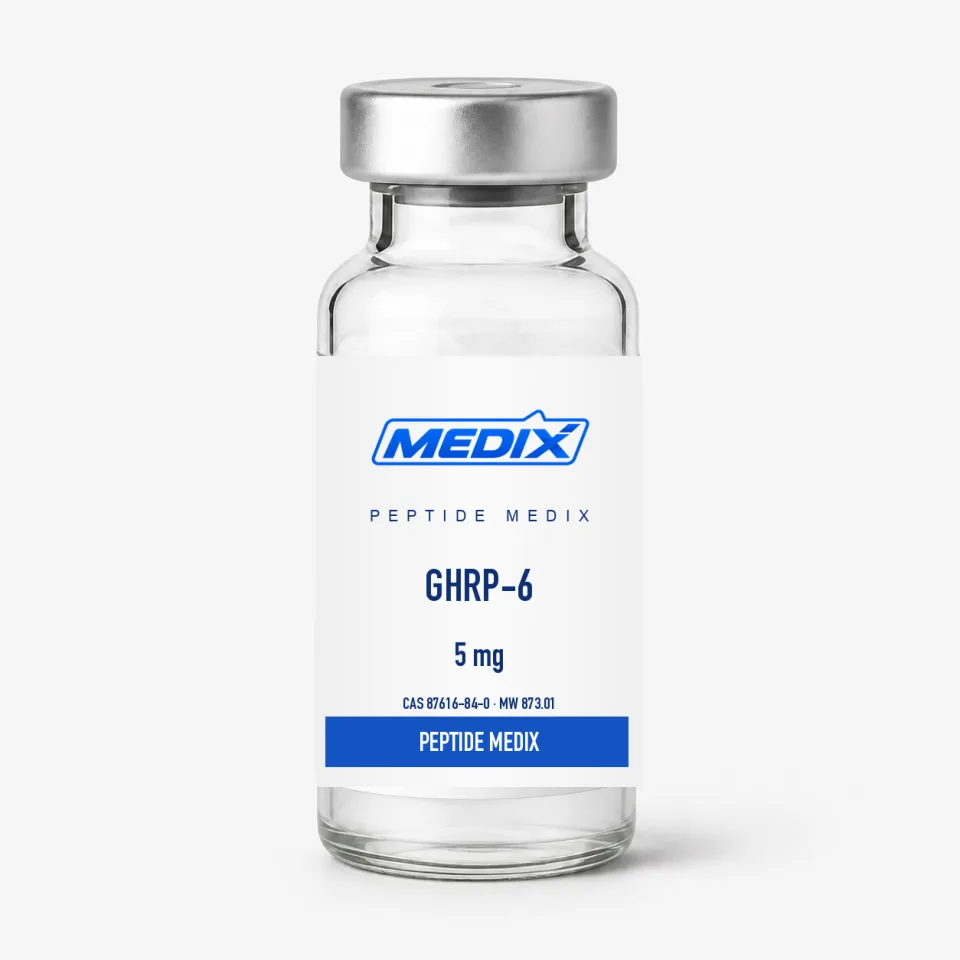
- ≥99% by HPLC
- Lot-matched certificate of analysis
- Ships next business day, tracked
GHRP-6 Peptide
First-generation GHS-R1a hexapeptide, His-D-Trp-Ala-Trp-D-Phe-Lys
- FormLyophilized powder, sealed glass vial
- Mol. weight873.01 g/mol
- Research areasGHS-R1a pharmacology, appetite and feeding models, gastric motility, cytoprotection
Overview
GHRP-6 is the original growth hormone-releasing hexapeptide, sequence His-D-Trp-Ala-Trp-D-Phe-Lys-NH2. It emerged from work on met-enkephalin analogues in the 1980s, when investigators noticed that certain opioid-derived fragments released growth hormone through a mechanism that GHRH antagonists could not block. That observation implied a second, unknown receptor — and GHRP-6 became the tool compound used to hunt for it.
The hunt succeeded twice over: first with the cloning of the growth hormone secretagogue receptor GHS-R1a in 1996, then with the identification of ghrelin as its endogenous ligand in 1999. GHRP-6 remains a widely cited reference agonist in that literature, and is also studied for ghrelin-receptor involvement in appetite signalling, gastric motility and cytoprotection models, where its effects on food intake in rodents are more pronounced than those of later, more selective analogues.
Specifications
Identity
- CAS number
- 87616-84-0
- Molecular formula
- C46H56N12O6
- Molecular weight
- 873.01 g/mol
- Amino acid sequence
- His-D-Trp-Ala-Trp-D-Phe-Lys-NH2
- Chain length
- 6 residues, C-terminal amide
- Peptide class
- Growth hormone releasing peptide (GHRP), GHS-R1a agonist
Supply & purity
- Form
- Lyophilized powder, sealed glass vial
- Purity
- ≥99% by HPLC; lot-matched COA available
- Available sizes
- 5 mg, 10 mg
Handling & storage
- Storage (lyophilized)
- −20 °C, sealed and protected from light and moisture
- Storage (reconstituted)
- 2–8 °C, protected from light, used within the study window
Additional detail
- Also known as
- Growth hormone releasing hexapeptide, SKF-110679, GHRP
- Research areas
- GHS-R1a pharmacology, appetite and feeding models, gastric motility, cytoprotection
Working out the concentration
A lyophilized vial carries a mass on the label and no concentration anywhere, so the first calculation of any protocol is the reconstitution one. The peptide concentration calculator converts vial mass plus diluent volume into mg/mL, and back into the draw volume for a given mass.
Certificate of analysis
Every lot of GHRP-6 is released against a certificate of analysis: the batch-specific laboratory data for that lot, not a generic document for the compound. The lot number on the certificate matches the lot number printed on the label you receive — the vial label itself, where the product is vialled — so the record and the material it describes can always be reconciled.
Purity: ≥99% by HPLC — the specification for this listing. The figure for the lot you receive is the one reported on that lot’s certificate.
No lot certificate is on display on this page at the moment. That is a publishing state and not a testing one: lots are released and documented as described above whether or not the document is posted here, and we will send what exists for the lot in stock, or for a lot already on your bench, by its number.
Certificates are available on request before you order as well as after, with no account and no charge. Request the certificate for this listing, read the testing and documentation policy in full, or see how to read a peptide COA.
Questions about GHRP-6
What is GHRP-6?
GHRP-6 is a synthetic hexapeptide agonist of the growth hormone secretagogue receptor GHS-R1a. It was the first widely used compound of its class and remains a standard reference agonist in receptor pharmacology and ghrelin-pathway research.
Why is GHRP-6 historically important?
Its growth hormone-releasing activity could not be explained by the GHRH receptor, which pointed to an unknown second receptor. GHRP-6 was used as the ligand in the work that cloned GHS-R1a, and that orphan receptor led directly to the discovery of ghrelin.
How does it differ from GHRP-2?
The two share a hexapeptide scaffold but differ in sequence. GHRP-2 substitutes D-2-naphthylalanine at position 2 and is generally reported as more potent, while GHRP-6 shows a stronger effect on food intake in rodent feeding models.
Why does light matter for this peptide?
GHRP-6 contains two tryptophan residues, and tryptophan is among the most photosensitive amino acids. Prolonged exposure to light can oxidise it and degrade the peptide, so laboratories keep both powder and reconstituted solution shielded from light.
Is a COA available for each lot?
Yes. Every lot is third-party analysed by HPLC to verify ≥99% purity and identity, and a lot-matched Certificate of Analysis is available on request. Confirm the lot number on your vial matches the certificate before logging the material.
Related