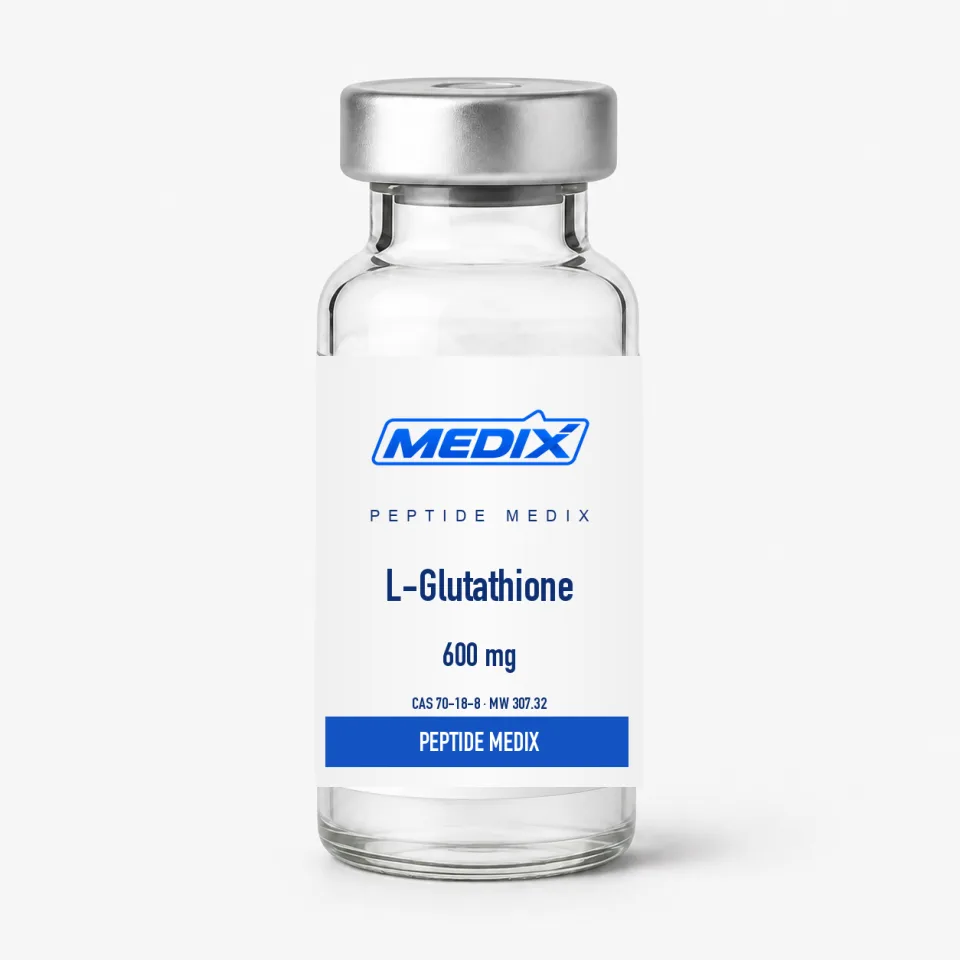
- ≥99% by HPLC
- Lot-matched certificate of analysis
- Ships next business day, tracked
L-Glutathione Peptide
Reduced L-glutathione tripeptide, 600 mg and 1500 mg research vials
- FormLyophilized powder, sealed glass vial
- Mol. weight307.32 g/mol
- Research areasRedox homeostasis, glutathione peroxidase and S-transferase assays, oxidative stress, melanogenesis
Overview
L-Glutathione is the reduced tripeptide gamma-L-glutamyl-L-cysteinyl-glycine, abbreviated GSH. It is unusual among peptides because the bond between glutamate and cysteine is a gamma-peptide linkage formed through the glutamate side chain rather than its alpha-carboxyl group, an arrangement that shields the molecule from ordinary peptidases and explains why it is synthesized enzymatically in two ATP-dependent steps rather than on the ribosome.
The free thiol on the cysteine residue is the reactive center. Glutathione is the most abundant low-molecular-weight thiol in most cells, typically present at millimolar concentration, and it participates in glutathione peroxidase and glutathione S-transferase reactions, protein glutathionylation, and the regeneration of ascorbate and other antioxidants. The GSH/GSSG ratio between the reduced and oxidized dimer forms is one of the standard measures of intracellular redox status in experimental biology.
Our L-glutathione is supplied as a lyophilized powder in a sealed vial with lot-matched HPLC documentation. Because thiols oxidize readily in air, careful handling matters more than for most catalogue compounds.
Specifications
Identity
- CAS number
- 70-18-8
- Molecular formula
- C10H17N3O6S
- Molecular weight
- 307.32 g/mol
- Peptide class
- Non-ribosomal gamma-linked tripeptide
Supply & purity
- Form
- Lyophilized powder, sealed glass vial
- Purity
- ≥99% by HPLC; lot-matched COA
- Available sizes
- 600 mg, 1500 mg
- Solubility
- Soluble in water; solutions are acidic and best buffered before use
Handling & storage
- Storage (lyophilized)
- −20 °C, protected from light, moisture and air
- Storage (reconstituted)
- 2–8 °C, prepared fresh where possible; thiol oxidizes on standing
Additional detail
- Structure
- gamma-L-Glutamyl-L-cysteinyl-glycine (reduced, GSH)
- Reactive group
- Free cysteinyl thiol (−SH), oxidizes to the GSSG disulfide dimer
- Research areas
- Redox homeostasis, glutathione peroxidase and S-transferase assays, oxidative stress, melanogenesis
Working out the concentration
L-Glutathione ships as a lyophilized powder, so nothing on this page can state a concentration: the figure you work with is the one you create when you add diluent. Put the vial mass and the volume you intend to use into the peptide reconstitution calculator and it returns mg/mL, mcg/mL and the mass sitting at each mark on a U-100 syringe.
For work specified in µM or nM rather than mg/mL, feed 307.32 g/mol and your volume into the peptide molarity calculator.
Certificate of analysis
Every lot of L-Glutathione is released against a certificate of analysis: the batch-specific laboratory data for that lot, not a generic document for the compound. The lot number on the certificate matches the lot number printed on the label you receive — the vial label itself, where the product is vialled — so the record and the material it describes can always be reconciled.
Purity: ≥99% by HPLC — the specification for this listing. The figure for the lot you receive is the one reported on that lot’s certificate.
No lot certificate is on display on this page at the moment. That is a publishing state and not a testing one: lots are released and documented as described above whether or not the document is posted here, and we will send what exists for the lot in stock, or for a lot already on your bench, by its number.
Certificates are available on request before you order as well as after, with no account and no charge. Request the certificate for this listing, read the testing and documentation policy in full, or see how to read a peptide COA.
Questions about L-Glutathione
What is L-glutathione?
L-Glutathione is a tripeptide of glutamate, cysteine and glycine joined by an unusual gamma-peptide bond. In its reduced GSH form it is the principal low-molecular-weight thiol in cells and is used widely in redox biology and enzyme research.
Is this the reduced or oxidized form?
This product is reduced L-glutathione, GSH, with a free cysteinyl thiol. The oxidized dimer GSSG forms when that thiol is exposed to air or oxidants, which is why prompt reconstitution and cold, dark storage matter for accurate assay results.
How is purity confirmed?
Each lot is analyzed by HPLC for purity of ≥99% with a lot-matched Certificate of Analysis available before purchase. For thiol-sensitive work, laboratories often verify free thiol content independently using a DTNB assay after reconstitution.
Why do glutathione solutions lose activity?
The free thiol oxidizes to the GSSG disulfide on standing, accelerated by air exposure, alkaline pH and trace metals. Preparing solutions fresh, buffering appropriately and including a chelator helps preserve the reduced fraction during an experiment.
What sizes are available?
L-Glutathione is supplied in 600 mg and 1500 mg lyophilized vials. Larger quantities than a typical research peptide are standard because glutathione is used at millimolar concentrations in buffers, enzyme assays and affinity purification workflows.
Related