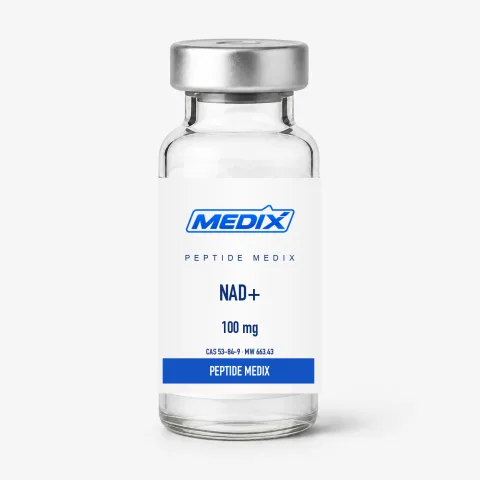
- Purity (raw material): ≥99% by HPLC
- Lot-matched certificate of analysis
- Ships next business day, tracked
NAD+ Capsules
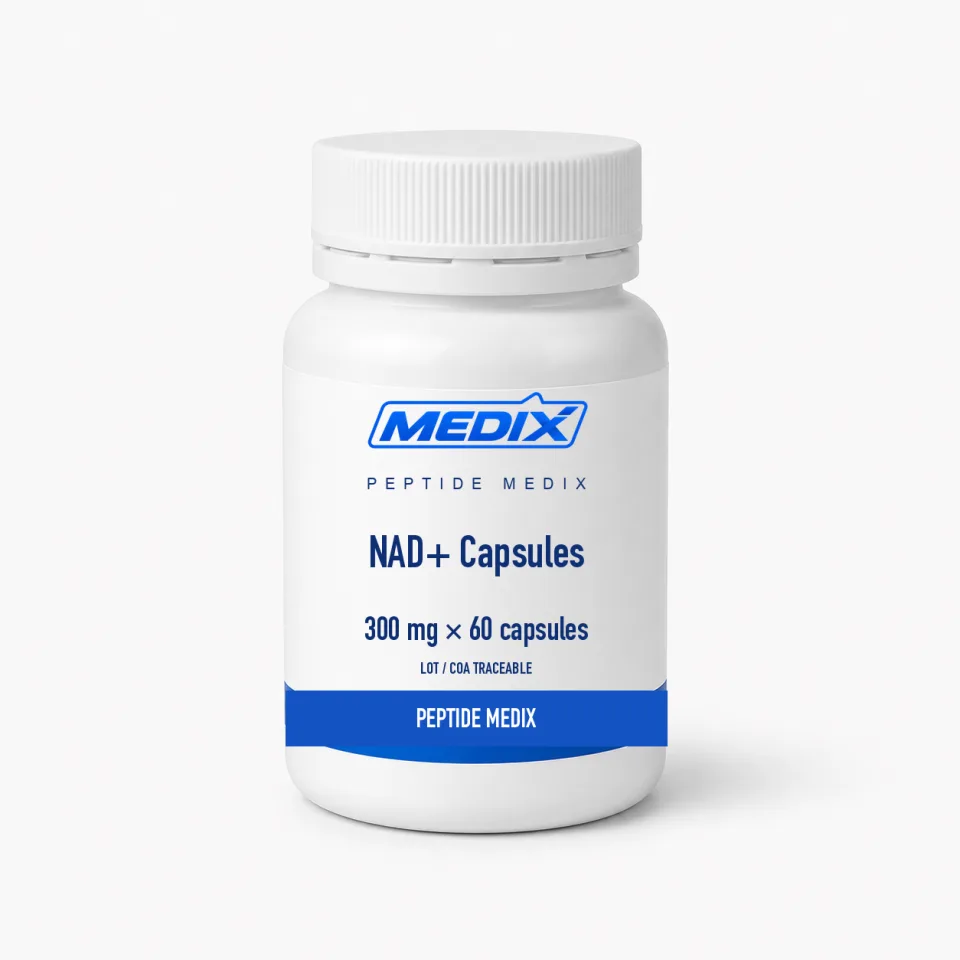
Oral NAD+ research capsules, 300 mg of the dinucleotide coenzyme per unit
- FormOral capsules in a sealed bottle with desiccant and tamper-evident closure
- Mol. weight663.43 g/mol
- Research areasCellular redox state, mitochondrial metabolism, DNA repair signalling, ageing biology, oral bioavailability of NAD precursors
Overview
These capsules present nicotinamide adenine dinucleotide — NAD+ — as a fixed 300 mg oral research unit rather than as the lyophilized vial format. The molecule itself is identical to the material in our NAD+ vials: the oxidised free-acid form of the dinucleotide coenzyme, CAS 53-84-9, with the formula C21H27N7O14P2 and a molecular weight of 663.43 g/mol, assayed to a ≥99% HPLC specification with a lot-matched certificate of analysis.
NAD+ itself sits at the centre of cellular redox chemistry as the electron acceptor for hundreds of dehydrogenases, and it is consumed as a substrate by sirtuins, PARP enzymes and CD38. Research interest in the oral route is heavily focused on the question of whether the intact dinucleotide survives digestion or is degraded to precursors such as nicotinamide riboside and nicotinamide before absorption — an open question and a common study endpoint.
Specifications
Identity
- CAS number
- 53-84-9
- Molecular formula
- C21H27N7O14P2
- Molecular weight
- 663.43 g/mol
Supply & purity
- Form
- Oral capsules in a sealed bottle with desiccant and tamper-evident closure
Additional detail
- Content per capsule
- 300 mg NAD+ (free acid)
- Available counts
- 60 capsules
- Purity (raw material)
- ≥99% by HPLC; lot-matched COA available
- Active compound
- NAD+ (nicotinamide adenine dinucleotide), oxidised form
- Chemical class
- Dinucleotide coenzyme — not a peptide
- Also known as
- Nicotinamide adenine dinucleotide, oxidised NAD, DPN
- Enzyme substrate for
- Sirtuins (SIRT1–7), PARP family, CD38/CD157
- Research areas
- Cellular redox state, mitochondrial metabolism, DNA repair signalling, ageing biology, oral bioavailability of NAD precursors
- Storage
- Cool, dry and dark in the sealed bottle; refrigeration extends shelf stability
Units and conversions
There is no reconstitution step for a solid oral format: the mass per unit of NAD+ Capsules is fixed on the label. Where a published method is written in micrograms and the label is in milligrams, the peptide unit converter does the conversion.
Certificate of analysis
Every lot of NAD+ Capsules is released against a certificate of analysis: the batch-specific laboratory data for that lot, not a generic document for the compound. The lot number on the certificate matches the lot number printed on the label you receive — the vial label itself, where the product is vialled — so the record and the material it describes can always be reconciled.
Purity (raw material): ≥99% by HPLC — the specification for this listing. The figure for the lot you receive is the one reported on that lot’s certificate.
No lot certificate is on display on this page at the moment. That is a publishing state and not a testing one: lots are released and documented as described above whether or not the document is posted here, and we will send what exists for the lot in stock, or for a lot already on your bench, by its number.
Certificates are available on request before you order as well as after, with no account and no charge. Request the certificate for this listing, read the testing and documentation policy in full, or see how to read a peptide COA.
Questions about NAD+ Capsules
What is in each capsule?
Each capsule contains 300 mg of NAD+ — nicotinamide adenine dinucleotide in its oxidised free-acid form — with 60 capsules per sealed bottle. The raw material is the same as in our NAD+ vials, assayed to a ≥99% HPLC specification with a lot-matched certificate of analysis.
Is oral NAD+ absorbed intact?
That is an open research question rather than a settled fact. NAD+ is a large, charged and chemically labile molecule and is a substrate for gut glycohydrolases, so published work examines whether measured NAD increases come from intact absorption or from degradation to precursors followed by resynthesis through the salvage pathway.
How does NAD+ compare with NMN as a research material?
NMN is a smaller, more soluble salvage-pathway precursor that cells convert to NAD+ through NMNAT enzymes, while NAD+ is the finished coenzyme. Studies that need to alter the coenzyme pool often prefer a precursor, whereas assays that require NAD+ itself as an enzyme substrate use the dinucleotide directly.
Is a certificate of analysis available?
Yes. The NAD+ raw material used in these capsules is analysed by HPLC to a ≥99% purity specification, and a lot-matched COA reporting identity, method and measured purity is available on request before or after ordering.
How should the capsules be stored?
In the closed bottle, cool, dry and away from light with the desiccant left in place; refrigeration extends shelf stability. Allow a cold bottle to warm to room temperature before opening so moisture does not condense on the contents, and avoid leaving the bottle open in humid conditions.
Related