- ≥99% by HPLC on the NAD+ used
- Lot-matched certificate of analysis
- Ships next business day, tracked
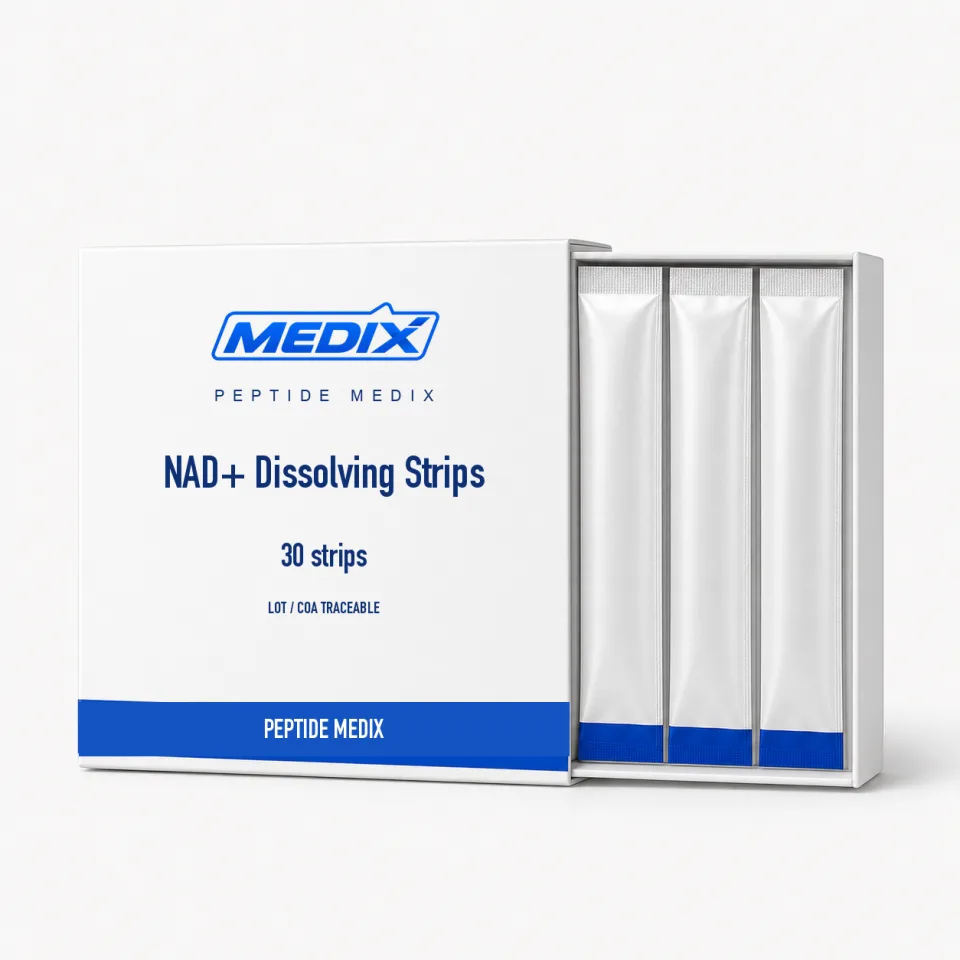
NAD+ Dissolving Strips
Pre-measured NAD+ thin-film strips, 30 per sealed tin
- Research areasFormat comparison studies, NAD-dependent enzyme work, cellular energy research
Overview
NAD+ Dissolving Strips present nicotinamide adenine dinucleotide in a fast-dissolving thin-film matrix rather than as a lyophilized powder. Each sealed tin holds 30 pre-measured strips. The format exists because a film removes the reconstitution step entirely: no diluent, no vial septum, no syringe, and no variance introduced by weighing or pipetting small masses.
The film itself is a water-soluble polymer matrix — the same class of hydrophilic film-forming polymers used across oral thin-film technology — loaded with the coenzyme and cast to a controlled thickness so that each strip carries a consistent amount. Dropped into an aqueous medium, the matrix disperses within seconds and releases its payload into solution.
For research groups, the practical value is reproducibility and portability. Strips are useful when a protocol calls for repeated identical additions, when a workflow needs to avoid opening a large powder vial many times, or when comparing delivery formats of the same compound is itself the experiment. The NAD+ used in the film is tested to the same ≥99% HPLC standard as our vialed material, and a lot-matched Certificate of Analysis is available.
Specifications
Supply & purity
- Purity
- ≥99% by HPLC on the NAD+ used; lot-matched COA
Additional detail
- Format
- Fast-dissolving oral-film-type thin strips
- Pack size
- 30 strips per sealed tin
- Active compound
- NAD+ (nicotinamide adenine dinucleotide, oxidized)
- NAD+ CAS number
- 53-84-9
- NAD+ molecular formula
- C21H27N7O14P2
- NAD+ molecular weight
- 663.43 g/mol
- Matrix
- Water-soluble film-forming polymer base
- Dispersion
- Disperses rapidly in water and aqueous buffers
- Reconstitution
- None required — the strip is the delivered unit
- Storage
- Cool, dry place in the sealed tin, protected from light and humidity
- Handling note
- Handle with clean dry forceps; films soften with moisture and skin contact
- Research areas
- Format comparison studies, NAD-dependent enzyme work, cellular energy research
Units and conversions
There is no reconstitution step for a solid oral format: the mass per unit of NAD+ Dissolving Strips is fixed on the label. Where a published method is written in micrograms and the label is in milligrams, the peptide unit converter does the conversion.
Certificate of analysis
Every lot of NAD+ Dissolving Strips is released against a certificate of analysis: the batch-specific laboratory data for that lot, not a generic document for the compound. The lot number on the certificate matches the lot number printed on the label you receive — the vial label itself, where the product is vialled — so the record and the material it describes can always be reconciled.
Purity: ≥99% by HPLC on the NAD+ used — the specification for this listing. The figure for the lot you receive is the one reported on that lot’s certificate.
No lot certificate is on display on this page at the moment. That is a publishing state and not a testing one: lots are released and documented as described above whether or not the document is posted here, and we will send what exists for the lot in stock, or for a lot already on your bench, by its number.
Certificates are available on request before you order as well as after, with no account and no charge. Request the certificate for this listing, read the testing and documentation policy in full, or see how to read a peptide COA.
Questions about NAD+ Dissolving Strips
What are NAD+ dissolving strips?
They are thin films of a water-soluble polymer matrix loaded with a pre-measured amount of NAD+, packaged 30 strips to a sealed tin. The format supplies the coenzyme without any reconstitution, diluent or syringe handling.
How many strips are in a tin?
Each sealed tin contains 30 film strips. The tin is the primary moisture barrier for the product, so keeping it closed between removals is the single most important handling step for this format.
Is the NAD+ in the strips tested?
Yes. The NAD+ used in the film is analyzed by HPLC to ≥99% purity, and a lot-matched Certificate of Analysis is available before purchase documenting identity and purity of the coenzyme.
How do strips compare with NAD+ vials?
A vial supplies bulk lyophilized powder that must be weighed or reconstituted, giving full control over concentration. A strip supplies a fixed pre-measured unit with no liquid handling. The trade-off is control versus convenience and unit-to-unit consistency.
Does the film matrix interfere with assays?
The water-soluble polymer base dissolves into the medium along with the coenzyme. For most cell-free and cell-culture work this is inert, but assays sensitive to viscosity, surfactants or polymer background should be validated with a blank strip control.
How should the strips be stored?
Store the sealed tin in a cool, dry place, protected from light and humidity. Films have a high surface-to-mass ratio and absorb moisture readily, so avoid refrigeration without a desiccated container, where condensation can form on opening.
Related